Lettitor

Dear Reader,

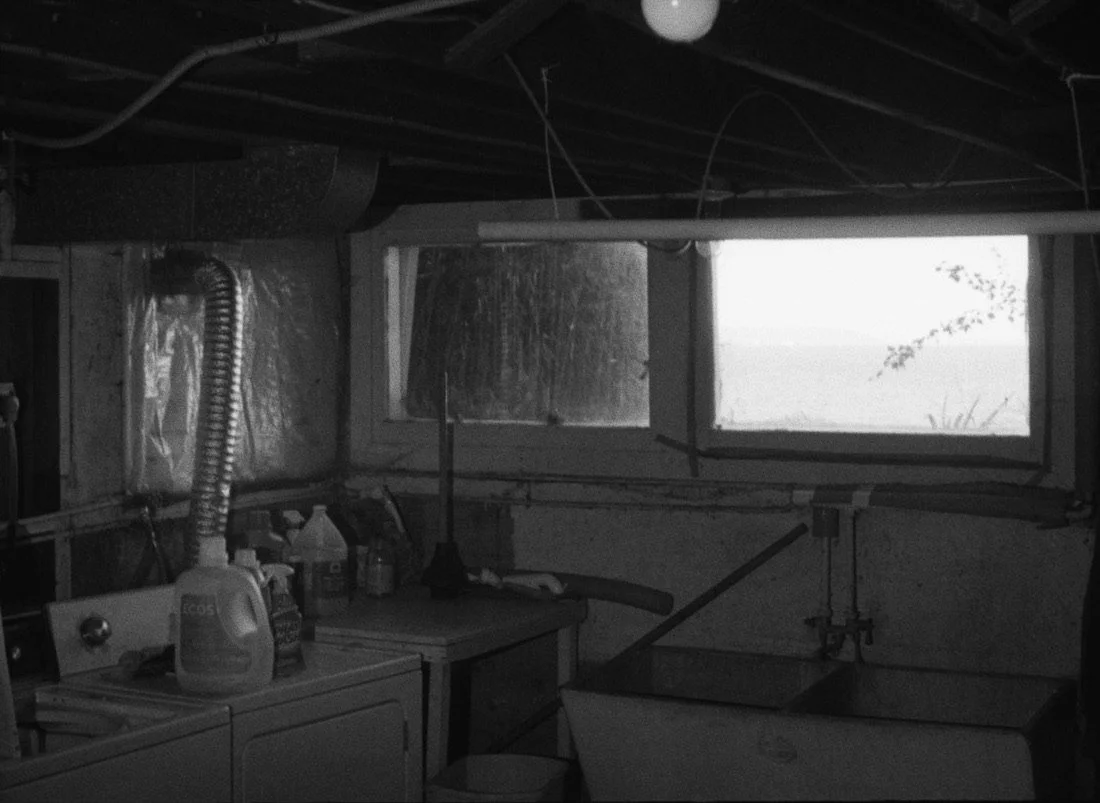
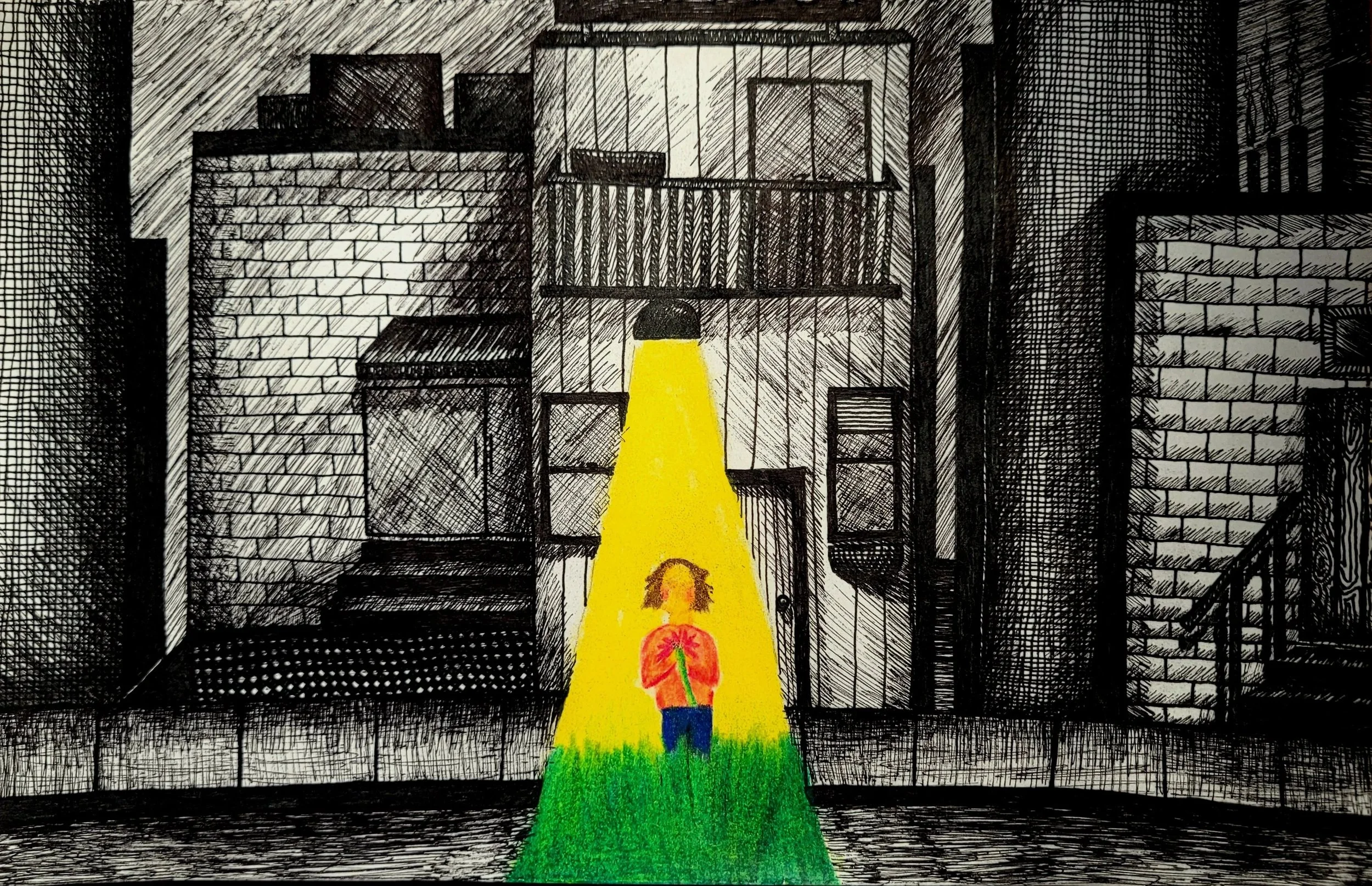
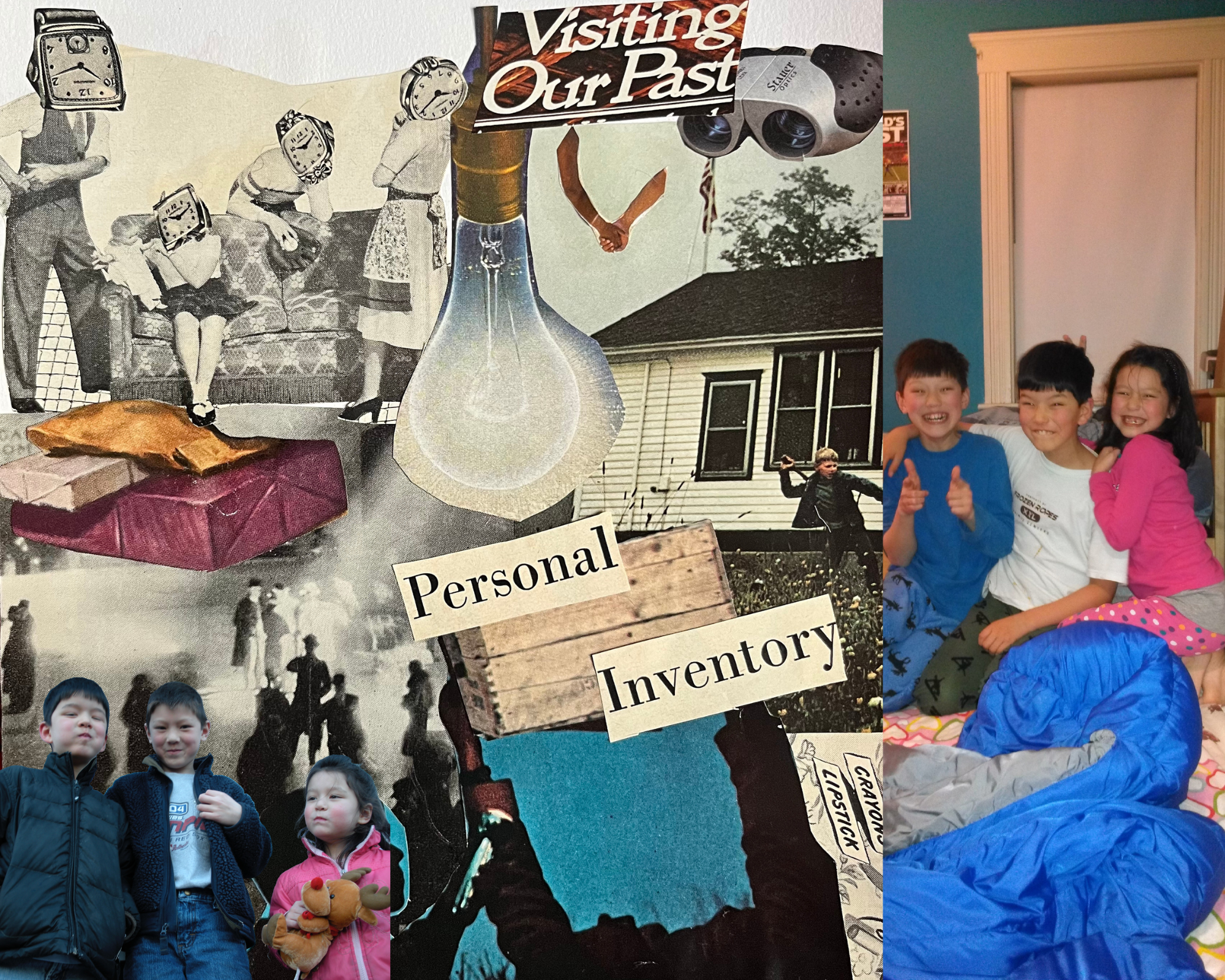
When we first brainstormed the theme for this issue, we wanted an interesting way of portraying opposites. So, we gave our writers two points of inspiration: attic and basement. Our intention was for the contrast between those opposites to structure the issue. We had all these cool formatting and stylistic ideas for how we’d portray the duality — and then, we received 13 submissions. Every single one took place in the basement. 

Well, not literally of course, but there was something about each piece that felt fundamentally basement-y — something buried, or dark, or damp, or dusty, or … well, we think “basement-y” is probably the best word to describe it. 

Eventually, we realized that there was a problem with our original idea. We thought that basement and attic were far enough apart that each piece could be categorized as one or the other. But they aren’t opposites, are they? In both places, we store things so that we can remember them long term. In both, we forget what we stored anyway. Both are fundamentally empty. Both are fundamentally full. Both are echoes of the house they complete and the ghosts they hold.

But even as the two locations are connected, there’s something strange and alluring about the basement, isn’t there? Something that draws us to descend, to excavate, to unpack the things that are sealed away, to hide and breathe in the dark — a call of the void, we suppose.

The following articles have that in common. Each will hold out their hand and beckon — in various ways — for you to join them below the first floor. Whether you’d like to climb back to the surface or collect dust among forgotten things is up to you. So follow closely, bring a light, and keep your wits about you: are you a tourist or a resident?


Watch your step, 

Cipher 

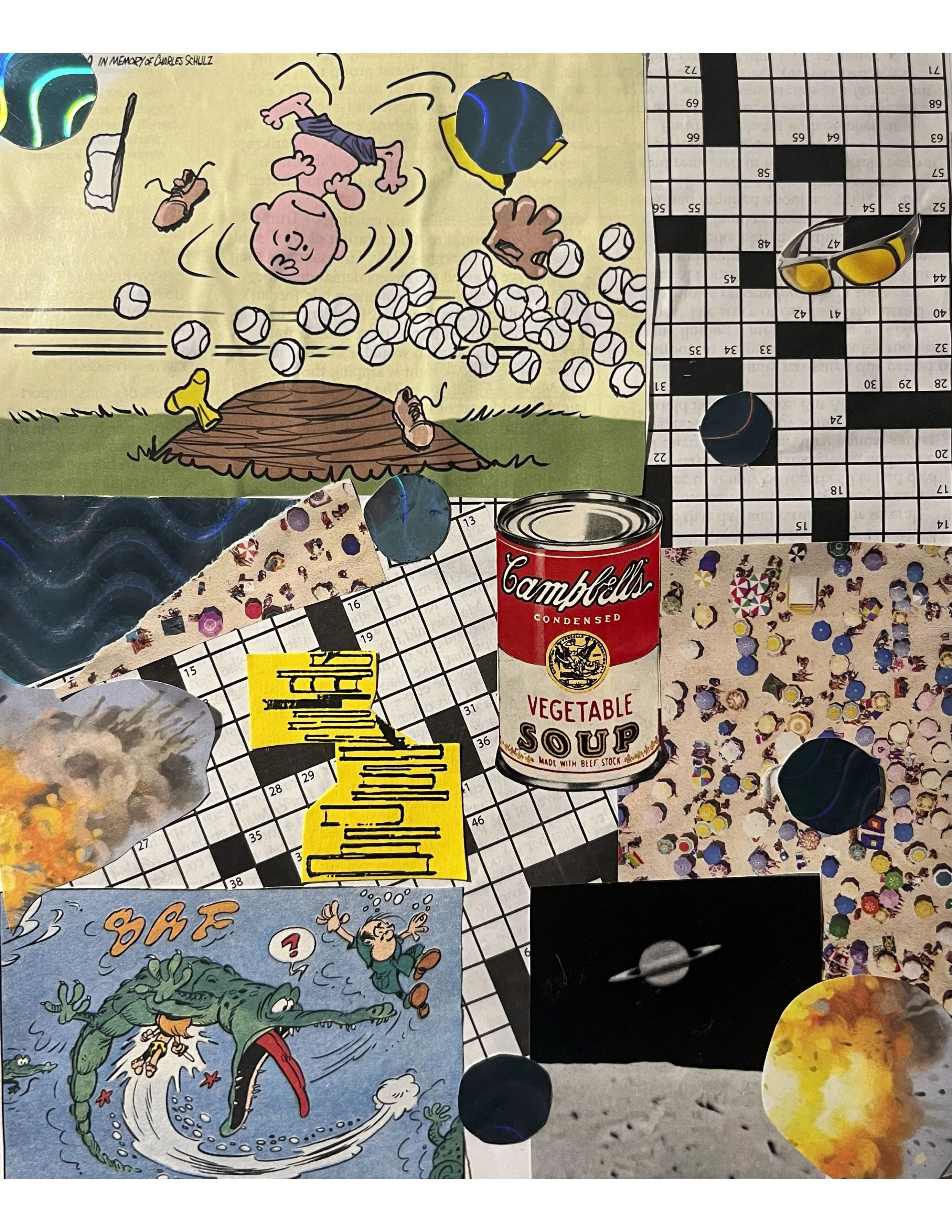
Transcript of a Voice Note to my Childhood Best Friend

Article by Riley Burr Art by Carina Rockart

Have you ever seen Home Alone? Of course you know it, it’s the classic Christmas family comedy, featuring an immoderately violent booby-trap montage that every child under fifteen and divorced dad over thirty is guaranteed to enjoy. 

That’s every kid’s dream, right? To be home alone? Kevin (played by Macaulay Culkin) has the time of his life all alone in this big house. The problems start when he goes into the basement. I shit you not, this was the scariest scene in the entire movie because the basement is dark and full of junk, so you never know what could be hiding around the corner. And there’s this furnace that Macaulay Culkin (who plays Kevin) is super scared of, and in his imagination, the furnace opens up like a mouth and calls his name. 

The whole scene feels like a nightmare, but do you wanna know what scared me the most? In the shot right before the furnace opens, there’s a mannequin in the corner. Every time I’ve ever watched this movie, I think it’s a person in there staring right at Kevin (Macaulay Culkin). And it’s extra scary because there’s something off about it, you know? Like, if it were a real person, why’s it standing so still? Why doesn’t it have a face?  

And you know how scared I am of things that look like people but aren’t. Case in point, that old-ass Abraham Lincoln animatronic. You know, the one that Walt Disney made in the sixties, which kept malfunctioning, went missing for a few years, and now lives in a museum without its skin on. It’s a real thing. Look it up. It’ll freak me out forever. Anyway, back to Home Alone. 

Then you realize it’s just a mannequin, and then you feel a little silly about it all. And then the furnace is speaking to Macauley Culkin (Kevin), and that’s not as scary as the mannequin, and you feel even sillier (or I guess I do) because the furnace is supposed to scare you, and the mannequin isn’t. 

Anyway, maybe I’m looking for an objective opinion, and I guess I just wanted to ask: Do you think I’m too scared? Of everything, the world, politics, my job, the mannequin in the corner? Listen, I know I’m a nervous person, but do you think it’s getting out of hand? 

Okay, to lean further into the metaphor, do you think I search for mannequins? I think I’m always afraid, and so I’m always searching for something to blame my fear on. And for some reason, I tend to choose the mannequin in the corner rather than the talking furnace. 

(Like how the only times I get nervous on airplanes are when they take off and land, when they’re the closest to the ground.) 

(Like how I’m afraid you’ll think I’m being too pretentious while I’m talking about how afraid I am.)

The thing about Kevin is that in the beginning of the movie, there’s nothing he wants more than to be alone. And then at the end, he asks Santa (the kid-equivalent of God) to bring his family back to him. 

And the thing about humans is that we can’t stop ourselves from making something out of nothing. I’m not unique; I’m guilty of this. I love hearing music as my fingers hit the computer keyboard and finding metaphors in the sunlight on my desk. People love to see things where there isn’t anything, until those things are scary, like mannequins in a rich kid’s basement. But is there anything scarier than the nothing just being… nothing? Maybe it’s not anything special, maybe it’s just fingernails or just sunlight or just a rich kid’s basement. Maybe there’s nothing to be afraid of, but at the same time, there’s nothing to admire. 

Is there anything more terrifying than that? 

Well, okay, maybe animatronic Abraham Lincoln. Seriously, look it up at your own risk. (There’s an example of humans doing something they never needed to be doing, taking a long-dead national hero and turning him into a creepy quasi-functional robot. Seriously, Disney?)

But really, I’m talking about existential dread. I think that’s where art comes from. I mean, we’re all searching for some kind of meaning in the universe, some kind of reflection that we can recognize ourselves in. And so we create art, beautiful and terrible and desperate art. 

Did you know one of the first-ever documented forms of human art is in a cave in Argentina? It’s covered floor-to-ceiling in handprints. They’re all different sizes and shapes, left by hundreds of people, centuries and centuries and centuries ago. 

I guess no one has ever found what they’re searching for, because we all just keep leaving more handprints and finding more mannequins and falling in love with each other over and over again. 

Maybe that’s not such a bad thing. 

Skeletons in the Closet

(Or Alternatively, Ghosts in the Basement)

Article by Asta Sjogren-Uyehara Art by Oliver Siegal

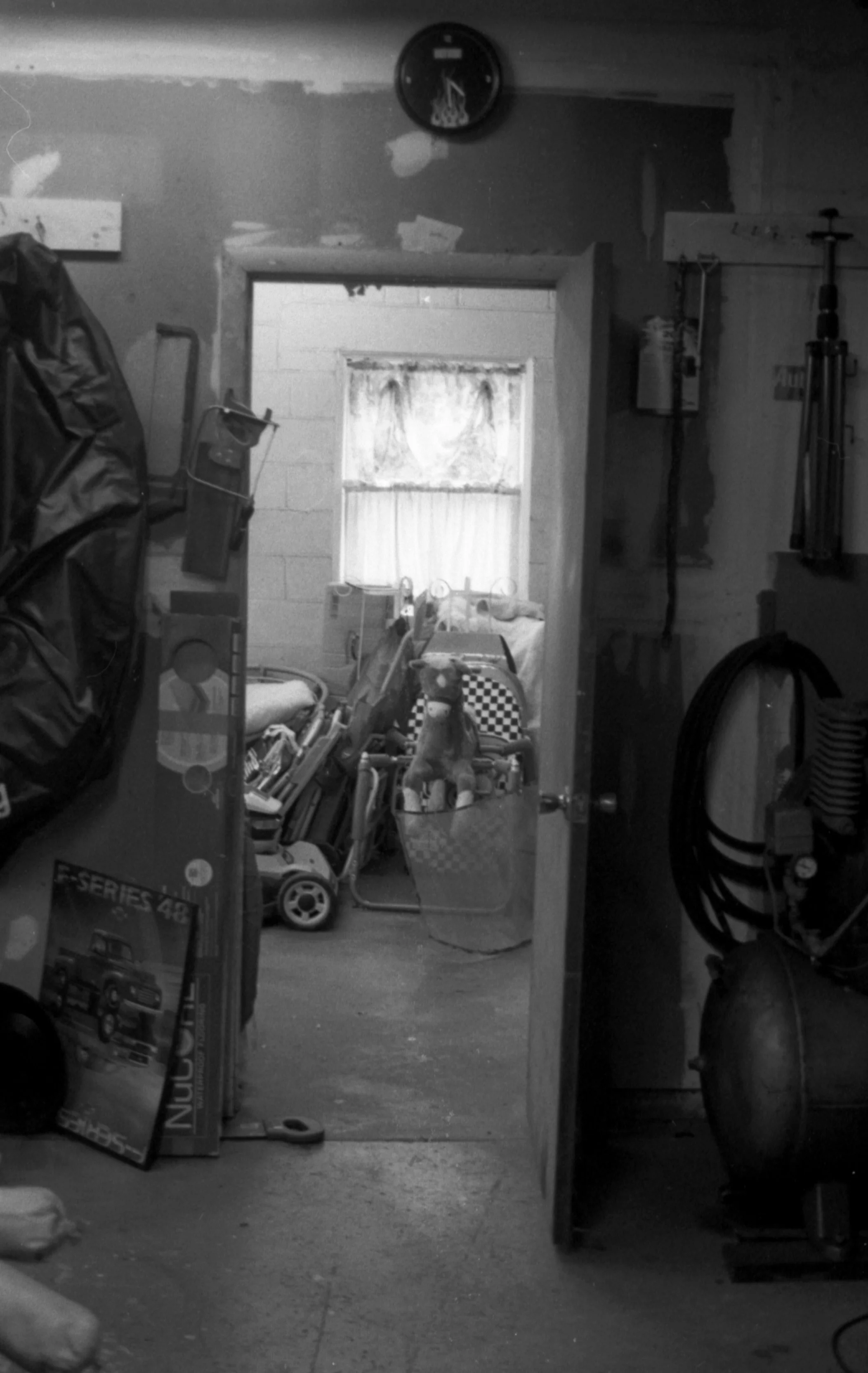
I’d like to kick things off by telling you that I grew up in a house without an attic. Or a basement. Or even a crawl space. It’s just as well; I’ve always been terrified of the dark. But right now, I share an off-campus home with a few friends, one that’s cute but clearly has lead paint peeling off the side and about a hundred things broken, and we have a basement (unfinished), and I think there’s a real chance there’s either a ghost or a murderer in it. 

We’ve only been moved in for about a month and we have already had a supernatural unlocking.

i didn’t have a basement growing up, but i did have a garage

once i went in there and the adjoining door locked

i was plunged in the dark

that was enough basement for me

I’m pretty sure there’s a reasonable explanation for the sunglasses holding the basement door shut to have moved without me or my roommate touching them. I’m pretty sure if there was a real person of bone and blood in there, we’d know by now. I’m pretty sure ghosts (if they’re real) are friendly and want to stay out of your way and have no desire to antagonize or frighten. Being pretty sure, though, isn’t a good enough reason to ever go back down into that basement.

when i was in kindergarten we had a “ghost club”

we’d all gather around a storm drain

the one with the criss-cross grate

and listen to the “ghost” below. 

 now i know it was water, sloshing and crashing

we’d drop dead leaves and twigs down there

listen to the “ghost” respond

so i guess there were ghosts —  just of our own creation

I don’t believe in ghosts. Except for when I do, which is most of the time. I just don’t believe they want to hurt you, and I certainly don’t believe they want to kill you. I’m much more afraid of real people. So, to clarify, ghosts are real and kind, and also don’t exist.

Like I said earlier, I’ve always been afraid of the dark. Not because of ghosts, at least I don’t think. Growing up, my bedroom had floor-to-ceiling glass doors (covered by curtains, most of the time), and at night I would conjure up images of men standing just outside, waiting for me to draw those curtains back. Or perhaps the villain of whatever scary story I had most recently heard, crouching just out of view, waiting for the lights to go off and their cloak of night to grant them safe passage into my room. Or to the dark spaces in my closet. October was hard for me. Storytime on that normally-so-comforting library rug became a nightmare. And so, in turn, did my bedroom. 

Now I’m older and wiser, and still, if I am alone in a bedroom, I need a light to fall asleep. I’ve never had this problem at sleepovers, or with my boyfriend, or sharing a hotel room with my mother. But alone in the dark, I’m convinced that a lamp is going to protect me — and who am I to argue with 22 years of hard evidence? An intruder has never climbed through my window, or scratched beneath my floorboards. 

dark

/därk/

(adj.) 1. with little or no light

2. (of a period of time or situation) characterized by tragedy, unhappiness, or unpleasantness

(noun) 1. the absence of light in a place

to be in the dark

in a state of ignorance about something

Please do not keep me in the dark any longer. I cannot navigate without my lamp. If I run my hands on your face, can I feel the lie? Or, more optimistically, the truth?

to Dust

Article by Ella Roxy Boyd Brocker Art by Eliza Blanning 

I have the strangest thoughts just before I fall asleep, the richest mixing of deep cold wordless current and turbulent warm epipelagic consciousness. 

One night not too long ago, the dark air already carried a sweet shiver through the windows: beneath the weighted blanket which acts as a pacifier to my vagrant anxiety, my body curled in remembrance of the womb. Just before I dropped off beyond reckoning into the deep, a feeling almost the color of the blanket — an abhorrent army gray — crawled up like disturbed dust. Although, that’s not quite right. It was closer to smoke; it just didn’t have the fire behind it. Mist, without the generosity that water carries. It felt ancient and unchanged and terrible, somehow so hopelessly immortal as to be banal. Yet in its banality, my terror lies. I understood in a fractured heartbeat a despair I had never fully let in. It had no shape and no end. 

And in a different fractured realm of that same heartbeat, with all the genius of a mind surrendered to strangeness and the rich realm between the shallows and the deeps, an image arose. That unnameable and ancient and omnipresent despair was, without interval of change, an egg. It did not become an egg. It was one terrible thing, and it was another thing. Something I could swallow. We say, they swallowed their fear. I have swallowed my mother’s fear, my father’s, my sister’s. I have swallowed my friends’ fears. My beloveds’. My own. I have tried to digest them time and again, to surrender it into my stomach. Most often, the surrender does not come, and I am gripped by the pain of fear untransformed, undigested. But on rare occasions, I have released my grip, and as with any food accepted totally by the body, the fear returned to a state of pure energy unburdened by the residue and judgments of mortality. 

I swallow the egg of despair, its golden center sconced in gleaming white. I let it slide whole down my throat and feel the weirdest morbid joy, a wild laughter softened by sleep. I surrender the egg to the stomach, where all things change and the source of great power slumbers. The egg unbinds itself, its energy loosening from perfect ratio into perfect ratio, its baffling smoothness broken into stories, questions, bursts of passion, longing, fear, love, fear, love, fear, love, fear   

There’s no meaning here, and the sky is dark with smoke, and escape is relief, and they won’t miss me anyway. Or if they do, I’m more welcome as a loss than as a presence, an unreachable pain that only rose only ever could rise—from the messy yolk of love before it had settled into shape, I only hurt because it comes from there. The central golden soup of no difference, no distance, just loving/being loved/beloved/beholding. How beautiful is this? Says someone softly. It is my voice, and within my voice are the voices of everyone who loves me, loves wholly and messily and in praise of the unreasonable, the clumsy, and the broken. They say, stay. Escape nothing, feel everything. Come back. We want you. Not a hole where your life once lived. 

I swallow the egg. I let it lose itself to its own energy dancing, the movement digested. The egg belonging in change, always. Delicious becomings. 

When I walked into the tea house with my friend, I walked somewhere between a chaos of feeling and sensation and memory and a carefully constructed reality made of rules to be followed. Brutal honesty is sometimes its own performer. What can we ever know about what is real, and when we tell the truth? Are we simply circumscribing what could be possible? When we say, this is how it is, how do we leave room for this is not all that it is, this could be true also… 

We sat down only after having repressed our need to smell every jar in the place, and settled on an Oolong and a Pu-erh. 

What to do when you’ve forgotten how to care

Or maybe it’s just I’ve lost conviction, or inspiration, or the crackling heat of bravery

Without which I might die

Not knowing I had been surrounded all my life with the answers to my prayers. 

There’s a white rocking swing somewhere in the Midwest, and a girl is swinging there, maybe, and maybe I am that girl, or maybe I’m somewhere else. She sits and kicks her legs, and I remember the feeling of her bathing suit, which renders her as quintessential as the swing itself in its faded topskin, which has begun to wrinkle and separate from the underneath like other old skins. The peeling paint, for instance, on the slatted bench of the swing — the swing has laugh lines from all the times it’s rained — speaks of its years holding people and the things inside them they are afraid to look at. The things they’ve shoved to the bottom and allowed to gather dust.

Or maybe what I remember is the restlessness of summer that softens so in memories and blurs itself into an irretrievable childhood that maybe wasn’t there — without which, however, I would not know where to land in the story I have become. She, girl in old skin, popped unopened flowers like an assurance of small deaths — like she wanted a certificate that said, 

It’s all uncertain; that said

Don’t try too hard to bloom 

don’t be too magnificent, it’s better

To stay with petals tight around your vital center, like lowered eyelids after only half a smile

At that stranger, you might have loved

Without which, you are safer 

for now.

My uncertainty travelled with me just under my feet. This friend and I were a strange tangle, unchosen. Sometimes reluctant. New to each other and eyeing the silences warily. 


The server arrived, taking us through the nature of the leaves, the water, heat and steeping, and health benefits that seemed to cover most bases. We sipped.

I’d tasted emotions that weren’t my own before. But that tea carried an entire story, a creature I’d never encountered hiding whole in well-steeped leafwater. 

The house looks back at us warily as we look in, half in the tea shop, half caught in the sharp dust of the Pu-erh like a potion into wistful bitterness. Images not my own opening like stricken flowers, that gray coming in again, but this time house-shaped, softly painful but enticing. The floors are made of concrete. The walls are washed gray from ambiguous light. Stepping through, we leave footprints. The floor is made of dust, and there is a single rocking chair near a fireplace filled with ash. 

The house looks back at us without trust. No one ever earned it by staying. The house, like my despair, asks for something improbable: a transformation slower and stranger than the one I witnessed, or orchestrated, while half asleep. Formless and terrible feelings became white-gold potentiality; the tired and abandoned ghost of home asks to return to earth, to not hold emptiness any more, to no longer be a tomb for the wild wind. We take another unwilling and fascinated swallow of liquid story. Autumn turns towards us outside the window, her face full of the last pollen — we wade through the field between her long fingers and our longing feet. Dust and pollen dance, caught and ravished and equally golden in sunlight.

Stuffed Animals, Nostalgia, and Other Things I Hoard

Article by Sophia Murphy Art by Willa Schendler

It’s something you always think is there. That pink scarf you loved when you were seven. The stuffed animal monkey you got for Christmas when you were twelve. Your collection of Barbies. The Frozen songbook you would place above the piano. Or maybe an old iPod touch with Minecraft and Temple Run, with a home button too sticky with maple syrup to actually click. You’re a little anxious walking down. But you can visualize exactly where you packed it away, leaving it behind. You’re in the basement, ready for the relief.

Myles left first. He went away to Michigan. On our last night, I cried silently in the hotel room.

You’re not immediately disappointed; you frantically throw things around, digging, almost pleading. Where is it? You’re tearing through old field hockey gear and orchestra programs from middle school while stepping on an old LEGO set as you continue to stumble over your past in boxes. The basement is disheveled, and you’re wondering how you could’ve messed this up. You’re regretful of your poor memory, maybe your poor organization, or a misguided belief that something you had left would be waiting for you. 

I got the next two years of high school with Joe. When he left, I cried in his bed for hours after he drove off to Connecticut.

You’re frustrated, probably sweating, and regretful for ever throwing things down there. You’re on the brink of a breakdown until it transitions into defeat — realizing you didn’t have a choice. You grew up. You moved. You changed. And through all of that, some things had to be left behind.

Right now we’re in our twenties, miles apart. But one day we’ll be in our forties, living thirty minutes away, and our kids will be best friends. Maybe we won’t have children, and we’ll go over to our parents' house every Sunday to play games and have brunch. We’ll bicker and banter like our younger selves. We’ll have a bar where we meet up once a week, where we keep each other in our lives.

Maybe living close to each other is too much of a dream. Maybe we’ll live far away, but at least we can still visit. We can book flights to each other’s homes, our kids will get along, and we’ll still love each other. We’ll try to call and text. We’ll have days of fun together. Maybe we can even vacation in Florida with our families and Mom and Dad. And maybe we’ll be content with that. Maybe life is grieving everything you’ve lost, but one day you realize that you should start being grateful for your new experiences. 

Because we’ll never be elementary school kids again, running into each other on the way down the stairs when Mom calls “Dinner!” We’ll never wrestle on the couch until someone is genuinely hurt and crying and yelling for our parents to yell at the other sibling. We’ll probably never turn our dining room into an epic dance floor for our Friday nights, consisting of talent shows for each other. We’ll never have this house where our possibilities are endless, where we are fiercely protected, and where we are unconditionally cared for by our parents. We’ll never have another brothers’ sleepover over school break where we all get to stay in the same room — what I always looked forward to most. I don’t remember the jokes we made before bed, but I know I felt like the luckiest girl in the world getting to hang out with them.

You can keep digging in that basement and try to find everything you’ve lost. But it’s all too heavy, the force of change and growing up preventing you from ever fully making it up the stairs. 

It was my turn to leave. It was 2023, and my family was going to Burlington for the city’s Fourth of July festival. A trip we took every year, but this time it was different. The world around me felt like it was shifting. Joe had been gone for the first time, and Myles was going to be back for his last summer before adulthood. Instead of allowing the impending doom of college to pull me out of the moment, I was grounded in the two people next to me, sweating as profusely as I was. Myles, Joe, and I danced until the sun set on the bay to an 80s cover band. For four whole hours, we danced to the slow rock at the beginning, and then, by the end of the night, to what felt like a punk rock moshpit concert alongside three-year-olds and grandparents. I knew half the words to every song, and at times, we were the only ones in front of the band. Nothing mattered except to keep dancing with each other until the music stopped.

When I miss my childhood and fear the future, I look back to that night in Vermont. When so much changed and would continue changing. What I had with the two people next to me was dizzingly stable. For that night, it felt like we were back in our dining room, spinning and jumping around to Lady Gaga and LMFAO as if we were our ten-year-old selves once again. And maybe that’s who we’ll always be, no matter the distance or time apart. We might no longer grow up holding each other’s hands in every picture, but I’ll never stop holding onto my two older brothers in life.

Growing up with Myles and Joe was the best gift life could have ever given me, even if they acted like they didn’t know me in the hallways at school. It’s a gift that sits in a box in the very back of my basement, buried under my mom’s wedding dress and dusty books. A box that must remain inaccessible but unconditionally present. 

The Gift of Womanhood

Article by Raychel Stark Art by Jennifer Martinez

Think of memories that disappear, memories evanescent as infancy, childhood, youth, a glass of wine, a kiss. Memories that blend in so well we seldom notice them.  

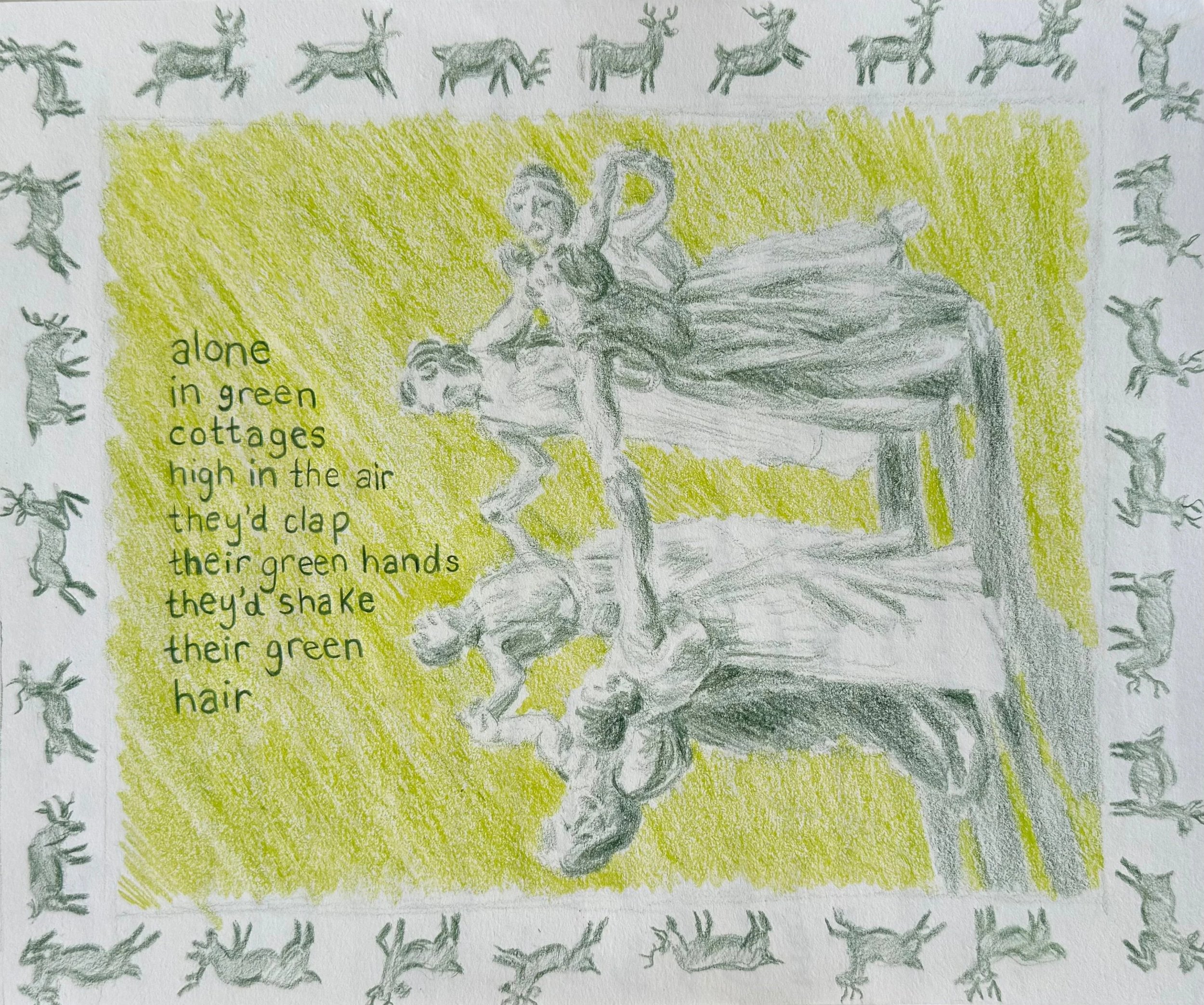
Growing up, I lived in a quaint, storybook neighborhood full of twisting, swerving roads. On each path, I was surrounded by tall pine trees that embraced, surrounded, and wrapped around me. The trees lived alone in green cottages high in the air, and I knew what would happen if I climbed way up — they’d clap their green hands, they’d shake their green hair, they’d welcome me. As if kissing the sun, the harmony of the trees’ breath reached my inner being. 

I spent most of my time outside, attempting to preserve my naive mind. In my fairytale of mythical friends, I felt peace, from the bright red dahlias to the moss growing on each rock that I jumped to and from. I would examine the green, spongy, soft forms and rub my hands all over them to feel closer to Mother Nature. One late afternoon after an outburst of temper over some inconsequential offense, I ran out of my house amid my tantrum. Racing through the forest that lay just behind my river’s dwelling, I did not stop until I was sure no others had followed me. I lay back on a tree stump, crying my eyes out, overcome with tears and letting go of all the grief my little heart carried. I stared at the sunbaked dirt and stone roads, and each yard, a field of wild grass. My best friend Evie suddenly appeared beside me. She sat down on a tree stump and sighed. We watched, together, the snowshoe rabbits who ran wild, a tawny doe with a freckled child, and swooping wrens alongside bumble bees. 

Evie lived right across the street from me in a modest brown house with creaky stairs leading up to the front door, on which I often grated my bare feet. I ran over, without my mother’s knowledge, to dance to Mamma Mia songs and play dress up. We designed our own clothes, often wrapping Evie’s mother’s scarves across our chests, and blankets from our waist to feet to look like Ariel. Or grabbing knives from the kitchen, cutting a small piece of paper to place over one eye, with a hat made from newspaper to play pirate. 

In those formative years, I spent a lot of time running through my neighborhood causing mischief. Evie and I would race outside to bike and jump over rocks and try mysterious berries. Our mothers told us that while the deer that leaped through our neighborhood, never wary of moving vehicles, easily ate the berries that populated our bushes, they were poisonous to humans. Little did they know that we were children and not obliged to the same rules as adults. So we chewed and spat out the enticing, intensely red berries, imagining that the poisonous fruit contained hallucinatory elements. We fantasized we were deer, galloping on our feet and jumping in front of cars, giggling and smiling at one another the whole time.  

Some days, Evie and I assembled a group of mischievous kids who lived in our community. We all biked to our neighborhood’s beach and playground to jump on the water trampolines and glide on the zipline or play on the swingset until our legs got tired. Other times, we knocked on doors and then fled, twisting our ankles and pushing one another to avoid being the one who got caught. Evie and I occasionally escaped the wrath of the boys and the idiocracy, the roguish lack of maturity of the group, to plan our own schemes in our own impish ways. 

On a particularly dull day, Evie suggested we go into Jean’s, our neighbors', attic, to rummage through her things. I never had a basement or attic, so I was afraid of what happened in there. Especially Jean's. She seemed aloof, unsightly, and perhaps cruel. I never had a liking for older women; they reminded me of when childhood comes to an end, and a plain, ugly life begins. I would be grumpy, too, if I couldn’t play with grass and dandelions with my friends, and instead had to take care of the kids who played … with the grass and dandelions. I imagined her attic to be dark, dirty, daunting. What was she hiding from us? 

Evie had told me there was a ghost in Jean’s attic. She announced it quite casually as we were skipping and throwing rocks at passing cars. “You don’t have to worry, Ray,” she reassured me, “we can capture them as pets; they can help us fight off boys and grown-ups.” I smiled to humor my dear friend Evie, but I never walked past Jean’s house normally after that. Whenever I’d go by on my pink shimmering bike, I was convinced I had caught sight of something in the corner of my eye that made everything shadowy, weird, distorted. I felt I was being watched as the sparkles flickered in the sun and then reflected into a dark abyss. I’d cycle away as fast as I could, looking behind me in terror. The possibility of a ghost, even benign, freaked me out completely. I thought I was a strong girl that could combat any enemy, but after all, I was still scared of spiders. From all my antics, I knew karma would find me one day.  

We whispered on Fridays and Saturdays, when our parents were too oblivious as they drank and sulked in their grown-up obligations, to finalize plans for our delinquent exertions. It was summer; the air was still, and it hadn’t rained since school was out. The brief breezes smelled rotten and forbidden as if the wind blew from some faraway breath of life. Our short legs were covered in beads of salty, sweet sweat — saved by the youth of nonexistent B.O.. We specifically picked a day that made even the shadows wet and mucky. A day so hot that Jean wouldn’t dare be in a home that made her ghosts melt under the oppressive heat. 

We knocked passionately on the grand, antique lime green door, leaving my knuckles red and scraped with splinters. With no answer, I turned the knob slowly — its coldness shocking my sticky skin. Her living room slowly came into view as the door creaked open. Immediately, when we stepped in, I let out a loud sneeze — the warm air having intensified the piles of dust that layered her floor. Evie’s older sister, who had been in before to watch a dog, told us exactly where to go: “Find the closet in the big bedroom, the trap door is in the back.”  

Our instincts led us to the attic quickly and quietly. We climbed up the attic stairs slowly — each tip-toe softer than the next. Once we reached the top, we nervously darted our flashlights around, searching for the spirit. I pulled out a clown doll from a box and was laughing with Evie when suddenly a presence filled the room. Our mouths were agape. There she was with her black, long hair back in a bun. Her long flowing cotton dress covered with a dark gray apron, and on her feet were laced-up boots. She had Italian features with tanned skin and appeared middle-aged, waiting for the wrinkles to approach. I don’t remember what happened after that. There is a version in my mind where we reached for her, but she disappeared. We ran out, unsatisfied with our findings. 

A year ago, I attempted to return to the river, carefully avoiding the sight of Jean’s house. Once I got closer and closer to the river, I shook from nostalgia as tears formed and leaked down my face. I felt alone. I didn't hear any squealing children, I didn’t see any spilled wine from drunk, chatty moms, I didn’t see any footprints from the tawny does. The sun was going down. It was getting late and dark.

I suddenly stumbled and tripped. I fell off a hill I hadn't recalled was there prior and rolled down at a swift speed. My body came to a stop as it hit a rock with a loud thump, soon overtaken by a weak, calming sound. 

“My dear, why don’t you let me ease your pain?” inquired the soothing voice.

I looked up from where I was on the ground and saw an old woman with a kind face. I felt at ease and at peace with her smiling reassurance. Behind her, there were a dozen women of her age, dancing and giggling around a fire. Their hands were intertwined, some were cheering each other on, others were laughing so hard their heads fell back. It was easy to miss at first, but something about them was different. They were well-aged with long gray hair that seemed so dull it almost looked like it was fading into the moon’s radiant beams. They had white wax paper-like skin so delicate, a simple breeze might turn each of them into dust. There was a transparency about these women that seemed like a blur. I could almost look beyond them and see the woods. 

“You have gotten so old, and so have I.” 

I looked myself up and down, and then I looked at her up and down, stopping at her wrinkled forehead. I felt envious of her humble, sagacious self-confidence. I looked behind her once again to cherish the sight of the bond among those women. Maybe childhood does vanish, but womanhood — womanhood lasts forever. 

She interrupted my silence, “There’s someone out there waiting for you.” 

I understood it was the eerie, fleeting ghost of Jean’s attic. I ran away to find the trees. 
Lost Interests

Article by Kole Petersen Art by Riley Diehl

An orange skateboard, whose body has rusted from underuse and whose wheels will never be replaced.

A set of dinosaur magnets, whose scientific names (Pachycephalosaurus, Plesiosaur, Triceratops) were once memorized and held close, but who are now forgotten and out of sight.

A Weird and Wacky Contraption Lab box, whose Velcro pieces are worn to the bone, yet who long for one more session of gear turning, “egg” laying, and stunt pig launching.

An eight-foot basketball hoop, who has been compressed to just four feet, and who hasn't seen a basketball since its shrinkage.

A collection of monochromatic drawing pens, half of whom were never uncapped, the other half of whom were opened but ignored for their more colorful cousins to transcribe imagination.

A collection of “I Survived” books, who miraculously survived a decade of constant use, but who are now entering their second decade of neglect.

A set of three green juggling balls, who were intended to be used alongside a set of three blue juggling balls, but who never saw the light of day.

A box of rainbow colored dominoes, whose days of being assembled into lines and toppled and assembled into pyramids and toppled and assembled into Rube Goldberg machines and toppled again are long behind it.

A box of markers, all of whom have been used to half capacity for illustrating books about Christmas and Easter, but who now embody the same fate as their monochromatic cousins.

A bike tool kit, who has been left unopened, even though it was intended to mend a triathlon bike for many years to come.

A Tupperware container of marbles, whose contents no longer experience movement through a track, but through the rumbles of an unfurling ladder and stomping feet.

A Bananagrams game, who was never interacted with in the way it was intended, but who now misses the organized chaos of its past.

A container of Lego bricks, who used to be stars of many a stop motion video, but who now have stopped moving entirely.

Eggshell White

Article by Liza Mcdougall Art by Rusty Rhea

The summer before my freshman year of high school, my family and I moved across Maine to a wooden house nestled on the banks of a salty river. That first summer, I spent my days in my new room (the basement), sheltering from the sweltering heat and rotting in my bed. My mom and I spent an afternoon covering the baby blue walls with blank-slate eggshell white paint. My former bedroom had been beautiful: the result of countless hours spent pouring over Pinterest boards and decorating with my grandmother. Now, I was living in a liminal space. I was in a new part of the state, far away from friends, without any autonomy to venture beyond my house. I was willing to do anything to switch up my space, my energy, to have something to do. I resorted to running errands with my parents. The pivotal moment of my summer took place at the hardware store. Creative inspiration struck, so I collected every single paint chip in the paint aisle. That evening, I spent hours meticulously rolling up tape and sticking the paint samples to my closet doors. The new color in my otherwise blank room made everything seem brighter. From then on, the first thing I saw when I woke up was my paint chip rainbow. Each day was suddenly more bearable, and the unfamiliar space was starting to feel more like home. 

One chilly winter evening I had a girl in my class over for a sleepover. We had gotten pretty close that fall, polar plunging after school. Most days it was overcast, and every time it was freezing, but we would still hold hands and run into the ocean, squealing and quickly plunging, then running back as fast as we could to our warm clothes and towels (it’s fun, I promise). We would lament in the way that only fourteen year old girls can, then listen to whatever music we thought was cool that day. At the time of our sleepover, our favorite song had a lyric about swimming topless in the ocean under the full moon. Every time we heard it, we vowed that one day it would be us. That winter evening, we sat in my mostly empty room and looked at the few measly posters that I had put up. It quickly became clear to our late-night minds that I absolutely needed a mural adorning my walls. We scavenged my house for supplies, then spent hours dancing, laughing, and painting a scene on my wall. The mural was inspired by our favorite song and took the shape of what we each aspired to be: a naked woman swimming in the ocean under the moon. After my friend went home, I laid in bed and I couldn’t help but smile while looking at my new wall, reminiscing on the ocean swims of my past and dreaming of the ocean swims awaiting in my future. 

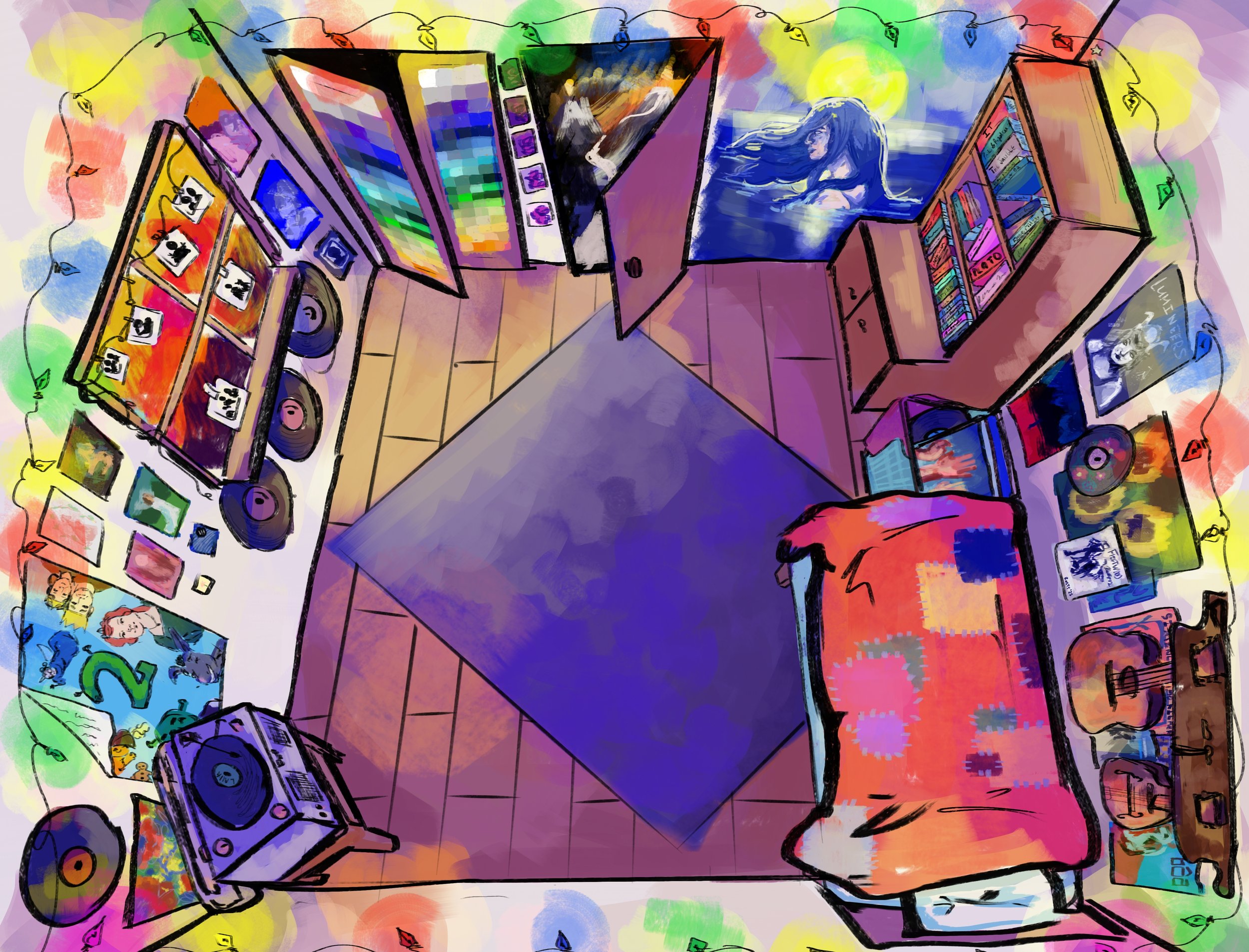
Less than two years after moving, there wasn’t a speck of eggshell white left on my walls. I was always on the lookout for items to decorate my space. Everything had a story. The Shrek 2 poster by the window was mailed to my friend by his great aunt. Above my door were different bibs from my cross-country races. I put a single hiking boot next to my bed because I had lost the other one at my local agricultural fair. I’m not quite sure where it came from, but a framed picture of a pixelated strawberry sat on my windowsill. I covered my door with a mishmash of stickers. I put vinyl records on one wall and hung my instruments on another. Many of my acquired posters were tributes to musicians that I loved. I would spend hours sitting on my floor strumming my guitar and singing along to lyrics from the back of my vinyl record booklets, inspired by the posters of musicians on my walls. I covered my bulletin board with different scraps of paper, concert tickets, wristbands, and photographs. One Christmas, I took the lights from the tree and strung them up around my room. After that, I never turned on my overhead lights again. In the blink of an eye, the bright white square box that I moved into had turned into a reflection of my hopes and dreams, my music, my memories, me.

Over winter break my senior year I had some dear friends stay with me. We spent our days cooking elaborate meals, going out in the snow, and laughing more than any of us had in a long time. Having my friends stay with me completely reoriented my perspective on life. They were all from states away and had never seen my room before. What I had grown accustomed to, they saw for the first time with excitement and awe. I don’t think my room was ever the same since. One friend asked me about every single item on my walls. She patiently listened while I explained the different stories behind the artifacts. The various sides of my room were like pages torn from my scrapbook, each wall a captured moment in time. We stayed up laughing and talking in my room until the wee hours of morning. I captured pictures of all of them with my Polaroid camera, and a new tradition was started. From that moment on, every new visitor to my room got a picture that I taped to my window frame. My last addition to my full room.

Moving out snuck up on me too fast. Somehow, even though it felt like I was thirteen and had just moved, it was the summer after my senior year, and I needed to pack up and go to college. While I was packing, my mom flitted in and out of my room, helping. We laughed and cried together while I pulled some of my childhood diaries off my bookshelf and read my entries. I spun my favorite records while I took down my favorite posters and put my life into three tiny boxes, all ready to move across the country. Over the four years that I spent there, my room was forever expanding with decorations. Memories blossomed across my walls. I think my room was complete just a few weeks before I left, when I added one final Polaroid to my window frame. My room was beautiful. Now, however, even though in my mind and my heart I remember my room as complete, I know that if you were to go visit that wooden house by the salty river and go into the basement, all you would see is a room painted eggshell white with a single Polaroid hanging on the wall.

When I smell dust I think of this

Article by Thomas Nielsen Art by Jane Keenan

Sometimes, especially around holidays, I think about my grandparents' old house and their unfinished basement with the harsh yellow light and its cord you had to pull. To my grandparents, the basement was a storage space, a place to put old clothes, boxes filled with knick-knacks my grandma didn’t want to get rid of, and furniture. To my cousins and me, it was our playroom. 

It had a dusty, slightly wet smell. It was large and completely open, except for the water heater and pipes, in a large concrete-floored room. It was always cold enough to elicit the occasional shiver, even in summer. 

We would push around plastic cars, kicking our feet underneath, stopping at the stairs to go through our own constructed “drive-thru” to spend our paper money for plastic food. The game continued long after we were too big to fit inside the cars — instead, we would lie on top of the yellow dome, pushing off the ground for a boost. The money often became a point of contention. One of my cousins would always be the “banker”, distributing money for jobs done. He’s a business major now. He would usually stiff his younger brother, which started a few screaming matches that my sister and I mostly stayed out of. 

Somehow, it took me until the year before that house was sold to realize that I was experiencing my father’s childhood home. I always knew it was, but I didn’t make the connection to him growing up there, being young in that same place. I remember seeing his bedroom through new eyes, the carpeted floor, the wooden plane, and the photos on his shelves. Pieces of his past. 

That was something we shared, growing up in that home. It must have been funny for him to be sleeping in his childhood bedroom past the age of 40, visiting a home that was mostly the same for years and years. 

Mostly what I miss about that home is the feeling: of laughing up late with my cousins until my aunt came to yell at us, of waking up early to watch Tom and Jerry with my uncle as he got on his laptop to do work, of sunlight coming through the window and illuminating the pastel colors of the couch. When I think of it, I see flashes of dew, the smell of dust, sitting on air mattresses, and reading old books. 

When my grandparents sold that house, it was one of those first explosive moments that showed me I was growing up, that I was leaving childhood. In my head, it was a rock, present for as long as I could remember. At that point, I didn’t have a lot left like that. I had moved houses, moved schools, and was myself experiencing the growing pains of adolescence.

It was the first year I was a teenager. They moved into a smaller condo. They didn’t need the space anymore. Neither did the rest of the family. We started seeing our cousins less and less. 

Sometimes I feel old, but I’m not. I’m long gone from those days of childhood, though, and I’ll go weeks without thinking and feeling like the kid I used to be. But sometimes, a certain smell of dust, must, cardboard and concrete will hit my nose, going straight to my brain, and I am seven again, on top of a plastic car. In thirty minutes, my dad will yell down to tell us to come up and set the table. After dinner, I’ll watch the football game with my grandpa. I don’t really have much else to worry about.

All of my family is still East. I miss when four hours felt like a long way to travel to see family. And I miss staying somewhere that felt older than me. Family isn’t a place anymore. 

Under My Feet

Article by Stella Epstein Art by Katie Paterson

Tell us about your strange collections, forgotten report cards, old letters, fire-hazard levels of storage, and ghosts.

I keep my body in the crawl space. Down there, it is dank, and the body stays cool. The spiders can get to it, but I go down every day to perform maintenance. 

To start, I dust off my skin with the eyes of strangers. I take their gaze and run it over so I can see myself the way that others might. Taking stock, there is my tummy — do people find it as upsetting as I do? Below that are my legs, which I think are too short; though they’re very good at their job, they have a performance review that points out the flaws of shortness, fatness, and their odd bumpy texture. Above my tummy, I think about my face. True, I do like my eyes, and I love my face. This could just be the mere-exposure effect, but it has gotten nice to look in the mirror and recognize with love what I see staring back at me. 

Once the debris is gone, I sit myself up and begin to do my exercises. Oh, this is the worst part. I cannot let my muscles atrophy, but I wonder if the process has already begun. There must be a hidden door in my brain, and when I find the key and unlock it, I will find a room full of motivation to exercise. 

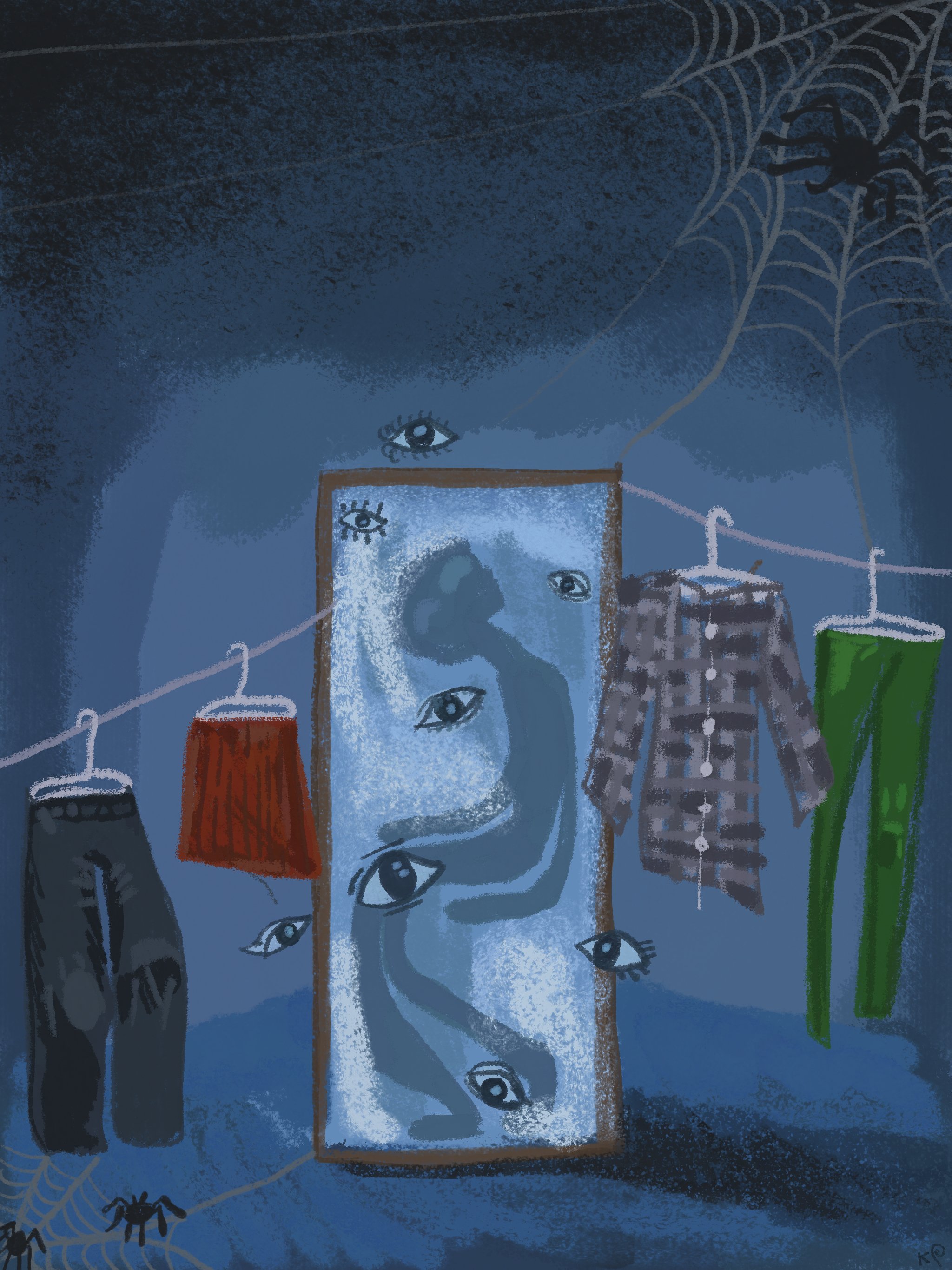
Fully warmed up and poseable, now is the time for dress up. Going through my closet and seeing the shirts and pants that are less fabric and more memory. Some of my clothes are stained with tears from lofty ambitions crushed or deep insecurities exposed, and even when they are clean, they still carry those moments. Black flannel I put on when I want to hide from the world, aspirational leggings from the days of aerial training, jeans with rips in the inner thigh from chafing, and skirts I don’t mind wearing out, because if the night is bad, they have seen worse — if the night is good, they could become nice again. 

I use the compliments of others to choose my outfit, because dressing is a performance for me. When I put on clothes, I am putting on a costume, no matter the occasion. Each garment tells a story, and when all conditions are right (audience, weather, hair), others' perceptions of me will fall in line with my desire. Do I care too much about these opinions? I don't believe that to be true; these opinions do not form my own self-worth or value, they merely educate me as to what combination of clothing can most efficiently produce the desired effect. Am I the tortured academic, dazed art student, or massive theater kid? I want you to know, based on how you see me. 

Ultimately, my body remains the same. Down in the crawlspace, no one sees me, but I am prepared if it ever happens. One day, I will emerge like a moth from a cocoon, spiderwebs of memories falling off in an early morning breeze. But until that day, I will go down to care for my body and build up the strength for re-entry. 

The occasional maintenance of my body has taken time to develop. I am more used to having my body taken care of than having to take care of it myself. Once this routine no longer tires me, I believe I will be ready to emerge. Having a body can be exhausting. Some days it is an art piece for strangers to comment on, other days it is a vehicle that will be used for taking me to the places I need to go, it is always the only way I can accomplish any of the things I want to do. This realization breaks down like so:

Inside a classroom, I am sitting and getting more agitated as I talk to my English teacher. This conversation began with my frustration over college applications and has now devolved into me letting off steam. “And I mean, I keep going, no matter how hard it is, because I can't stop. But are you seriously telling me that I have to do all of this? I have to find what it takes to make a fulfilling life, have goals, friends, and become a better person, all while taking care of myself. I don’t know how to do that, all I do is respond to emails and send out new ones — and this just doesn't stop? Why did no one warn the parents that their children would have to become adults too? And while I don't want to die, it just keeps getting harder to live. Ugh, sorry for the rant. It's stupid too, I am so lucky to have all these opportunities.” 

She had heard the Stella soliloquy by now and knows what I am looking to hear. “I understand where you are coming from, and it will be hard to do, responding to emails and calling people back,” she responds. “But there are parts of life … that are necessary to live. The worm doesn’t think about eating and pooping out the dirt; it just happens. You don't need to think about the effort it takes to live; you do that every day without trying, but you should reward yourself for working on all that you have. You applied to the colleges you wanted to go to, and that is something that takes effort beyond what you normally do. Have you taken any time to think about what has been happening around you while you focused on college applications? The leaves have changed, and so have you. Take a moment and breathe.” Score! That is what I wanted to hear. Getting the validation can be so helpful in making it to the next step.

 All this was said back before my body was transferred to my complete custody. I grew used to being able to go to others for help when I needed an outside perspective or encouragement, but there is no one else down here. The years of being in my body haven’t prepared me as much as I would’ve hoped for owning it. Over time, I am sure a routine will develop, but I am afraid I will never move beyond the constant maintenance towards the part of life where I am truly living. That's why I use the thoughts and comments of others to assist in self-conception. My own judgement has pervaded my life so thoroughly that I forget there are others outside of the crawlspace. Here in the damp darkness, surrounded by unfinished walls with insulation and spiders crawling out, everything else will disappear if I don't leave. How long until this happens? There was no instruction manual sent with the body box, and I have yet to receive a representative to explain the setup of the body. 

This leaves me with an incomplete project below, the tell-tale body of shame that I cannot work fast enough, hard enough, or good enough to finish it on my own. If I use people's opinions, then maybe my body will be finished enough to take it out into the world without the skin falling off at the first touch of sun. No. Days will keep passing, and I will remain with myself and my body. As time goes on, I’ll forget what others have said. Slowly but surely, the nags of peers and family will disappear like sugar on the tongue, and one day I will remember only the crawlspace where day after day I rebuilt myself into the person who would emerge. This time, I will remember the lessons learned after months in the crawlspace; there is no true sight, and in darkness, we all look the same. 

Decks and Other Basements

Article by Willa Schendler Art by Talia Cardin

My dad tore up our back deck a few weeks after my younger brother left for college. He texted:

...also, I dismantled the deck, and had this whole pile of lumber in the driveway. 

Came home to find Jerome Osentowski rifling through it.

It’s his 85th birthday today. He took it all.

My dad is going to replace the wood with plastic deck composite, which sort of disturbs me. Growing up, my dad would ritually retell the history of our house. It was built in the 50s (two families owned the house before mine) by a man named Mr. Redmond, who saw the beauty in crosscut logs that show the knots and age rings of trees. Our house is entirely made of wood, and the grace Mr. Redmond saw in the material is recalled in the golden panels on the walls, floors, and cabinets of our house that creak and snap as they expand and contract in the dry Colorado cold and heat. 

I guess the deck’s fate was foretold in early summer, when, like a biblical plague, black flies began swarming, crawling along the deck for weeks, undeterred by various attempts made with the hose, bleach, soap, or cleansing sun and rain of early summer. It was like something out of a horror movie. What the fuck was under there? 

Our house is partly warmed in the winter by a wood-burning stove. We buy wood in absurd bulk amounts, so much that it takes entire days of collective familial labor to chop and stack the piles of scrap logs deposited in our driveway via dump truck. We wait months for the fresh wood to dry, until the bright red innards of the logs that smell like smoke and sap are ready to burn.

It turns out that there were corpses abandoned and decaying under the old deck. As my dad progressed in the deck-replacement process, we received missives of small, lost things recovered in the excavation. 

A hand-sized yellow plastic fish, covered in what appear to be human bite marks. 

My dad:

Do you guys remember this little fish toy?

I found it under the deck.

My brother:

I don’t remember that.

It was probably rationed off to Willa. 

I remember hours spent every summer rubbing viscous wood stain into the grains of wood on the deck, the railings of the porch, the lattice undersides of the front stairs. My dad explained how the sun dries out the wood, how the rich oil stain moisturizes it, how you can choose the color of the stain — vienna red, ochre yellow — to bring out its natural colors. Deck maintenance was often combined with painting the wooden shingles on the outside of the house. But, because no one in my family is attuned to detail except for my brother (who frequently “has to poop” during chore-like tasks), a careful observer might notice that my house is painted in two very distinct shades of red. 

Interspersed with staining lessons was another tenet of wood-care: sanding. We selected sandpaper from the hardware store while I (to my dad’s annoyance with foods containing fat) ate popcorn. The hardware store is one of the only places that still sells circus peanuts: orange, styrofoam-textured candy shaped like an unshelled peanut, inexplicably flavored like artificial banana. Lessons in rare candies (somehow falling in a different category from fatty foods) accompanied home-repair projects. You start with rough, heavy-grain sandpaper, progressing to finer, more delicate grades as the job gets detailed. We sanded wood with sandpaper wrapped around blocks of cut-up two-by-fours for traction, or sometimes with an electric sander that, disturbingly, my parents also use to sand their heels. 

Also rescued from under the deck is a felt dinosaur missing a few lower extremities, wearing a red hat my dad described as a fez — in Moroccan style, circa the Ottoman Empire. 


My dad asks: 

Does anyone recognize this dinosaur?

It has been living under our deck for over a decade.

The toys might have belonged to my brother and me, or the other families who lived in the house before us — we don’t remember them. Still, something about them brings up other moments on the wooden deck, nostalgia for a family and childhood that might be mine or someone else's, here and not here. Moments spent extracting bunched-up pine needles and dried leaves from the cracks in the deck with a butter knife. Or, the closely monitored progression of a robin’s nest from construction, laying of bright blue eggs, to the feeding of the baby birds with pre-chewed worms my brother and I watched being pulled out of the high desert dirt of our backyard, dusted with juniper berries and dead sage leaves. 

My friend told me that after he, the youngest, left for college, his parents got into hard drugs and Burning Man. Composite wood isn’t so bad, but I’ll miss the staining. 

THE LIST

Article and Art by Bella Houck

I started writing a list. 

A list of Things that trigger The Feeling. 

Things that coat my throat in tar and pulse behind my eyelids. 

An archive of Things that have thick dust around old fingerprints as they sit untouched for days or weeks or months until I feel the need to bear them into my psyche again to prove I have felt this way before and I can feel this way again.

THINGS THAT TRIGGER The Feeling, a list: 

Naps 

Deep blue skies 

Guilt

Unallotted time 

Block Break 

Long drives with bad music 

The thing about The Things: they have no rhyme or reason. Sometimes, The Things make me feel fine. But more often, they land like a body blow, knocking the wind from me for days.

The day before therapy 

Napping until sunset

No distractions 

Not responding to texts 

Not responding to calls

Not responding to emails 

The only way I know how to defeat The Feeling is to starve it from The Things as much as I can. Refuse to engage with them in any way. Respond to the texts. Ban daytime naps. Schedule every hour so there’s no empty space for it to seep through. And no, I don’t care if you’re tired; you cannot nap.

This method works for the most part. I find myself going about my day in ways that feel like a movie character. A fool-proof method for stalling The Feeling is to pretend you’re in an 80s movie where everything is in a grainy filter and everyone’s worries are shrouded by big hair and shoulder pads. This is also known as dissociation. Another sure way to defeat The Feeling. 

Dirty room

Social media 

Unrequited love 

Regret 

Greasy hair 

I spent the entire summer craving college. Being home makes me feel too big for my body, and so I swell myself up until nothing can pierce my skin. But now summer is passing, and as I walk at night, fall’s familiar scent — her cool breath — wraps me in a promise of hibernation. A homecoming. Eyes closed, I whisper: This is the fall where I will finally deflate.

Being too social 

Not being social enough 

The smell of an old sweater

Traveling abroad 

Missing mom

The Feeling coils itself into a tight ball at the back of my throat. I swear I could press my fingers there and find its roundness bulging against my skin. Sometimes it creeps upward, pulsing behind my eyes. When it’s really bad, it sinks into the pit of my stomach where I can’t reach it, and I must swim through acid to drag it back out.


Limerance

The color blue 

Dying plants 

Solitude 

Nina Simone 

The Feeling will linger depending on circumstance. February-April, my freshman year is covered entirely in a haze of blue, snow, and a perpetual state of sadness. Sophomore year, I tried so hard to stave it off. I would only allow it to seep in when it was raining outside. There’s a strange fondness I have for The Feeling. A sense of clouding and dread mixed with a craving for its familiarity, proof that somehow I am still capable of feeling deeply. 

Freshman year walks 

Old photos 

Empty campus 

Embarrassment 

Comparison 

Rejection 

There’s a conflation between love and The Feeling that I have yet to understand. The echo of loving someone; the screeching feedback of not knowing if they love you back. The Feeling crash-lands into my ribs whenever I get a new crush. Ex-boyfriends, ex-situationships, ex-eye exchanges: they haunt The Feeling like ephemeral ghosts I can never quite touch. The weight of love crushes my heart, and I turn purple and pink in a bruise of longing. The more I sit with The Feeling, the more and more she looks like my desire to be loved. 

Crying 

Lying in bed 

Libraries 

Traffic 

Grandpa’s house 

Old pets 

The passing of time 

Virginia, The Feeling hovers above me that night we sat on the cold park bench covered in drops of sprinkler water. Thank you for listening. I’m sorry for letting it go on so long without answers. The Feeling convinces me that explanations aren’t wanted, that no one would care enough to have them. Thank you for caring. 

Love, 

Bella 

Polari — To Speak

Article and Art by Rusty Rhea

A language made for outsiders: Performers, criminals, 

Homosexuals — though the last two were one and the same during Polari’s height of popularity in the United Kingdom's queer community. 

Words taken from all over Europe mashed together to form a singular language. Words borrowed from US slang, the Romani language, French, Cockney rhyming slang, the extinct Sabir, Yiddish, backslang (the reversing of words), Cant (a secret language used among thieves), and even made-up exclamations and acronyms all found a home within the expansive world of Polari. The word itself comes from the Italian “parlare,” which means “to speak.” A perfectly absurd language that flowed from region to region, changing origin from one coded word to the next. Helpless on its own, the vocabulary was complemented with smatterings of English for all the words that never existed in Polari. 

Frankly, it's not very much of a language at all. It’s more like a secret code, a lexicon of words taught to those desperate enough to need it. Though even “taught” feels like an overexaggeration. A language with such secretive origins means that we don’t know the full extent of the vocabulary, and neither would any of the users. It’s thought that any speaker of Polari could know around 20 of the basic words like “boyno,” “omee” and “palone” (“hello,” “man,” and “woman”), but it’s hard to say whether they could have known some less common words like “voche” (meaning “singer”). With the strange collection of words from other languages that Polari housed, the Polari vocabulary could vary from person to person, with different words and even different spellings of the same words. Looking back, we have to wonder how any speaker of Polari could understand the other. And yet, they did. After all, the safety of the speaker depended on the eccentric, downright absurd nature of it. It was meant to be esoteric — you could walk down the street, people hearing snatches of it, and those who were not well acquainted with Polari (including the police and other dangerous figures) would be none the wiser: a language of whispered words, of a fear that reflected the times. A language for secrets. Something that could accommodate all the skeletons in your closet, even if you were hiding yourself. 

But it was also a language of joy, of a knowing smile in the dead of night, of a laugh shared between friends. It was a way of fighting back, of resistance against the United Kingdom’s laws against homosexuality. Laws that persisted until 1967, when homosexuality was finally decriminalized in the UK. Despite its popularity mainly existing across the pond, I believe that Polari still has some things to teach us. So, I invite you nellyarda to Polari. 

Imagine a journo much like this one, around say daiture years ago in the United Kingdom. You see dooey omees minnie down the frog, polaring in hushed voices that would occasionally break into a boisterous laugh, dishing the dirt about newest affairs of fellow gaff-goers. They must be bona bencoves. One retells the story on how he met his new heartface, calling her Samantha, even if they know his name is Sam. It must be a story the other omee has heard a million times, as he rolls his ogles, but doesn’t stop the story in its tracks. From a gajo's point of view, he’s speaking nonsense, but all you need is a passing glance of conversation to know he’s a omee-palone. One wrong lav to the wrong cove, outside of their code, and any semblance of a normal life is torn down around him. So he indulges in this nonsense speech, takes joy in it, the bonas and the naffs torn apart with nothing comprehensible left for the gajo to vada. 

“You wouldn’t believe it, you just had to vada it. She did a scarper from a cottage the lilly had gotten well acquainted with, a ferricadooza that completely blindsided her. So she’s running down the street, and then bam! Ducks right into my shop where I was working a late one. Her riah stuck to her eek, completely drenched in sweat. Looking back it was quite gross, but in the moment, all I could think about were her ogles, y’know? And then she turned to me, and —”

His emphatic tone was cut off by his bencove as he stole the thunder of the moment. 

“And she said ‘boyno’ to you, I’m well aware.”

It was polaried with a sigh, although they knew he wasn’t actually mad. 

“Well, you know I'm more of a manly alice. It was just unbelievable that she was able to get my number like that. Samantha just staring like that, in the nochy sky, most dolly omee I had ever seen. Barely snapped out of it in time to hide her from an orderly daughter. She was convinced I had seen something, threatening to shove me in a queer ken if I didn’t tell her where the nelly went. Just batted my ogle riders and said I knew nanti… Can’t believe we're sharing a lattie now.”

He trailed off, getting lost in the joy of the revelation. 

“Oh! You hear who isn’t? Melissa and whatever the omee’s name was. After Melissa got remolded, her affair wasn’t keen on her anymore, they palavered every nochy. Didn’t want her to be a dona.”

The bencove cuts in, excited to share what he had heard last night from a savvy voche. 

“He was a meshigener bevvy-omee anyway, Melissa deserves better. She’s still a young palone, and if she wants to be a walloper, she doesn’t need an omee like him.” He cut in, indignant on her behalf. 

“Well, I’ve heard she’s met someone new at the gaff anyway. A palone-omee this time.” He polaried, to reassure his friend. 

“No flies?” he exclaims. 

“Heard he’s swell, too. Although I think that’s tat. Queens love a good love story. You’re the prime example,” he replies, a hidden laugh suffocating the end of his sentence. 

“Oh, quiet. Bona lavs to them, I really do hope it works out. You know what else I heard?...” The man’s voice trails off as they both minced away, out into the journo. Lives, continued on through the lavs they share. 

One of the things that I find the most charming about Polari, and something illustrated through this fictional conversation, is that it is fundamentally intertwined with a sense of community. There’s no use for a secret language if you only want to hold your own secrets. Several words mean police. “Nanti,”  a very versatile word that can be used to negate other words or mean nothing, can also mean beware. It’s built upon sharing words, warning others, and living what life gave you at the time — both good and bad, bona and gaff. 

In a time where it feels like the walls are closing in on queer people in the US, where we can see our history being erased before our eyes, where it feels like all we are doing is taking steps backwards, I encourage us to look to the past. Whether you are a part of the LGBTQ+ community yourself or just an ally, we won’t let queer people be erased. We can look back to find that there have always been methods of survival. There has always been a community to share in our hardships. Like all movements of resistance, it was only accomplished through community. When we speak of Stonewall or mourn the AIDS crisis, we persevere through those events by having a community. Despite all we have been through, we still find time to celebrate our queerness. That despite sorrow, despite fury, despite secrets, there has always been joy alongside it. It may just be hiding behind a few deceptive words. 

After all, while greetings like “boyno” and “bona to vada your eek” are common in Polari, there are no commonly recognized words for goodbye. The closest thing that exists to a farewell is “bona nochy.” So while Polari may have fallen into disuse, it hasn’t counted us out quite yet. 

It’s simply waiting for the morning.

Light-bodied Grief

Article by Marynn Krull Art by Liz White

I couldn’t bring myself to plunge a tack through him, so his photograph is tucked against the wall, peeking out at me from around the top left corner of the corkboard. 

It hasn’t moved in six years.

When I catch his eyes fixed on me while I’m changing in my childhood bedroom, my heart surges with the startling rush of an overdue crush. The hairs on the back of my neck stand in an invisible breeze as I pull my shirt up and over my head. When I feel his presence, I’m a cat basking in a fortuitous beam of sunlight breaking through the curtains, savoring this beautiful, unexpected moment for however long it lasts. It’s those six seconds between the flash of lightning and the roar of thunder when you hold your breath and begin to count.

Perhaps, more aptly, I’m a prisoner caught in the flashlight of the panopticon, happy to entertain while he’s paying attention. 

I’m always tempted to let out a laugh, like I’m getting dressed next to a familiar lover. Only we never experienced cold hands on bare skin and prolonged barefoot kisses. It’s the incompleteness that makes my stomach roll a bit in discomfort. Long-expired coyness seizes me, and I quickly pull on a too-small t-shirt, enveloped in the smell of stale drawer. I offer one last self-aware glance back at the photograph and think to myself, to him, it’s okay; I don’t mind. These moments feel like offering him a glimpse into the grown-up, comfortable relationship we never had.

At the funeral service, I remember gazing numbly at the table of his things: loose cups of instant ramen, a Costco tub of big crunchy pretzels with the large grainy salt, a PlayStation controller, and a scattering of turtle plushies from family trips to Texas. The treasured objects of a fifteen-year-old boy. How terrible that a loved one should have to immortalize a person in their most treasured things. That’s why I can’t remember what photo they chose to capture his memory in the program.

It’s fitting that our immortal moment should be one of early-teenage desire, like a lip-puckering sip of cheap wine. Our time together was self-conscious and giddy, tinged with a sarcastic self-deprecation that ages embarrassment into nostalgia.

Wondering who he would have become lingers in the exhale after every adult milestone. I stifle the twinge of hurt that singes my lungs and suppress the cough like I pulled an overly ambitious drag of someone else’s cigarette. His memory filters each memory like dust particles suspended in the light, visible only to me: he should’ve experienced this. 

Like squinting into an overexposed photograph, I strain to make out the contours of his face. I wish we could linger in a corner together now, with our respective partners mingling around a loud room. I would aimlessly swirl my mature choice of drink in its glass and throw my head back at one of his jokes, feeling older, a little sexy, and thrilled to have run into each other, but completely uninterested in anything more. Blinking slowly, a little tipsy, I’d burrow my eyes into his, searching for recognition nestled in long pauses and prolonged gulps. My chest would warm, and my words would slur together, talking about nothing and remembering everything. I’d think about it the whole way home, and for a few minutes before bed, staring up into the inky black ceiling. I might even bring it up to my boyfriend in the car, or while brushing our teeth, nonsensibly but innocently, just savoring the cosmic oddity of introducing one’s first love to their last one. 

When I picture it, he’s as old as he should be, and more confident. 

In the photograph, his face looks too young to my older eyes. His dark, stubbly beard dwarfs the age-appropriate, barely-there mustache he didn’t bother to shave. His hair is cropped short across his forehead, I think in the style his mom chose. He’s wearing the too-thick-for-October black hoodie that I only really noticed in the last few months of his life. I always thought it looked heavy, like a weighted blanket — like it held him together. You couldn’t see the way his chest quaked and quivered when he laughed with that big hoodie on. His expression is shy but smiling, on the precipice of a groan, frozen in the moment he saw someone he loved, simultaneously realizing they were photographing him.

That’s why it’s so uncanny to meet now, at twenty-one and forever-fifteen. When I feel him in my room, I’m fractured down the middle, split from crown to core. Fourteen-year-old me, size small and five feet tall, oozes out all over the new carpet. Twenty-one-year-old me is paralyzed, yearning to pull him to me and rustle that dorky haircut — not run my fingers through it. In the years that have passed since his passing, encountering him has fermented into something astringent — sour, dry on the tongue. Now, I’m a too-old babysitter of his memory, no longer a peer in young love. It’s a light-bodied grief that lingers on the lips.

Around wintertime, when everyone comes home to rendezvous uncomfortably in the candy aisle, I’ll half-heartedly listen to his old friends, aimless without the presumption of any glimpse into his life. Someday in the future, when I’m scrolling late at night, I won’t stumble upon his wedding photos and frantically text old friends. There won’t be baby photos from his mom, or cross-country moves that make me wonder, “Is he really a Florida kind of guy? What about the snow?” I would only feel pride that in some small way, we taught each other the first syllables of loving. 

At least he’ll get to know those things about me, I tell myself when I feel his eyes pouring into me, at me, from the photograph.

I’m left standing all alone, half-dressed in my ballerina pink bedroom, wanting to call his mom with nothing to say. 

As if his heart is still beating somewhere else, when I’m not confronted with the cold truth of the photograph, I ponder him, as all exes do. When I slide into the leather backseat of a messy minivan, I wonder if any first dates are happening at the Baskin-Robbins on his side of town. When I saw the beach for the first time and waded through the softly lapping water, I searched for turtles. A knot settles in my throat when I consider whether I’ll wear the turtle pin on my college graduation gown. A small part of me thinks I might pin it to my wedding dress, too.