Article and Art by Rusty Rhea
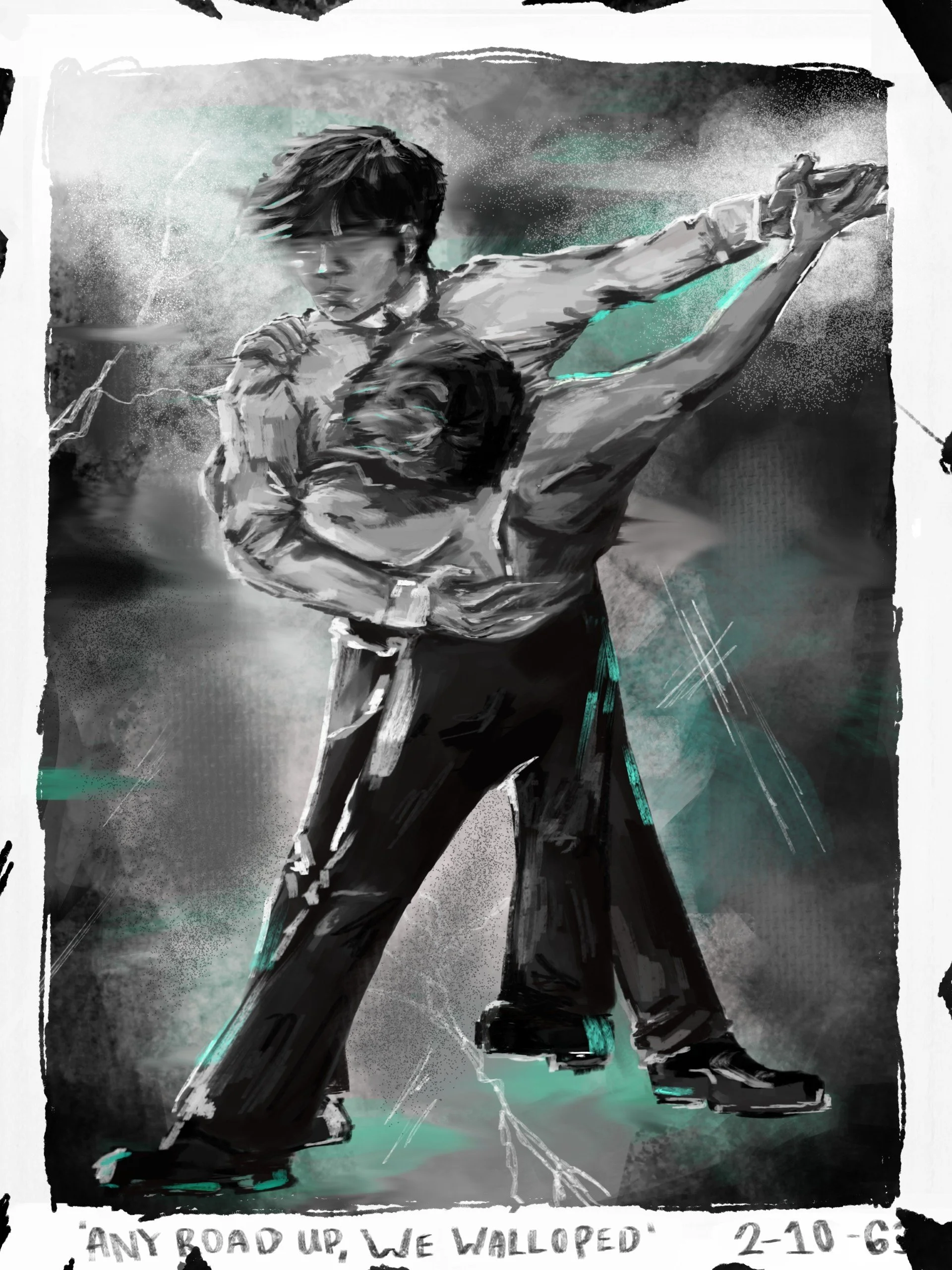
A language made for outsiders: Performers, criminals,
Homosexuals — though the last two were one and the same during Polari’s height of popularity in the United Kingdom's queer community.
Words taken from all over Europe mashed together to form a singular language. Words borrowed from US slang, the Romani language, French, Cockney rhyming slang, the extinct Sabir, Yiddish, backslang (the reversing of words), Cant (a secret language used among thieves), and even made-up exclamations and acronyms all found a home within the expansive world of Polari. The word itself comes from the Italian “parlare,” which means “to speak.” A perfectly absurd language that flowed from region to region, changing origin from one coded word to the next. Helpless on its own, the vocabulary was complemented with smatterings of English for all the words that never existed in Polari.
Frankly, it's not very much of a language at all. It’s more like a secret code, a lexicon of words taught to those desperate enough to need it. Though even “taught” feels like an overexaggeration. A language with such secretive origins means that we don’t know the full extent of the vocabulary, and neither would any of the users. It’s thought that any speaker of Polari could know around 20 of the basic words like “boyno,” “omee” and “palone” (“hello,” “man,” and “woman”), but it’s hard to say whether they could have known some less common words like “voche” (meaning “singer”). With the strange collection of words from other languages that Polari housed, the Polari vocabulary could vary from person to person, with different words and even different spellings of the same words. Looking back, we have to wonder how any speaker of Polari could understand the other. And yet, they did. After all, the safety of the speaker depended on the eccentric, downright absurd nature of it. It was meant to be esoteric — you could walk down the street, people hearing snatches of it, and those who were not well acquainted with Polari (including the police and other dangerous figures) would be none the wiser: a language of whispered words, of a fear that reflected the times. A language for secrets. Something that could accommodate all the skeletons in your closet, even if you were hiding yourself.
But it was also a language of joy, of a knowing smile in the dead of night, of a laugh shared between friends. It was a way of fighting back, of resistance against the United Kingdom’s laws against homosexuality. Laws that persisted until 1967, when homosexuality was finally decriminalized in the UK. Despite its popularity mainly existing across the pond, I believe that Polari still has some things to teach us. So, I invite you nellyarda to Polari.
Imagine a journo much like this one, around say daiture years ago in the United Kingdom. You see dooey omees minnie down the frog, polaring in hushed voices that would occasionally break into a boisterous laugh, dishing the dirt about newest affairs of fellow gaff-goers. They must be bona bencoves. One retells the story on how he met his new heartface, calling her Samantha, even if they know his name is Sam. It must be a story the other omee has heard a million times, as he rolls his ogles, but doesn’t stop the story in its tracks. From a gajo's point of view, he’s speaking nonsense, but all you need is a passing glance of conversation to know he’s a omee-palone. One wrong lav to the wrong cove, outside of their code, and any semblance of a normal life is torn down around him. So he indulges in this nonsense speech, takes joy in it, the bonas and the naffs torn apart with nothing comprehensible left for the gajo to vada.
“You wouldn’t believe it, you just had to vada it. She did a scarper from a cottage the lilly had gotten well acquainted with, a ferricadooza that completely blindsided her. So she’s running down the street, and then bam! Ducks right into my shop where I was working a late one. Her riah stuck to her eek, completely drenched in sweat. Looking back it was quite gross, but in the moment, all I could think about were her ogles, y’know? And then she turned to me, and —”
His emphatic tone was cut off by his bencove as he stole the thunder of the moment.
“And she said ‘boyno’ to you, I’m well aware.”
It was polaried with a sigh, although they knew he wasn’t actually mad.
“Well, you know I'm more of a manly alice. It was just unbelievable that she was able to get my number like that. Samantha just staring like that, in the nochy sky, most dolly omee I had ever seen. Barely snapped out of it in time to hide her from an orderly daughter. She was convinced I had seen something, threatening to shove me in a queer ken if I didn’t tell her where the nelly went. Just batted my ogle riders and said I knew nanti… Can’t believe we're sharing a lattie now.”
He trailed off, getting lost in the joy of the revelation.
“Oh! You hear who isn’t? Melissa and whatever the omee’s name was. After Melissa got remolded, her affair wasn’t keen on her anymore, they palavered every nochy. Didn’t want her to be a dona.”
The bencove cuts in, excited to share what he had heard last night from a savvy voche.
“He was a meshigener bevvy-omee anyway, Melissa deserves better. She’s still a young palone, and if she wants to be a walloper, she doesn’t need an omee like him.” He cut in, indignant on her behalf.
“Well, I’ve heard she’s met someone new at the gaff anyway. A palone-omee this time.” He polaried, to reassure his friend.
“No flies?” he exclaims.
“Heard he’s swell, too. Although I think that’s tat. Queens love a good love story. You’re the prime example,” he replies, a hidden laugh suffocating the end of his sentence.
“Oh, quiet. Bona lavs to them, I really do hope it works out. You know what else I heard?...” The man’s voice trails off as they both minced away, out into the journo. Lives, continued on through the lavs they share.
One of the things that I find the most charming about Polari, and something illustrated through this fictional conversation, is that it is fundamentally intertwined with a sense of community. There’s no use for a secret language if you only want to hold your own secrets. Several words mean police. “Nanti,” a very versatile word that can be used to negate other words or mean nothing, can also mean beware. It’s built upon sharing words, warning others, and living what life gave you at the time — both good and bad, bona and gaff.
In a time where it feels like the walls are closing in on queer people in the US, where we can see our history being erased before our eyes, where it feels like all we are doing is taking steps backwards, I encourage us to look to the past. Whether you are a part of the LGBTQ+ community yourself or just an ally, we won’t let queer people be erased. We can look back to find that there have always been methods of survival. There has always been a community to share in our hardships. Like all movements of resistance, it was only accomplished through community. When we speak of Stonewall or mourn the AIDS crisis, we persevere through those events by having a community. Despite all we have been through, we still find time to celebrate our queerness. That despite sorrow, despite fury, despite secrets, there has always been joy alongside it. It may just be hiding behind a few deceptive words.
After all, while greetings like “boyno” and “bona to vada your eek” are common in Polari, there are no commonly recognized words for goodbye. The closest thing that exists to a farewell is “bona nochy.” So while Polari may have fallen into disuse, it hasn’t counted us out quite yet.
It’s simply waiting for the morning.