Content warning: quoted use of the R-word
Article by Charlotte Maley Art by Liz White
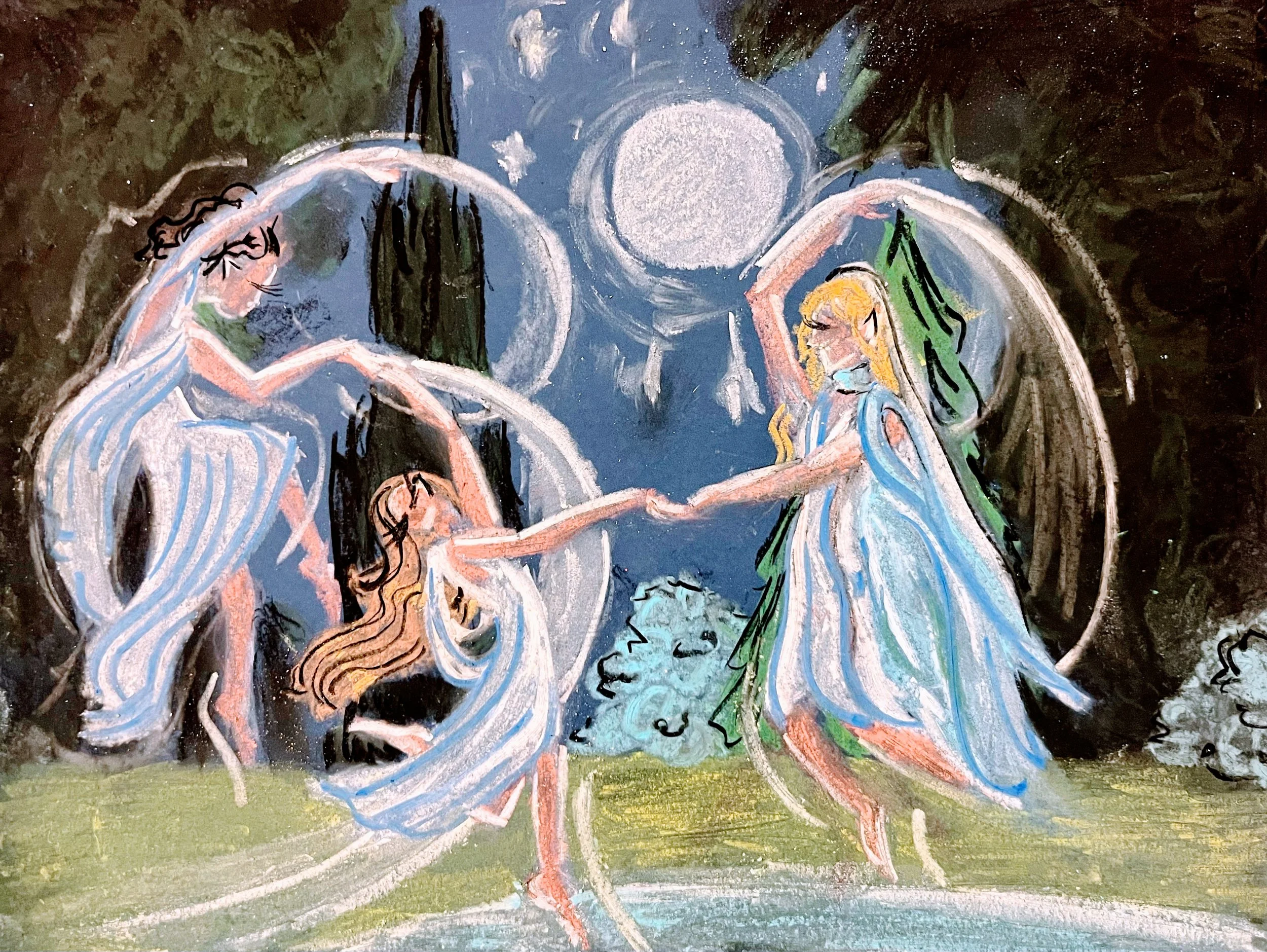
I live with girls because I’m an anthropologist. Sometimes, I feel like a voyeur. A peeping Tom. I’m looking into an exclusive garden for holy beings with secrets I’m not worthy of knowing. I notice delicate earlobes and thin, shiny lips. I see a group of ethereal objects, obscured by cloudy halos, huddled together at a desk in class, confirming with each other that none of them did the reading because why would these daughters of divinity need theory? Maybe philosophy was invented to understand these creatures who float through this dimension, devoid of tangible substance, and just because heaven could only have been discovered by watching them.
Most of the time, however, I think they’re just mentally handicapped.
I live in their territory because I’m a good anthropologist. I keep my distance and don’t intervene when they eat their own kind. In the opaque and damp forest of female culture, who am I to tell right from wrong? I’m the Jane Goodall of girls — I respect their primitive customs because I’m aware enough to be scared. Take it from me, the expert who dwells on the periphery of their sacred lake, that these are the most potent things of this world, and they’re here to destroy us. Wolves dressed as little girls. We’re right to be terrified of the little games because, if we were expected to play, we’d fail.
I learn their language because I’m a dedicated anthropologist. The girls dance around the bonfire of their intentions, luring the listener away from the burning bodies atop their roasting sticks. I hear about a house on a street by campus where three nymphs have waged war on their roommate for ‘not locking the doors at night,’ but the proper translation of such an expression is this: “We are annoyed by our roommate’s main character syndrome, and there is absolutely nothing she could do to win back our favor. We desire the annihilation of her whole person, which we will simulate through never-ending gossip and petty accusations, as well as a gradual exclusion.”
Another nymphet, once separate from the situation, throws herself into the dancing circle to play peacemaker. The main sacrifice is not enough — she needs a side project — and starts doing her own mesmerizing leaps and turns. I just want everyone to get along, she claims, but I’ve paid special attention to this girl, and my field notes suggest that she needs this dramatic performance more than any of them. No one ever makes her the ring leader of this ceremony due to her slightness, so she introduces a solo act called ‘mediator.’ No one, not even the poor victim, wants this role filled, but they permit it for a little while because her half-time show extends the crescendo and prolongs the finale. There’s so much pent-up anger and aggression waiting to explode.
It’s a terribly gorgeous tradition, this dancing circle, and I watch many curious explorers mistake angelicism for innocence. There was a documentary that came out a few years ago, called Grizzly Man, about a guy who tried to live with the brown bears in Alaska. He thought these predators were his friends. He was, of course, mauled to death because of his ignorance, and I see the same thing happen to many men who mistake poison ivy and stinging nettles for simple leaves; they’ve become so civilised that they’ve forgotten that wild animals are dangerous — they see nature as beautiful before it is cruel — leading them to trust Venus flytraps. For example, I’m at a restaurant and overhear a woman to my left say to her partner that she was diagnosed with a learning disability called ‘slow processing disorder.’ The man across from her nods, raises his eyebrows, and says, “Slow? You mean you actually got diagnosed as retarded?” It was like watching a man walk up to a bear and ask for a handshake — I had to look away.
I try to understand the girls because the rules of their society are never formal. In the world of men, everything is explicit… There are constitutions and due process. There’s a paper trail and logical formula to follow. In the forest, on the contrary, not only are there no documents, but putting something into clear language is one of the central taboos, punishable by social exclusion. There is a common misconception that, because the girls don’t value the hard dollar, they don’t have a system of exchange or tendency to exploit, but this couldn’t be farther from the truth.
Girls, like humans, have a gift-giving culture, but it’s not traceable because it’s not material, at least not to our poorly adjusted outsider eyes. Instead, it takes form in ‘emotional energy,’ and indebtedness cannot be calculated through net-loss functions by numerical equations. However, debt can only be assessed intuitively. The charge of ‘emotional vampirism’ is pressed because someone ‘felt’ it, and penalization is carried out with social isolation as vengeance. A central feature of these girl groups is that you can’t dip too deep into the pot of emotional attention. That’s what therapists are for. Therapists are prostitutes for women.
I’ve noticed that a girl can get more than her fair share from the cauldron of emotional energy if worse things have happened to her. To be a victim in the dancing circle is a prized position, and the central sport, the most important competition to win, revolves around this achievement. If that’s impossible for a girl, due to favorable life circumstances, she can take the role of most attuned and sensitive, but no girl ever gives up reaching for victimhood completely. One day in the forest, I heard this conversation between three nymphs:
“We need to throw Sarah a birthday party. She’s never had one.”
“That’s really, really awful.”
“Well, I mean, I had them when I was little,” said Sarah.
“Yeah, my parents weren’t really birthday party people either,” said the first.
“Me neither,” offered the second. “They threw me, like, one, but they said it was too much work, so that was the last time.”
“No, after that — for me — they would like, invite my friends over for cupcakes or something, but that was it.”
“God.”
“It’s so fucked up.”
Recently, I’ve noticed another thing, which is that there can never be any acknowledgement of who’s on top of the social hierarchy. There’s always a girl in command, but if the conductor ever called attention to herself as such, she’d be banished from the forest forever. Such behavior is not merely not permitted, but entirely unthinkable to the female kind. Likewise, no girl can be the subject of praise if she is actually worthy of it, for everyone has to remain under the banner of equality, the same way that no one can get more from the pot of emotional reserve than they ‘deserve’. I’m thinking of this one phenomenon in particular, which happens often, and it totally fascinates me; a girl who’s self-deprecating will be met by the other girl appreciating her. However, if the girl is self-appreciating, the other girl will call a council behind the first one’s back, and they’ll denigrate her image ad nauseam. It’s as if, for every compliment a girl gets, a derogatory remark must be made to even it all out. Again, I find this custom so interesting. Is it the preservation of democratic values? Is this a primitive form of communism? I’m wary of applying my anthropomorphic language to this curiosity. Perhaps it stems from some sort of spiritual attunement that the human race can’t access at this time because, despite popular understanding, the girls might be more evolved than us?
I’m aware that my ability to completely understand the girls is limited because I’m a humble anthropologist. The anthropologist, being on the outside, might get a picture of the culture in a way that alludes to some sort of aesthetic totality, but what makes us capable of objectivity is that we are observing and not participating; the full portrait is available to the filmmaker. People who become experts in a topic are usually those who are so foreign to the concept that its mundane inner workings become an object of incredible interest. In other words, they lack an intuitive understanding. The psychologist, for example, is usually the most mentally ill or socially incapable person. Completely impotent to understand human relationships, they look to extract constants from variables in order to come up with a formula to control the situation that they would otherwise be totally unable to respond to. The expert is always an anthropologist. This is why people shouldn’t trust ‘experts.’
I tell you all of this because I’m an anthropologist who, first and foremost, loves the girls. They are the only thing that gives this life any excitement at all, and only because their world is another realm that might as well be magic. Talking about feelings, it seems, is a primary activity of the girls because it’s an art form. Cloaking the actual meaning of the intention, which always stems from an animalistic impulse, is a delicate craft with a high mortality rate, like tightroping, but they brave it nonetheless, and only because they don’t accept the given of this earth, but transcend it instead. They are endlessly creative and refuse to fix anything. They honor the silent barbarity of nature and try to emulate it themselves. They are little goddesses, and like Gods, they instill fear and respect in anyone who dares to see what they’re actually up to.