Article by Seniada Vigil Art by Sana Bhakoo
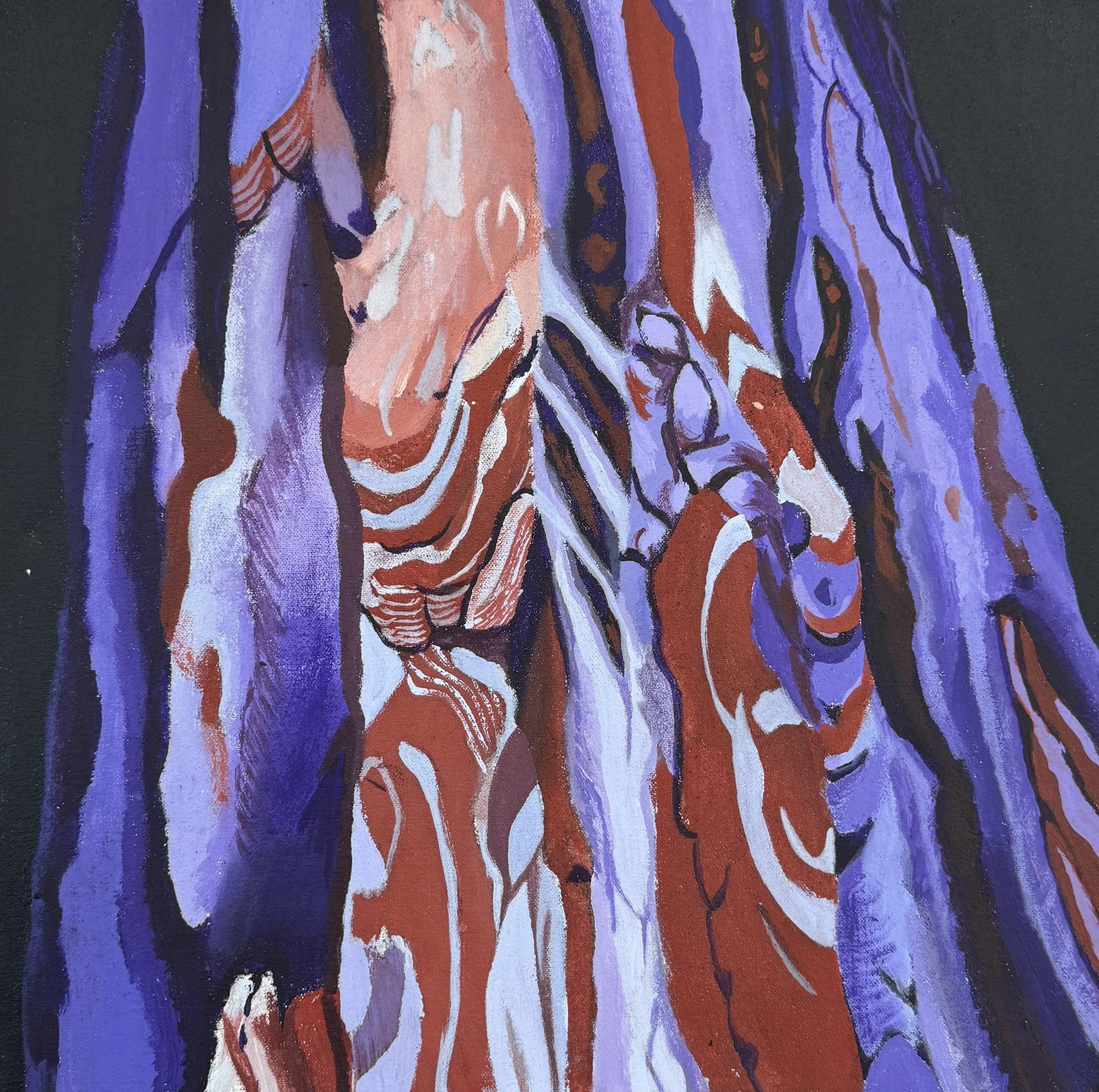
As far as I am concerned, my mom has nearly died four times. The number is higher than this, and the events don't line up. But the truth is not within a distance that my concern is inclined to stretch. There has been no death, nor miraculous return, but I have mourned the imaginary over and over again. Laying flowers on sanguine memories has yet to help me, but grief is hardly rational, even when it’s real, so I might as well hold another service.
The first time I thought my mom was dead was somewhere around the third grade. I had gotten the usual spiel: she’d be out till 10 pm with a friend, don’t forget to eat, I’d keep her phone so I could call someone in an emergency, she loved me, bye bye. I was used to being left home alone, my mom had a life to live, and I had shows to watch, but I was still scared of the dark. It got darker when she left, but that's okay, it was only 10 pm. I have always liked to tell myself things will be okay. No one gets back perfectly on time. I was sure she’d be back soon. Then it was 10:30. That was okay too; maybe she got caught up. Then it was 11 pm. I called my mom to ask when she’d be back, and her phone rang. I didn’t know who to call. The ringing phone in my hand was no help; no one in there could help me. I got cold at 11:30; Virginia doesn’t really get very cold, even at night, especially in the spring. But how cold it really is doesn’t matter when you’re shaking. There was a knock, or there might’ve been, but every noise that could’ve been my mom coming to warm me up and turn on the lights came from downstairs. It was darker downstairs, where the neighbors were asleep, notably unable to make the distinctive noises of a familiar return. From 11:35, each minute got heavier, slower, meaner. I checked the clock after five minutes, and it had only turned 11:36. I have always been one to whip myself into a frenzy, but 10 is not 11 is not midnight, and I couldn’t bring myself to shut the blinds that were letting the dark in. Tension rose within me until my thoughts wrapped around my throat. Shaking turned to tears turned to a phone number. I could’ve sworn that every heaving breath dimmed the lights. I called my aunt and tried not to cry with all the might an 8-year-old who knows just enough to feel guilty, but not enough to look into the dark, can muster. I begged my aunt to find my mom, to tell me where she was, and to turn on the lights.
Stop.
Remember what has not happened.
See the reds in vivid detail.
Delay until tomorrow.
Something shifted after that. The windows were looser, the deadbolts less certain, the vents more navigable. I was so sure that someone would get in the house, that someone was already in the house. I think, in a way, my mom had already died in my head. I just needed a way to fill in how. The air was pumped with poison, the streets were more abrasive and hungry, and strangers stood closer. It didn't matter how many days rolled past one, stupid, dark night. It didn't matter how many meals she fed me. None of it mattered. Some part of me knew she was dead. So every night I read myself a bedtime story written in her blood. It was more than shaking, more than a weight; it was a signed death warrant. The details filled themselves in sloppily. Shot, stabbed, torn to shreds. She was gone, and the doors were still locked. The murderous mirages followed me everywhere. They were always behind my back, or the shower curtain. I tried to press my back against a wall, but grasping hands melted through and dug into me. My mom was long dead, and there was no one left to protect me.
Stop.
Remember what has happened.
Watch the reds chase you.
Delay what is behind you.
Few things are more jarring than your weeping mother telling you she is suicidal. Because of you, or rather because of the lack of you. The knowledge of your dead mother shifts and becomes something altogether different. The responsibility for your mother’s death. You already knew she was dead, of course, she is dead already, but now the blood pools in your nails and fingerprints instead of at your feet. Of course, she is dead already, but now you can’t help but wonder what missed call did her in. OF COURSE, she is dead already, but you are afraid, and silent, and expressionless in that car when she tells you that your rotten silence has seeped too far in. She had told you that you were drifting a p a r t. She told you how much it hurt her. But tucked away in the mountains, it all felt so far away. Now, here, in the passenger seat, it feels like you need to do anything in your power to push it all away again. This is a bad moment. You do not want to be here. All you can think to do is pray that you will not be held accountable for the body in the driver's seat. All you can muster is stone stillness. The tears might implicate you in the crime. “I’m sorry,” is all you can manage to say
Stop.
Remember what you’ve done.
Wipe the red off your hands.
Delay.
There’s a special sort of exhaustion that comes with thinking your mom is dead for most of your life. It’s an old, bone-deep tiredness that creeps in and makes my fingertips and eyelids heavy. Sometimes in the moments before sleep, exhaustion can look like apathy, and I can convince myself that all the pre-traumatic stress of mourning a living woman has prepared me. Sometimes I convince myself that I won’t cry when I finally get the call I’ve been waiting for. And then there’s a crash, and my mom is in the hospital. It proves me right, I’m fine, I don’t tell the same friends I normally tell. It’s easy to be okay, it’s easy to feel prepared. My mom has been dead for years. I’m ready for this. I tell the person next to me that I’m ready for this. I know the next steps, and all I have to do is keep it together. But, as it always does eventually, the weight catches up to me. Tears burn my cheeks, my throat burns as it acquiesces to my mind's demand for silence. I won’t let my roommate hear me cry. I’m supposed to be okay with this. I won’t let myself hear sobs. A sharp breath is the only hint at my saline-soaked cheeks. I’m breathing too fast, too slow, and then suddenly not at all. As I hold my hands over my mouth and nose, I beg myself for silence; it doesn’t matter how I get it. I wish that I could say that I have never been so afraid. But I am always afraid. It is never the height of the fear that surprises me, but its insistence to remain undeterred by time. There is no healing. How can you blame a child for being afraid without their mama there to hold their hand?
Stop,
Take a deep breath,
Your mom is alive.