Lettitor

Dear Reader,

The binary of “skeptic” and “believer” is somewhat meaningless, as most binaries are. You saw something out of the corner of your eye. There is always a gap between our senses and our stories — and it always gets filled in. Even a skeptic is exercising faith. Some of us see ghosts in our peripheries, lurking in our vision’s vignettes. Some of us swear that it wasn’t an animal that rustled the bush just now. Some of us think that any supernatural account is full of shit. But whatever you believe, on some level, everyone is capable of being all these at the same time. Cryptids too harbor this conflict all at once. 

Whether or not you believe in them, cryptids are modern personifications of our culture around myth. We see them, then they’re gone — we take photos, but they’re too blurry to verify. They are painted into campfire stories, warded away by definition, passed down as cautionary tales, hunted with pitchforks, unmasked by Mystery Incorporated, worshipped and debunked to be worshipped again.

Cryptids are compelling precisely because they don’t quite get to be real. If the Loch-Ness Monster (Nessie, to her girls) were 100% provable, she would just be another animal — an incredible one, but an animal nonetheless with a lengthy taxonomic name and a DNA sequence. But because cryptids get to lurk in between grainy CCTV pixels and moderately upvoted Reddit posts, they float around comprehensibility — not quite within nor without our logic. And that makes them mysterious. Or fascinating. Or lovable. Or terrifying.

Cryptids are like secrets. And mirrors. They’re hidden, but everyone knows about them. They’re unobservable, but we’ve all seen a picture. And your perception of them is reflective. Lots of people are afraid of “Bigfoot.” Others see the Sasquatch as a unique, benevolent, deific species. Probably most never think about them/it (?) all too much. As editors, we’re pretty split. We believe, we don’t, we’re neutral — what does that say about us? What does your belief say about you? Can you trust a skeptic or a believer to present you with this project themed around the unknowable? Probably not, but here it is anyway. We hope you enjoy the sound of our writers leading you into the woods.


Hurry, get the camera,

Cipher

Whale Song

Article by Sadie Hale Art by Liz White

You can only run in so many routes on an island: you end up going around and around and around and around again. Lavender fields. Oyster farm. Old house full of clay pots. Jam store. Camp. Bakery. Lavender fields. There is a correctness to living on an island for a summer. A summer is the time for an island. An island is a summer of land. All those long days, spent in one place, become one day. In Washington, I was awake for 91 days straight. I just watched the waves roll up onto the same stretch of beach.

Sabine says that even when she’s home, she’s not really home anymore. This is difficult for me to interact with, like a very large number. I come from the most beautiful place. If Washington was your right hand, the part right between your pointer finger and thumb. There is no improving upon it. I went back there, to the islands, as a pilgrimage, the summer after my first year at college — it was a bad year at college. I was never going back to that school again. There was no way of knowing then if my future was going to get better or worse, and those were the only two options: better? Or worse? All I knew was that my first attempt at adulthood — at leaving — had failed.

I came to the island because I had been told there was work for me there. The work would be seasonal, a single summer, and it would be hard. But I needed hard work. I needed a chore, something that would keep my mind from wandering. 

I joined the long line of cars waiting for the ferry boat that would bring us across the Salish Sea to Orcas Island. Orca whales, in particular Southern Resident pods J, K, and L, swim, hunt, and live in the waters surrounding the San Juan archipelago. They are sometimes visible from the islands’ shores, their smooth black saddles and jagged dorsal fins breaking through the waves. But the island is named after a man: a Spaniard, Horcasitas, who commissioned a colonial expedition to the region in 1791. It is shaped like a horseshoe. Someone had flung it across the water and it had landed upside down, spilling something into the Puget Sound. The orcas clicked and whistled in that water. They ate fish in that water. You could see them. You could drive to the top of a tall hill and look out at the Cascade mountain range in one direction, the Olympics in the opposite. This is how I have always lived, between these two spines. When one is in front, the other is behind.

I was very busy that summer. Everything was sandy, and I was almost never alone. They only paid me for eight hours a day, but I worked from the moment that I woke up in the cedar slatted bunk of an open-air cabin to the moment I fell asleep there at night. I set my alarm to vibrate so that it would wake me first and I could spend five minutes gasping myself awake in privacy. Then I would blare Here Comes the Sun. But I loved it. They trained me on it, on the beach I would live on. I knew blackberry, nettle, cedar and salmon. I was trained in otter, madrona, lavender and marijuana. I ate tater tots and grease. Sweet yogurt and oats. I stole chocolate bars from stacks of s’more supplies and ate them for breakfast. On my nights off, I went into the woods and slept in a swinging hammock, my down jacket under my head as the waves beat and beat and beat the shore. I wound down 25 MPH roads to coves, inlets, jetties. You can only drive so far on an island. To clear my head, I went up the one mountain again and again and again.

The children tugged on me from ear to arm, and I was always worried whether I was doing it correctly, and then I became too tired to worry and was just guilty instead. My freedom was so cherished and specific that I remember every second of it: the chile and maple latte, the mornings I spent in the library just sitting with my eyes closed in the air conditioning. My friends, my two friends, sitting in that one patch of grass. The work was so exhausting that when there was rest, there could be no distraction from it. I had to read poetry in my two hours off, not because I was far from my body but because I was so close to it. Machado, I have a type, and I always / find them. Aaron Smith, I want so desperately / to be finished with desire, / the rushing wind, the still / small voice. Calvocoressi, It will feel better than any floor / that’s risen up to meet you. It will rise.

I was mostly working, and when I wasn’t, I was very busy falling in love. I felt frantic all the time. We would escape on Saturday nights to a different pile of driftwood to drink beers and flirt. They would ask me to bring them tea with honey at night and I would put way too much in both of our mugs so it wouldn’t seem like I’d forgotten it in theirs. Cold and oversweet. The love was a part of my chore: as always happens to me, when I was around them I couldn’t eat, my stomach turning and turning over with emotion. I would call Annie and tell her about them, their landscape ribs and everywhere curls, how I would spend all day with the kids and then all night on the beach with them, pointing up at constellations and tracing the same shapes over their hands. Annie would pick up from the friend’s place in Martha’s Vineyard where she was working for the summer, and as we talked, we heard the ocean on both sides of the line. We missed each other even though good things were happening. I copied her texts into my journal, right next to the poems. Seidel, your life is anything you want it to- / and loves you more than it can show or tell. Annie, I am SO happy for you. Annie, God let me be this free forever.

I believe in this island more than I remember it. I went to it as a monk, and it delivered as a monastery. I would sit out late on the dock, watching the sun set onto the moon jellies, their translucent bodies, washed up on the beach. In the morning, they got poked with sticks by 12-year-olds. I took my girls around and around, pouring their milk. Is the ferry on fire? They asked me, watching the lights, moving across the water, almost burn.

A summer is an island of time. Famously, you have to go home. I was willing to make any kind of deal to any kind of power to not have to relinquish it, to relinquish them. No sleep no food sobriety new name shoeless through a desert hard work no pay. I was willing to do all of it, but of course I did none. God (my parents) did not have that in store for me. Colorado was calling. I left the island in so much love it was hard to walk. It was hard to see. 

Here’s something: our weeks with the kids involved a one-night camp out on a different, private island off the island we were already on. There were two boats that traversed these islands: one big, flat-bottomed one, with bench seats all around for shuttling campers, and a smaller metal speedboat, mostly for supplies. The speedboat was called the Whalefish. Riding the Whalefish was one of the ultimate pleasures of camp, and potentially of my life. It went fast. The wind made talking impossible. It scoured across your face under the July sun, and between the ride and unloading the gear you had at least 45 uninterrupted minutes to do a job that was not looking after children. Once, in the Whalefish, the captain cut the engine, coasting and pulling the boat in a wide circle. We were in the water with four orcas. The calves, the bulls. They bayed and broke the surface, their milky black bodies, their sharpness and roughness only now visible. Killer whales. We were so close. 

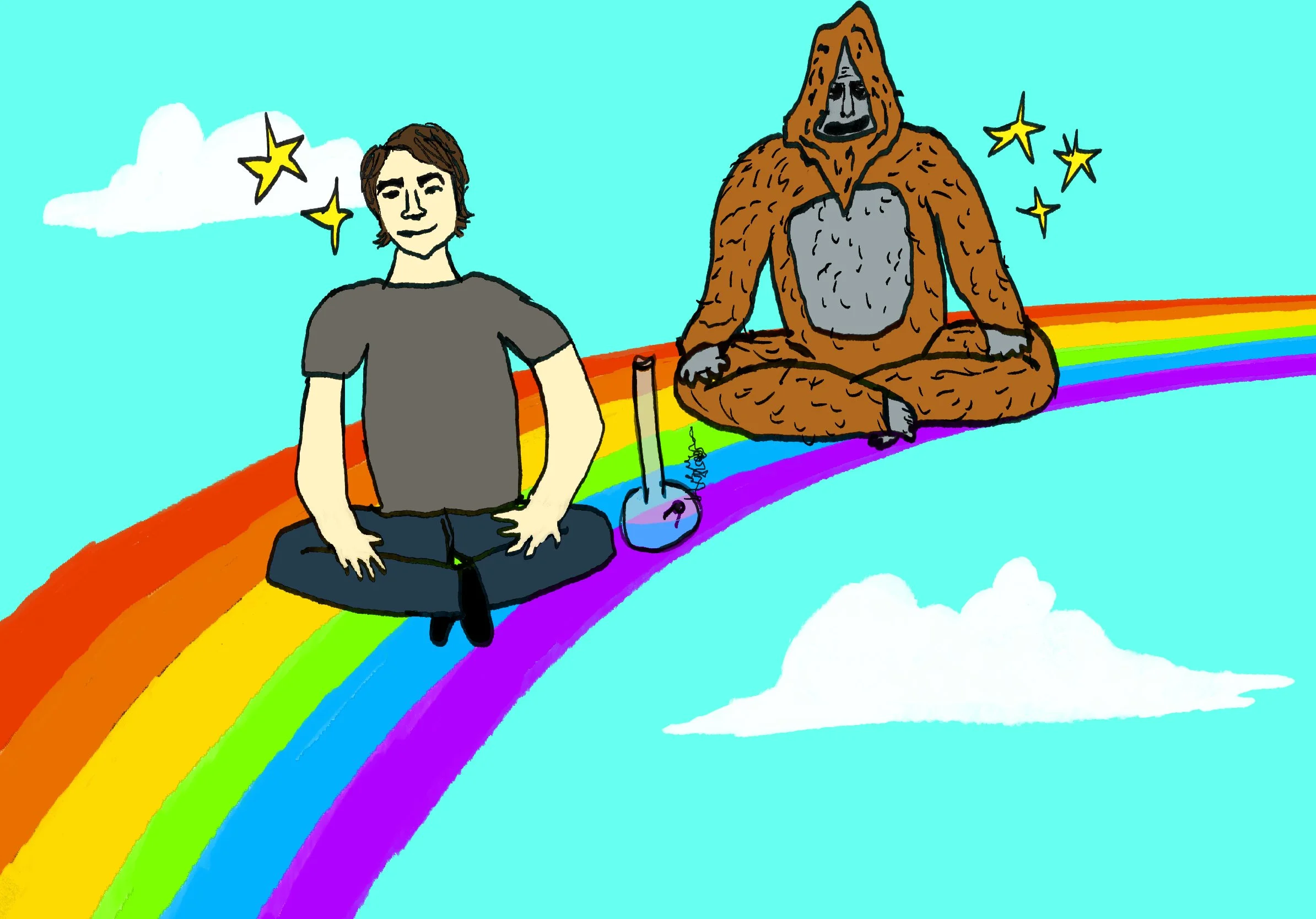
Jarrad on the Rainbow with Squatches

Article and Art by Katie Lockwood

“Oi, what are you doing in there you fucken druggos!?”

“He’s hitting the Stingin Roger!” 

The group of snowboarders descended upon the little tree fort tucked in a snowy glade like a murder of crows on skunked roadkill, their squawked remarks overlapping one another wildly. Their Australian accents were embarrassing enough that I hid over by the tree line, trying desperately not to be associated with the idiots who gave me a ride to the mountain that morning. 

“’You’re gonna fucken die of lung cancer, mate. You’re gonna get punched in the face by the long dick of cancer.’”

It occurred to me that these harassments could hardly be original, as they left the mouth of the biggest stoner of all my friends.

“What were you quoting at those guys smoking in the tree hut?” I asked him later on the ski lift. 

“Wadiyatalkinabeet?” he replied in one sputter before erupting into a laugh so loud people on chairs in front of us looked back. I remained stoically confused, at which he gasped: 

“You don’t know The Big Lez Show???” 

Though I couldn’t see his eyes through his goggles, I could tell they were locked on mine. He explained there’s this animated YouTube series about this fat guy named Leslie living in Brown Town, Australia who’s actually an alien, and he smokes a lot of weed with his neighbors who are sasquatches named Sassy and Donny the Dealer, but he’s also got beef with his alien brother and they are always beating each other up and pooping on each other’s things, which is super distressing to Lez’s orphan kid Quinton, and really I just need to watch it for myself. 

I Googled the show when I got home. I can’t remember if it was before Lez, Sassy, and Donny hit the volcano bong, after a lifeguard jumps off the lighthouse to kill a shark by body slamming it with a knife, or once Lez blasts the head off of some yellow creature called a Choomah, but a question took shape in my mind: who the fuck comes up with this shit?  

If you’re a stoner or YouTube rabbithole enthusiast, Jarrad Wright hardly needs an introduction. However, if you find yourself in the position I did, allow me to familiarize you. 

Jarrad Wright was a daydreaming teenager at Tweed Heads Highschool in New South Wales when he met two fellow losers named Izak Whear and Tom Hollis. Their attention spans were quick to glaze over lectures and landed hard in shitty doodles on the margins of their assignments. The threes’ sketches turned into characters turned into lore turned into a whole damn universe. 

And when their art came into inevitable orbit with the introduction of school issued laptops? Naturally, Jarrad abused it. Only, rather than playing video games or whatever else normal kids did at the time, he dedicated himself to learning Microsoft Paint. Pixel by painstaking pixel, he animated the first episode of an instant cult-classic internet sensation. 

From the jump, the story of the alien/humanoid Lez taking drugs with his sasquatch mates and fucking shit up in the outback captivated the high hive mind. At some point, the story naturally spread like fire on the side of the road from a misplaced cigarette butt; it was something the rest of northern New South Wales and the world was talking about.  

I say it spread to the rest of  northern New South Wales, but I think it would be a shame to rob the area of some partial credit in the genesis of Lez. I imagine that they call it the “Rainbow Region” for fun, but certainly not for no reason. 

The “Aquarius Festival” occurred over the span of 10 days in 1973 in the declining rural community of Nimbin in the Northern Rivers area. Today, the festival is broadly thought of as some obscure gesture to what America was doing with Woodstock: another new age exposition where concert lawns sprouted with Hendrix-ogling flower children. From an uneducated glance, it’s hard to really differentiate one mass bender in a dying dairy farm town from another. But student organizers Johnny Allen and Graeme Dunstan (who called themselves “Kaptain Kulture” and “Superfest”) vehemently sneered at Woodstock for being a stealth marketing scheme. 

The Australian Union of Students posted an ad in 1972 hiring a director and cultural director for the 1973 version of a biennial arts festival that had been running since 1967. As soon as Johnny and Graeme got their hands on those titles, an additional government arts grant, and, I assume, at least two joints, they sat down and wrote the “May Manifesto.” The mission was simple: sell drugs, not culture. Aquarius declared that it would not sell you a lineup of headliners to sway to; it told you to get up and post the drum circle you wanted to host at dusk on the chalkboard set in the middle of camp. It was a chaotic, radical experiment on self sufficiency and tribal living, and it was all advertised by word of mouth. After the festival, people actively relocated to the area of Nimbin and stuck around to see the droplets of their cultural manifestation refract brilliantly in the new anti-capitalist light shone by Johnny and Graeme. The Rainbow Region, northern area of New South Wales where Tweed Heads resides: the counterculture capital of Australia. 

I don’t know if I would say I completely believe in reincarnation, but if Jarrad and his mates aren’t Johnny and Graeme re-embodied, they at least must be frequented by the ghosts of Kaptain Kulture and Superfest. Or perhaps it is simply that The Big Lez Show is an inevitable product of its environment — the great grandchild of the festival. What could possibly be more Aquarian than using a complimentary software like Microsoft Paint on a school laptop to inefficiently make a raunchy cartoon to put on YouTube for free? And with zero advertisement besides sending the link to classmates, who then decided everyone else needed to get a load of this shit? The whole affair reeks of ancestral haunting. 

The familial tree has only grown, as Jarrad has created several other spin-offs from The Big Lez Show. The Mike Nolan Show (2016-2019) chronicles the tales of Lez’s friend Mike (the one Lez told was going to get punched in the face by the long dick of cancer) who continually finds himself chain-smoking and completing odd jobs. Sassy the Sasquatch (2020–2022) follows Sassy interdimensionally from the dawn of the dinosaurs as he keeps unknowingly escaping death through drug induced psychosis. And then there’s The Donny and Clarence Show (2024), which has sasquatch drug dealer Donny beating up this dumb little potato head creature named Clarence (Clarence appears in the first season of Lez, but everyone hates him, so I spared you the details of his miserable ass until now). 

Of course, Jarrad would never stoop to the level of explaining himself, but choosing to use Microsoft Paint for every episode he has ever drawn even in today’s ripe new technological age nearly gives himself away. Either he’s a total masochist, or it’s always been about the medium. I know I sound like a mother who insists their toddler’s Crayola scrawls are masterpieces oozing with unbridled creative genius, or like an insufferable college student talking about the politics of pixelation, but my god! The neon green grass and cyan skies are utterly naïve, the cartoonish texture of sasquatch fur and fat rolls is completely artless, and the simplicity of the houses and surroundings is totally guileless. It, like an empty chalkboard in the field, does the bare minimum, and that’s what makes it so goddamn wonderful!

And then there’s the sasquatch in the room, who I’ve largely let remain uninterrogated until now. Why would an intensely Australian show choose to steal a North American cryptid? The idea of a furry man-like creature isn’t singular; the Himalayas call him the Yeti, South America the Mapingauri, and even Australia has their own version which they call the Yowie! Why wouldn’t Jarrad just use him? The Yowie is a name originated from Aboriginal oral tradition meaning “hairy man” of an unpredictable nature. The creature, though, is considered as something beyond animal or human; it is said to inhabit the spiritual realm as a powerful ancestor tied to the land and the mysteries it keeps. Maybe, even under the influence of drugs, Jarrad’s mind was clear enough to comprehend that venturing into Yowie territory could teeter on appropriation; it is admittedly a super risky idea to bastardize a sacred indigenous figure into a drug mongering buffoon. 

Luckily for him, I guess, America already did that to the Sasquatch! Indigenous Coast Salish peoples of the Pacific Northwest similarly saw the sasquatch as a transcendent protector of the forest. And, as Americans do best, they stole the idea and packaged it into something “discoverable.” In 1967, Roger Patterson and Bob Gimlin released 59 second video of a testimonial squatch sauntering heavily through the Bluff Creek bed in Northern California. From there, amateur cryptozoologists were crazed to find Bigfoot, or at least say they did. In other words, Bigfoot became a movie star. The price of his star power is not too different from any other silver screen icon: beef jerky commercials, unflattering family-fun comedies, and rumors of drug abuse. Especially in California, where weed grew where the squatches roamed, it didn’t take long for dispensaries to token the elusive, smiley gorilla on their strain names and packaging. 

But Sasquatches weren’t the only consumable America manufactured for young, Bigfoot loving Jarrad. The US is also uniquely skilled at creating nightmarishly laughable deadbeat father figures, and nearly as good at making adult cartoons about them. It’s horrific how many there are when you start to list them: American Dad, Rick and Morty (grandpa but still), Family Guy, South Park, Moral Orel, Big Mouth, Fairly Oddparents, and I’m sure the list goes on. Jarrad has stated outrightly that Choomahs, the yellow aliens I mentioned earlier, were born from a competition of who could draw the most fucked-up looking Homer Simpsons. And though Lez is not a yella fella, he did eat a drug sandwich and pass out for two weeks, leaving Quinton to play with a GameCube he dug out of a dumpster for his birthday.  

And yet, Lez is not just a bong wielding Homer. Maybe that is because Lez’s friends actively encourage him to do drugs while Marge whips her bumbling husband into believing in the Nuclear Family they’ve made. Maybe it is because Matt Groening is a Portlandian punk poking fingers at the obtuse absurdity of the traditional Springfield family, and Jarrad secretly created Lez based off one of his friend’s dads (but made him fatter and wear pink to disguise it). Maybe that’s because Matt had everything to prove and Jarrad just wanted to make his friends laugh. 

Brown Town is a fantastical no place, and yet every Aussie recognizes it as a portrait of the suburbs. Brown Town is the sun-baked flatlands soaked in washed New South Wales humidity. It’s Tweed Heads. It’s Nimbin. It’s your cunt neighbor who fucks your fucken eyes with their fucken stupid flowers. It’s your druggo friend who accuses you of being a fucken druggo. 

I’m sure positively none of the people I know who love this show could point to where the hell Tweed Heads is on a map, but they can quote the damn show ad nauseum. I can now too, and it’s fun. It feels like a little secret that I get to be let in on. I’ve never had any desire to watch The Simpsons; I need to spend $11.99 a month on Disney+ (with ads) like I need an abscessed tooth. 

So, indeed: who the fuck comes up with this shit? I have come to know and love Jarrad Wright as a fair dinkum dipstick who loves making his mates laugh, including the parasocial fiends on the internet who have gotten tattoos based on the show. He is the salt of the earth and sediment of the Rainbow Region.

But did I really need to know him? I’ve shown the show to at least 12 different people, and they all laugh sidesplittingly regardless. It is painfully ironic to me now that I wrote an essay about people who never cared for the limelight of their own work and scoffed at the culture which placed the artist above the art. I’m sure if I showed any of my psychoanalysis to Jarrad himself he would simply reply:

“Wadiyatalkinabeet?”

Lobsters in the Forest

Article and Art by Stella Epstein

Pennsylvania nights are hot and sticky. The sun has gone down, but has warmed the night like it warmed the slate rocks. I lay on my mom's twin bed, perspiring. Levi lies by the window in Uncle Dan's twin bed. It is 10:30 or 2:00 am. Neither of us can sleep because, despite the air pushing at us from the two industrial-sized fans, the scent of lobster bisque still lingers. 


Every summer, we have a lobster night. Some families do a big thing, where they invite other families, and there is crab and salted butter. Our family does not do that. My mom loves seafood; it fulfills her in a way that nothing else does. Only seafood can scratch this itch or bring completion to a soul. I think that everyone has something like that. This completing love can be many things, and can be multiple for each person. But since my mom gets lobster once every two years, it becomes a priority. Since she has not been able to give lobster her love for so long, it is necessary to dedicate an evening to eating. My dad loves deep-dish pizza, Levi loves a perfume that smells like money, and I think I am still looking for what will bring me that “puzzle fit” feeling. Anyway, when there is lobster, Mom disappears. 


She becomes Vanessa, my mom in her youth, running wild in the tri-state area. Picking blueberries, jumping in lakes, sneaking out of cabins at night to swim the sweat off, and tasting the brine. In Colorado, seafood isn't the same. The overnight trucks take the saltiness out of the oysters, and the “living” king crabs at H-Mart are dead. Vanessa loves real seafood, so when it is lobster night, I know that I will be taking care of myself — because my mom loves me year-round, and this is the time she needs to love something else. There are times when too much love can be given to one person or thing, and a shift in love can revitalize a relationship. 


The summer heat takes me out of my mind and reminds me of what has just happened. It was lobster night. We start at Weis Market, where my aunt chooses the best lobsters. I don’t know how she tells the difference, because they all look the same to me, but she always finds ones that are better than the rest. We don’t need to buy anything else, because everyone will eat the lobster but me. 


I am a vegetarian in a family of meat lovers, so family vacation is constrained by my inability to digest dairy, meat, and general distaste for the finer places with mushroom oil and dishes that still have eyes. My dislike of meat doesn’t come from some moral high ground; sure, Big Meat is destructive, but I became a vegetarian in 4th grade because a girl I had a crush on was a vegetarian, and I already just didn’t like how meat tasted. The appeal of sausage was never there. Because of my specific tastes in a family with an overall adventurous palate, I am frequently the one who starts food-related fights on vacation. We will be going to dinner, and the only option for me is something with mozzarella, usually a pizza, or a salad that I will have to order with chicken on the side. By this point in the day, I am already tired, and the fallout of my argument tends to be that I will get takeout, while the rest of the family dines elsewhere. But for tonight, where there are no restaurants to go to, I will have some beans, and Aunt Kristen will end up cooking a pie or a breakfast cake, either of which will make an excellent pairing. 


The cooking begins. Uncle Dan brings the water in a large metal stove-top pot to a boil. Then, he puts the lobsters in, one by one, slowly so the water doesn’t splash out. I hate this part. The lobsters are still alive, and I imagine they feel the hot water outside their shell, heating their flesh, and as it seeps into the cracks between their shells, they are boiled alive. I feel this pain as if it is my own. I wouldn’t describe myself as particularly empathetic, but I hate the idea of a slow death. So, I feel for the lobsters who are stuck in a pot that is killing them over the course of a few hours. My mom has yet to succumb to the lobster madness, so she goes on a walk around the lake with us, then for a swim in the unheated pool. We get back to the house, and the boiling water has transformed the kitchen into a sauna. The room above the kitchen, which happens to be mine, is now muggy. The steam from the boil has wiggled up through the floorboards and into my room. The fan blowing from the door just blows in more steamy, lobster-scented air, and doesn’t disrupt the airflow around my bed. I can feel the sweat sticking my shirt to my back as I lie down, and know I need to be somewhere other than my room, which has become a temporary lobster sauna. 


I go outside to escape the smell. Lying on the thick carpet of the forest, I smell the leaf decay and hear the wind rustling the tops of the trees. When I go back inside, dinner will be ready, which means Mom will be gone. In an attempt to prolong the inevitable, I go on another walk. Down the hill from the cul-de-sac, I go to the bog. The air is always cooler here, and in the absence of any cars or other human noises, I can hear a creek running somewhere in the weeds. I wander through the bog until I find a bench forgotten by those who made it, left to rot, but still sturdy enough to sit on. Here I can see the red-winged blackbird, and hear the Northern waterthrushes call. Once I see the fireflies start to come out, I know it is time to head back, so I turn around and walk up the hill into the growing dusk. It is time for the feast to begin. 


We sit at the kitchen table, Levi next to me, Mom and Dad across from us, and Aunt Kristen and Uncle Dan at the ends of the table. In the middle lies a heap of red shells. The tails and claws are sitting in butter and corn. There are rolls, red potatoes, and a large bowl of salad. Before me, there is a bowl of beans, rice, and diced tomatoes from a can. 


Mom makes herself a plate, and I see the delight on her face. It disturbs me. Mom is gone now; she is consumed by the plate in front of her. The act of breaking open the lobster will not disturb her, nor will the smell that will stick in my hair for days, or the meat that was alive just a few hours ago. If she just loved eating the lobster, maybe I could excuse her, but she loves tearing it apart personally. How can something this upsetting, gross, and disgusting bring her so much joy? 


It’s Levi's first time having lobster, so Mom teaches him how to eat it. How to crack the tails, slurping, and how much lemon you need. I watch him get better, the tails come apart more neatly, he gets less on his shirt, and he enjoys every bite. Mom describes it like treasure hunting, looking for the best bite in the bunch of lobsters. When I watch her teach Levi, I see the same happiness I see when she braids my hair or makes dinner with me. This, right now, is more than just sharing a meal. She is bearing her soul to Levi, teaching him what she has learned. While she watches him experiment with her advice, I see Levi as an extension of her. The time they have spent together, and now, as he engages in this deep, treasured love of hers, he is getting closer to her. 


There is joy at this table. It is coming from the lobster and spreading to those eating it. Together, my family is working hard to be rewarded with a salty, buttery bite and to connect over the experience of treasure hunting. No matter how small the reward may be, less than a full mouthful after cracking a claw, my family relishes the whole prospect. Sitting there, surrounded by the sounds of slurping mouths and breaking claws, I remember all the times when Mom would share herself with me. We watch movies from her childhood, she takes me out for pastries when I have a bad day, and always lets me get in bed with her when I feel lonely. I see what she has sacrificed for me, and now, fourteen years into lobster fest, I finally understand this love. Right now, her love for lobster goes beyond temporary consumption and into engaging with her family. 


“Hey Mom, do you wanna watch a movie tonight?”

Memoirs of a Ghost

Article by Ethan Kirschner Art by Allison Garcia

The wind is blowing, pulling hard, battering away at my body like it does snow. The particles that make up my image are streaming off of me, leaving faster than I can react. I feel myself disintegrating.

I am trying to hold it all together, to not disappear. But the wind is strong, and my form is weak. Tears flow down my cheeks, yet they never reach the ground.

I do not know when I became a ghost. It is a difficult thing to measure. For a long time, I felt grounded, feet flat upon the earth. Then one day, I found myself drifting in the breeze.

* * *

I am sitting on the floor, looking through the wire mesh railing at the cafeteria below. It’s not really a cafeteria, more of an atrium with folded-out tables to eat on. After the lunch periods are over, they will fold those tables back up and it will become empty. No longer any reason to stay there.

I am looking at a table where I used to sit. It lies just below the steps leading into the atrium, squished between a wall and another table. A large group of people are talking animatedly, eyes wide, backs arched, arms stretching across the wood. They appear to be very engaged with each other. I take a deep breath.

It was there, when I sat with them, that I became aware of my incorporeality. I was trying to participate in a conversation, to engage with those I considered friends, but it seemed no one was listening. So I stood up, intending to lean towards them. As I did, my body passed through the table.

I stilled, looked down at my legless torso. Nothing felt wrong, but everything looked it. I turned to the nearest friend. “Do you see this?” I asked.

No reply.

“Do you see this?” I waved my hand in front of their face. No reaction. I waved my hand in front of the next person, and the next. It was all the same. They no longer saw me.

Over the next few days, I did what I could to make them notice me, to no avail. I could not impact a single one of their senses. They never realized that I had disappeared.

I left.

Next to me I hear a screech, pulling me out of the memory. It is loud, piercing, high-pitched. At first, it may appear to be a sign of distress, but then laughter follows the screech, squeaky and unrestrained. The source is no horrified person, it’s some immature kids who think screaming at the top of their lungs is funny. I shake my head, continue to stare out the mesh railing.

I could leave. There’s nothing preventing me, after all. No barrier in my way. But then where would I go? I turn towards the screeching kids, watch their game. Insanity. In a pause, one of them looks me in the eyes, and smiles. My joints lock up as I feel the ground below me. Surprise and confusion pass across my features. Why does this kid’s gaze elicit such a sensation from me? Suddenly, despite my first impressions, I want to form a connection.

* * *

I am leaning against a metal pole, the cool, round curve providing a comfortable support for my back. It is nearly eleven pm, and the temperature is surprisingly ideal. Not too warm, not too cold. Just right. The moon is in the sky, hanging over everything. It illuminates my astral form.

I rest my head against the pole, breathe deeply, smile. The air is fresh tonight, a hint of the rain that happened earlier in the day. I can almost feel how saturated the asphalt is, a slightly humid warmth rising from its surface. Everything is calm, quiet. There is the soft brush of the breeze against my arms, the distant drone of cars on the freeway. It is these moments that I live for. These moments, when it seems the whole world has frozen, just for me to enjoy.

A roaring, guttural noise cuts through my pleasure, followed by the choking stench of thick car exhaust. I scrunch up my nose in disgust. Once the smell dissipates, I try to go back to relaxing, but the moment is gone. I look at the car. It is difficult to see, even under these parking lot lights. The night makes it blend in with every other car I have ever seen. It feels normal.

Unbidden, a face flashes up in my mind: the kid who seemed to see me. Following that day, I started returning to the same spot, hoping I wasn’t imagining things. Initially, he just looked at me sometimes while speaking, like he was talking to me, even when he wasn’t. Then after a few days, he spoke to me, directly. I wasn't sure at first, but I chose to respond. Immediately, we struck up a conversation. From there, things slowly developed, and before I knew it we had a friendship. At some point though, the relationship began to fizzle out. The wind grew stronger, pulling me away. Eventually, our friendship was all but dead.

It has been a while now since I saw him. The last time I did, he asked if I wanted to hang out. I said I’ll get back to him. I was unsure when I’d be able to make time. He nodded with understanding, then walked off. In truth I had been giving in to the wind, and only too late realized what it was doing.

I could find him again, I’m sure. I have his contacts. There’s nothing stopping me.

As if to undermine my point, the breeze picks up, beginning to blow instead of brush. I have to shift myself so that I don’t lose my balance while leaning against the pole.

I should reach out to him, shouldn’t I?

The wind blows stronger, lashing out at me. It tears away parts of my body. I try to hold them together, but its force increases too rapidly. I look around the parking lot. Can anyone see me? I send out a silent plea, but the wind shreds it to bits. Finally, it is too strong. I am pulled away into the night.

* * *

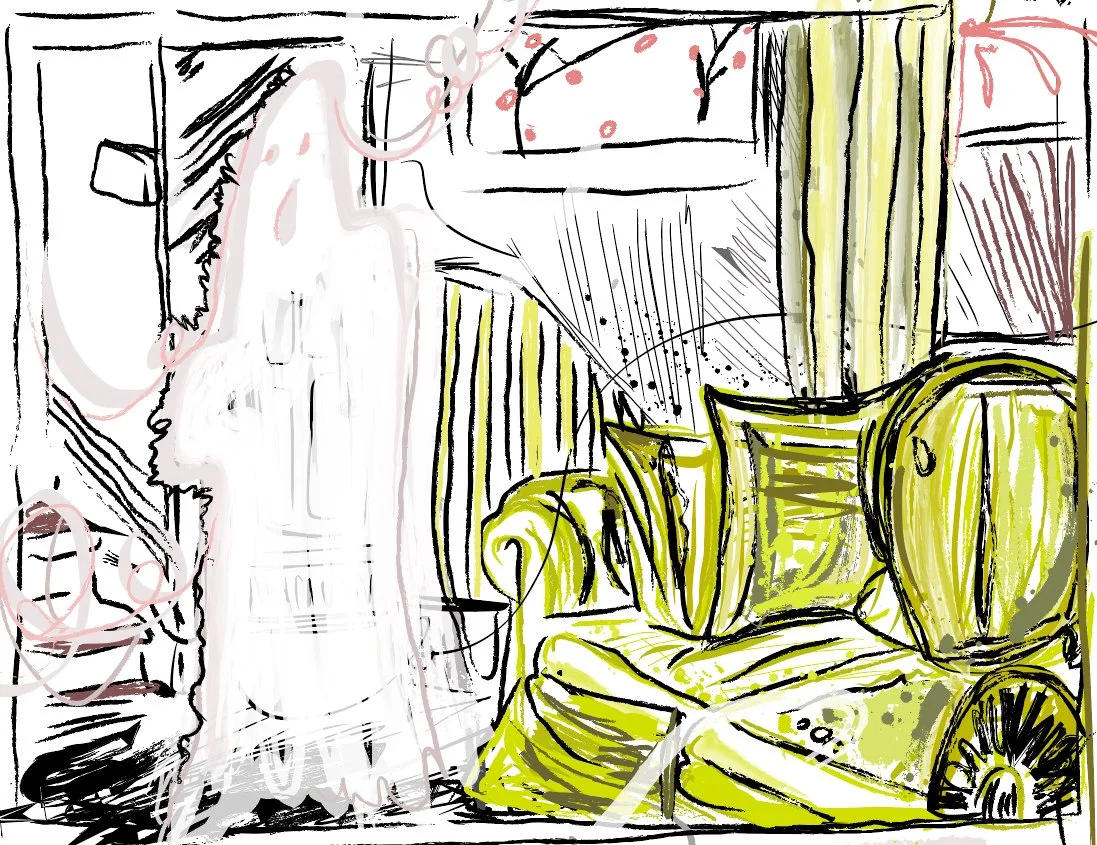
I find myself standing in a room, unsure of how I got here. It is a small room, perhaps a little over the size of an average college double, but it is stuffed to the brim with life. The wooden walls are old and faded, scuffed up from backpacks and bodies continually brushing against them. The carpet is soiled and dirty, its color muted by the hundreds of journeys that have gone over it. The couch is aging and weary, its dim yellow-green cushions oozing cotton stuffing with every person that sits down. The table in the center of the room is nearly overburdened, groaning under the weight of books and papers and projects and snacks and little board games. Around the table people are talking with excitement.

On the walls are posters of twenty different things — an anime, a movie, an album cover — all of which someone references at least once. There is a wooden cabinet, its doors partly hanging from their hinges, containing a motherload of VHS tapes. Some look official, many otherwise. On top of the cabinet is a wide flatscreen TV, a VHS player hooked up to it. Cascading from the back of the TV is a litany of cables. Next to the player is a stack of comics I have never heard of before. I go over and pick one up. I am immediately intrigued.

“Hey,” someone says suddenly, their voice ringing out loud and clear, “why don’t you come and join us?”

I turn around. I see you sitting at the table, waving me over. Everyone else follows your eyes. Some of them focus on a spot behind me, confusion characterizing their faces. But some of them . . . some of them don’t. I catch each of their gazes; there are minute facial responses. You keep waving. I set the comic down and come over.

* * *

The room became our place to hang out, to talk, but now you rarely appear. I wish I knew why. Sometimes, I see hints of your presence: a pizza box, a new book, the VHS stash in disarray. Sometimes, I see you here. But most of the time, I am alone in the room. When you do appear, I partly feel like I am talking to a void that is unable, and unwilling, to reply. You seem not to hear me. You seem not to see me.

I can’t have that thought. I mustn’t. Today I returned to the room, hoping to see you.

I do not.

“Hello?” I call out. “Is anyone there?” The room is dark and silent. “Hello? Please?” I am floating here, in this space, waiting. I look around. There’s a book from last year laying on the table. A movie I’ve never heard of is sitting in the VHS player. I pace, look out the windows. There is no one. Just the wind blowing stronger. It presses against the walls, threatening to break in. I shake my head. I need to distract myself. I start the movie and throw myself across the degrading couch, wait until someone comes.

It has been three and a half hours now since the movie ended. I have watched all the behind the scenes, all the director’s commentary, all the special features. Where are you? I look outside again. It is dark. The moon is covered by the clouds. Tiredness washes over me like a wave. I glance back at the couch. There’s no harm in sleeping here. I’ve done it before. I stretch out, and have a fitful sleep.

When I wake up you are here, with someone else, speaking. I bolt upright, my eyes squinting at the sunlight peeking through the blinds. I focus on your lips.

“-ody Problem, Dune, and Foundation. I really enjoyed them.”

You hold up a book. I walk over to you and look at the cover. As I approach I notice a slight twitch in your body. I can’t pin the cause of it.

The cover is blue with electric green text. Not among my favorite color combinations, but it’s certainly intriguing. There are massive, dark-blue orbs in the background, hovering over an equally dark-blue landscape. You set it down and continue talking. I pick it up and flip it over. Read the description.

“Looks interesting,” I say after a minute, “you mind if I borrow this?”

Your focus turns toward me. “Of course,” you respond. My mouth drops open. I nearly believed that you had forgotten me, that you considered our interactions a mere fiction of the mind created for some unknown reason. I find my insides twist as you stare at me, solidifying under your reassuring gaze.

Suddenly, your expression shifts. You look at your phone. “Shoot, sorry guys,” you say, “I have to go.” Then you get up and walk out the door. The words developing in my throat die.

I turn to the other person here, hoping I might be able to talk with them, but they also look at their phone. “I need to go too,” they mumble. I can’t tell if they’re speaking to me or themselves. Then they are also gone.

My mind begins to race. Where are you going why do you leave me will I see you again why can’t anyone see me?! The voices in my head are screaming, shrieking, overanalyzing every second of the past few minutes. My form flickers. I drop the book.

I hear it collide with the table, its pages rustling as it bounces. In a moment, it stills, and the room falls silent. A realization bursts into being: I am alone.

I curl up on the floor, tears soaking the carpet. Outside the wind becomes a tempest. The walls start folding in, creaking with every gust. The door and windows rattle in their frames. I look around the room again. There is no hint that you were here, except for that book lying on the table. I try to take deep heavy breaths, but I find myself struggling. If I can’t talk to you, then what’s the point of this room? My body shakes with rage, fear, grief. Tiredness. I look at the door. Why not?

With some effort, I push myself to my feet and stumble over to the door. My hand grasps the handle. Before I can reconsider, I turn it.

The wind takes advantage. It rushes in, bashing apart my face with the door. It rages against everything in the room, ripping apart the comics and decimating the furniture. I realize I am disintegrating faster than I ever have before. Before I know it my body is dashed across the walls, the cushions, the VHS tapes. The wind doesn’t seem to like that I am touching these things. It howls, and the whole room collapses, blown away like dust.

* * *

I am hovering over a chair, my legs crushed between it and the bottom of a table. I suck my stomach in so that my torso doesn’t feel equally crushed. In front of me is a wet meal sitting on a paper plate, the liquid slowly soaking through to the varnish of the table. I am holding a knife and fork flimsily in my fingers. I don’t need to eat anymore, but the action makes me feel alive again, if only for a moment.

I cut off a chunk of food and stick it in my mouth. I begin to chew.

I look at the juices seeping into the paper, slipping away, and think back on the past week, month, year. I can barely recall anything. There’s just a large blank space in my life. An emptiness. I look back on today. What did I even do this morning? An hour ago? The images are already fuzzy.

The piece of food nearly falls through my mouth. I catch it with my jaw, then push it back into position with my fork. It’s so hard to be corporeal, when your mind is telling you you’re not.

I try to focus on here, now, but my mind is already running, losing itself. I feel the wind start to pick up again, to pull at me. I wish there was a way to escape it, avoid it, but it seems no matter what I do, it always finds me again.

My form is disintegrating now, battered away like snow. I clutch my head, as if that will give me the strength to hold myself together. I don’t want to be like this anymore. I don’t want to be a ghost. Tears flood down my cheeks; not a single one reaches the ground.

“Hey,” a voice says, and the wind stills. It takes me a moment. That voice . . . sounds familiar. I turn my head. There you are, standing with your own wet meal soaking through a paper plate. You are looking at me, bags below your eyes, but mouth curving upwards.

“Hey,” I reply, my voice quiet and broken. My body is only partially present. The skin and muscles of half of my face are gone, revealing a translucent jaw and partial tongue. My chest is open, heart removed, though the blood vessels pulse as if it still remains. The entirety of my gut and lower spine are missing, my stomach dripping out from its cavity. My right arm fades into nothing just above the elbow. My whole left arm is non-existent except for the hand, which is grasping the fork with both fleshed and flesh-less fingers. Of my legs, only the left foot, right knee, and left portion of the pelvis remain. A single tendon floats where my right foot should be.

“You mind if I sit here?” you ask.

“Go ahead,” I say, and straighten what little of my back remains. “How are you?” I’m surprised I am still able to speak.

“I’m doing fine,” you respond, “a bit tired though. I have a lot going on.”

I nod thoughtfully. I know how you feel, though it’s a bit different for me.

“How are you?” you ask.

I pause my nodding. How am I feeling? Good? No. Tired? Yes, but not in the way others feel tired. Bad? I look at you, see you staring at me, waiting attentively. You are seeing me. I haven’t felt seen in a while.

I don’t feel bad.

“Fine,” I answer. “I’m having trouble focusing right now, you know?”

You smile wryly. “Oh yeah, I know.” We sit in silence for a minute, unsure of where to go next. You start to eat. Slowly, I re-gather myself.

“What do you have going on right now?” I ask.

You snort. “Where should I begin?”

You start talking, and I listen. I am enraptured. After a while, you ask me a question. I start talking and you listen. Before I know it we are deep in a conversation, and I am no longer floating above the chair. I am sitting on it, feeling the seat press against my thighs. I realize that I am no longer sucking in my stomach. I have let it out, and instead of passing through the edge of the table, the edge of the table is actually jabbing into it. In my hand, I hold the fork firmly.

Slowly, our conversation comes to a close. You glance at your phone. “Sorry, I have to go, but it was nice catching up. See you around?”

“Yeah, see you around,” I answer. You disappear. I lean back in my chair, a warmth moving through me. That was… nice. Invigorating. In a way I haven’t felt in a long time. At the edges of my senses, I feel the breeze again, though it’s not as powerful as it was.

I look down at my form. It still looks ghostly, ethereal. I can see the outline of my chest, my arms, my legs. I can see where I am, and where I am not, but I can also see the wood of the chair underneath me. The yellow grains flow forwards, cascading from the back of the chair over the edge of the seat in a gentle, rolling river. If I was corporeal, I shouldn’t be able to see this stream, these remnants of a life once lived. I am not a solid creature. Yet, in this moment, it doesn’t feel that way. I smile.
The War of [The War of the Worlds] Worlds

Article by DJ Nguyen Art by Sana Bhakoo

I

It’s just a novel. The War of the Worlds, I mean. When talking about stories, it’s easy to reduce things down into small, pointless fantasies. It’s all fiction. Games of imagination. Ink blots on a page that silly humans get invested in for no reason. So why do we care? Why do we care that, in 1898, a 32-year-old English socialist by the name of Herbert George (or H.G.) Wells wrote a book called “The War of the Worlds?” Why do I care enough to write about it?

Well, other than my own interest in the histories of genres (don’t get me started on murder mysteries), The War of the Worlds by H.G. Wells is actually quite important. This is a story that created a new monster which culture would hang onto for centuries to come. In fiction, the “monster” is a really particular cultural object. It always means something. That’s why monsters stick in our heads between authors and eras. Zombie apocalypses experiment with human desperation on a societal level. Vampires lurk in the dark, and in doing so ask what the dark means. For Wells, it was space aliens. Through them, he reckoned with inhumanness, and all the fear and philosophy that comes with it — how we feel small, unfamiliar, and afraid when removed from our overwhelmingly comprehensible bubble. 

To history-savvy readers who might protest that aliens as a fictional concept had been around long before Wells: you’re right. But his aliens were different beasts altogether. I mean that literally; he created (or at least popularized) a blueprint for thematically representing other worlds that still resonates today. So much so that the plot itself almost seems cliché in hindsight. It’s not hard to describe: one day, a strange asteroid fell to Earth. From within emerged octopus-like creatures from Mars with technology far surpassing ours. At first, humans attempted diplomacy in the form of a white flag. It didn’t pan out. By the end of the book, the Martians are thoroughly desolating the world, abducting humans, feeding on blood, vaporizing with lasers, piloting mechanical tentacles, and other classic alien stuff. Then, a stroke of luck — the Martians have never before encountered Earthly pathogens. And though sickness is entirely familiar to us, it utterly devastates our foes — it doesn’t take very long for the intruders to all fall dead. The world then has a chance to rebuild, but this time under the knowledge that there are things far greater and less kind than us out there in the universe.

I still haven’t really answered the question, why should we care about stories? I gave a half-answer, that Wells’s monsters would go on to make a massive mark in human history, a whole genre of perspective on life outside our bubble. The War of the Worlds was, among other things, a criticism of imperialism — the careless and violent ways us humans have torn each other from our homes, the inhuman otherness in how we have cannibalized each other. And as they’ve traversed our libraries, aliens have continued to be tools for questioning cultural norms. But that doesn’t really make this any more comprehensible. I suppose I don’t really have a complete answer. How about this: I think we all need to care about monsters. What they mean, why they frighten us, and why we are compelled to see monsters where they are absent. They help us contextualize our own fear, our weaknesses and morals, and make us reconsider their place in the real world. As stories of aliens have evolved, so have their thematic strengths. These invaders would keep making us reckon with being human. In a sense, we are the aliens — almost feels trite, doesn’t it? That’s kind of where all monster analysis ends up.

Monsters follow us. They lurk under our beds, stalk us in the darkness that dances along street corners when we’re walking alone at night, and pounce with lethal vengeance despite the fact that we made them up. We are scared of our own shadows.

II

I wonder if seeing monsters is innate to being human. Maybe we are so often afraid of our surroundings that in order to take some agency over them, we grab our fears and sculpt them like clay. 

October 30th, 1938. World War 2 was just bubbling to the surface, a stressful period for everyone. In such times, analyzing entertainment is important. What is the general public interested in? What are they thinking about? And — maybe you saw this coming — what are they afraid of? CBS’s radio play anthology The Mercury Theater on the Air, run by Orson Welles, had no intention of answering the latter question as thoroughly as they were about to. If you know Welles (Orson Welles, not to be confused with H.G. Wells [mind the second ‘e’]), it's probably because of his and his team’s radio adaptation of The War of the Worlds

For a radio play, you have to do some interpretation to get the original emotions of the text across in audio. Welles and his team approached this grandly: after some narration introducing the production, the broadcast was seemingly replaced with an orchestral performance, and some nice music played for a while. And then,


LADIES AND GENTLEMEN, WE INTERRUPT OUR PROGRAM OF DANCE MUSIC TO BRING YOU A SPECIAL BULLETIN FROM THE INTERCONTINENTAL RADIO NEWS. AT TWENTY MINUTES BEFORE EIGHT, CENTRAL TIME, PROFESSOR FARRELL [...] REPORTS OBSERVING SEVERAL EXPLOSIONS OF INCANDESCENT GAS, OCCURRING AT REGULAR INTERVALS ON THE PLANET MARS.


After this, the music returned, before being periodically halted again and again by breaking news reports gradually detailing the events of an alien invasion. These reports were written to feel real — like how the characters in the story would have heard them, helplessly receiving slow updates that the world was ending and there was nothing they could do. It’s understandable that this struck a chord with listeners — hearing World War 2 develop over the radio must have sparked a very specific type of dread, one which Welles and his team had distilled into this apocalyptic tale. That feeling hasn’t changed much in the present, has it? 

But there was a problem: imagine tuning into the radio and hearing a breaking news bulletin. It’s a politically tense time — you’re used to hearing these. You’re used to these interruptions bringing bad news. And when the official-sounding newscaster reports a strange presence in the sky, well… is it really so far-fetched that you might panic? 

You wouldn’t have been alone. Millions were tuned in, and a significant portion missed the clearly fictional narration at the beginning. It’s just a story, remember? Nothing about a story inherently matters. And yet, as the New York Times reported,


RADIO LISTENERS IN PANIC, TAKING WAR DRAMA AS FACT

Telephone lines were tied up with calls from listeners or persons who had heard of the broadcasts. Many sought first to verify the reports. But large numbers, obviously in a state of terror, asked how they could follow the broadcast’s advice and flee from the city, whether they would be safer in the “gas raid” in the cellar or on the roof, how they could safeguard their children, and many of the questions which had been worrying residents of London and Paris during the tense days before the Munich agreement.


So for a short time, America was thrust into a historic mass hysteria event. It was a nation buckling under years of collective stress, to the extent that the New York police department had to issue a public statement urging people to calm down — civilians reported seeing smoke, hearing voices, attempting to evacuate, and the streets were flooded with chaos. There were even several reports of people being physically injured, desperate urgency impairing their decision-making. The gossip and fear essentially caused a sort of psychosis, turning the nation’s monsters real. 

I’m not sure I could pick a better novel for this to have happened with. The War of the Worlds is already, without any of this crisis, an extremely important part of literary history. I don’t think H.G. Wells’s goal was to show how different his monsters were from us — like many alien stories, the compelling paradox resides in how much of ourselves we see in the unfamiliar. We shouldn’t relate to these frightening, apocalyptic beings — so why do we? Imperialism is a normal human activity, until it isn’t. That dissonance is what made them stick around. 

Space aliens are in fact much more plausible than zombies or vampires — they’re scientific, primed for reality, and that’s where a lot of their power comes from. Then, when Orson Welles and The Mercury Theater on the Air pulled this stunt, it’s like the monsters couldn’t help but pay our world a visit. 

After the broadcast was all over and everyone calmed down, the country was left with a stunning embarrassment. Much of it was taken out on Welles personally, but as it aged, the broadcast of The War of the Worlds became a cautionary tale about how susceptible we all are. That we sculpt monsters even on accident, and run ourselves in circles trying to avoid them. How silly; it was just a story, all along.

III

History-savvy readers: don’t worry, I know what’s going on here. You'll have to forgive my theatrics, I was trying to get a point across — besides, I did promise that each The War of the Worlds iteration would have an increasingly complicated relationship with truth. I’ll rectify it right now. Non-history-savvy readers: I have a confession to make.

This story which I have just told you in the previous section… Well, it’s a bit of an exaggeration. Which is to say, it was a lie. The parts about Orson Welles and The Mercury Theater on the Air were real — that was a genuine broadcast which adapted The War of the Worlds. They really did format things that way. And I do sincerely believe that this format of storytelling corresponded quite poignantly with the war-anxious America that it aired for. There were even a few people confirmed to have believed the events being narrated were real. But things begin to fall apart just around the moment I showed you that New York Times article. 

By 1938, the time of this story, the landscape of journalism was far from a united front (the more I learn about history, the more I’m inclined to believe that nothing has ever changed). Radio and print were at direct odds. Radio was far more accessible, fun, and novel. Because of this, radio was actively pulling readers away from the papers. There was a real rivalry between the two forms of media, so when The Mercury Theater on the Air’s disruptive formatting actually convinced a handful of people that Martians might be invading, the papers spotted an opportunity. Here was a panic caused by the inherent flaws in their opponent’s medium. This could be the warning that the nation needs: radio is unreliable, its newfangled messiness leaving the opportunity for misinformation and hysteria. Americans should stick to the tried-and-true reliability of a daily newspaper. The problem, of course, was that this so-called “panic” was rather small. If only they could just… turn the volume up a little bit.

So they did. That excerpt from earlier was real, it just wasn’t true. They inflated or downright fabricated reports of hysteria in order to portray the broadcast as some catastrophic national terror. Looking back at actual media surveys and first-hand accounts of the night, The War of the Worlds plainly did not have the impact it’s been mythologized to. It wasn’t just the New York Times — this was a widespread misinformation campaign across print journalism to discredit radio. It worked, on some level. While the radio certainly did not die at that moment, the rosy legend of Welles’s impact on the world has long persisted. If someone nowadays knows of the broadcast, they almost always recount tales of human imagination leaking monsters into the world.

I suppose that is what happened anyways. It was intentional — which feels worse — but rather than a night of panic, the papers created decades of myths, moralizations, and campfire stories that have seeped farther into our culture than was likely ever expected. The irony of it all is that this really was a story about how susceptible we are. The first time I heard about The War of the Worlds was in a mini documentary, which relayed this lie. I found it completely believable — stranger has happened in human history, after all. When I learned that it was false, I was weirdly disappointed. I wanted the fairy tale to be real. Maybe on some level, it affirmed a blurriness in reality that was comforting. In a way, that is how I experience the world — fictional frequencies pressing into nightmares. It felt nice to know that I wasn’t alone. 

As fabricated as the whole incident was, it did bring the monsters to life in a way. Not just because we believed them, but also because it portrayed them in a new light: radio. Radio was the monster. And even just like H.G. Wells wrote, the fight eventually died. Not completely, obviously, but the two mediums learned how to coexist. The invasion sorted itself out. And when the myth grew beyond its origin, it was still ultimately about monsters. I found something compelling and familiar in the idea that our imagined monsters were inescapable, and once again, I wasn’t alone. 

IV

I’ve had the idea to write this article for some time. It was going to be an unbiased, factual report of three layers of history — quite academic. Obviously, things didn’t turn out that way. When I actually sat down to write the thing, I couldn’t separate myself from the story. I don’t think there's anything wrong with that, but it does change things. It does mean that, as much as I’ve tried to give you the truth, it has been warped by my own ways of communicating and researching. I suppose that would have happened either way.

I can give an example. In avoiding distracting information, I left out the fact that H.G. Wells was a eugenicist. As progressive as many themes of his work were, he advocated for the shaping of the human gene pool via selective, “scientific” sterilization. Maybe to him, difference was its own sort of monster. Humans can’t help but tell stories, and stories can’t help but be false. 

In writing this, I have told a new story too, a new adaptation — just like Orson Welles did, and print journalism after him. Which means, in some sense, it is the same tale. I’m dealing with the same themes, the same monsters. It’s very abstract this fourth time around, but still here. As we traverse levels of existence, our demons remain on our shoulders. In a sense, they have to, because they are the same as us. That’s where all monster analysis ends.

Ultimately, a monster can’t be anything other than a story. That feels reductive at first, but I think it imbues them with a very real power. They are how we express ourselves (as Wells did), how we express the world around us (as Welles did), how we get what we want (as the papers did), and how we orient our own thinking (as I am doing, right now). Dark cannot exist without light, good cannot exist without evil, and reality cannot exist without fiction. Fantasy makes us real. That’s why we can’t stop making stuff up.

The Other Side

Article and Art by Maya Rosen

We pull into an empty church parking lot. It's Thursday at 9 am. We’re not sure it's the right place, but then we see the car in the parking lot, across the top, in a taxi-style advertisement, it reads: "Scientific Evidence for God?” Then a link: censoredevidence.org.


We’re definitely in the right place. I snap a picture. We want to pull out the big camera, but some instinct tells us not to. We’re running late — we only got the invite early this morning — and we’re all college students expecting to sleep in. We walk around the church pulling on any door; they're all locked. 


A hand snatches the blinds on a window near the front door. An angry old woman’s face appears in the window. We jump, and I half expect her to pull out a gun — you have to be careful around here.  She opens the door. 


“What are you doing here?” She’s snapping. It’s not a real inquiry, it's a get the hell out right now or bad things might happen. 


“We’re friends of Jerry,” I stammer.


“Oh!” She brightens. “Well, why didn’t you say so! Come on in!”


She leads us through a long hallway, and then we enter the small conference room. It’s starkly lit with overhead LEDs, and there's a ring of flimsy chairs in the center. There's nothing overtly church-like about this place. It feels more like an office building than a place of worship. I haven’t been in many churches, but I have learned to expect a certain kind of stained-glass to crucifix ratio. I don’t often find such long and winding passageways. The stained glass to crucifix ratio is 0-10, and in fact, along the whole way, there’s not a single window. At the end of the tunnel, fifteen or so pale, aging faces stare at us as we walk in. We’re not their usual crowd. 


A woman in a MAGA hat offers me a donut and asks me if I was sent by the Young Republicans. We try our best to give a vague answer. We settle upon repeating the phrases, “We’re here with Jerry,” and “We’re just here to learn.” That's enough for me to earn a second donut on my napkin and be introduced to the entire party. 


I quietly tell my partner to tuck his pants over his inconveniently-worn Hanukkah socks. Evangelicals love Jews: that's not quite what I’m worried about. Conspiracy theorists however, most of them at least, are not often the most trusting of Jews. Trust is important here. I’m sure to wish everyone who approaches me at the donut counter a Merry Christmas. 


Carefully, I ask the group leader if we can bring the camera in. He’s dressed in a Trump 2028 hat, a “Lets Go Brandon Shirt”, and he laughs in my face. His voice is gruff, condescending, 


“No, that wouldn’t be good. Most of this stuff, it… shouldn't get out.” Then he tells us to take a seat. 


We hesitantly sit on the outskirts of the circle of chairs. They add three more chairs, dispersed around the core group. We take our seats, separating from the safety of one another. I don’t think any of us would survive a horror movie. We are too curious to see where things will go. 


I’m very nervous to hear what exactly ‘shouldn’t get out’. We’ve been filming our source, and who they believe is our close personal friend, Jerry for the past few days. And he has said plenty of things straight to the camera that certainly ‘shouldn’t get out.’ I try not to think about everything our professor told us about blindly walking into a camera-off meeting.


We’re working on a documentary project for class. We have one week to film it, and so far we only have five hours of Jerry recounting studies on “gender-confused” rats, the truth about Anthony Fauci, and reciting website links by memory. 


I debate audio recording them on my phone anyway. But I figure that for a population that is concerned with foreign spies, it probably isn’t the best idea. 


They open the meeting with a prayer for Charlie Kirk and the pledge of allegiance. Only they forgot their flag, and their second flag. They all chuckle and point to the large american flag on the group leader’s Lets Go Brandon shirt. Then the room goes quiet. It's a circle, they can all hear me and see me. I put my hand on my heart. I don’t feel like elaborating. The things we do to find a story. 


Then the group leader gets up behind the church podium. The first thing he says is he would walk across 20 miles of glass to vote for Donald Trump again. They all cheer.


It was an eerie feeling entering that room. It’s like a portal of sorts. Somewhere in that long hallway, or on the way to the donut counter, I think I crossed over. Maybe the circle of plastic chairs had enough gravitational force to suck us in. We only came hoping to observe, now we are falling deep into the circle.


They ask me if I have seen foreign spies on my college campus. I can feel the portal pulse when the room gets so silent. 


The thing about documentaries is you're not supposed to interfere. My project partner tells me in his intro to psych class he learned that they're all at an age where they can’t think critically anymore. Maybe there is no use in trying to pull them back. I am not a part of this. I’m not supposed to be here. 


I sit a woman down in a church. I turn the camera on and for two hours I listen to her emphatic warnings about the end of the world. She tells me how her friend died of Turbo Cancer. She was killed 10 days after getting the Covid Vaccine. 


We are separated by dimensions. Each in our own universe threaded together from fibers of blabbering podcasts, and family networks, and a lifetime of sticking to your guns. There are stars in between us, there are galaxies, we are lightyears apart, and she lives deep down a hole I'd claw my way out with my fingernails. But I’ve made a tiny pinhole across the void, and across it, I think I hear myself say, “I’m sorry for your loss.”


She gives us a magazine to read. Its title is “Covid Vaccine Carnage.” She says she has to do things like this, educating people, so she can go to heaven and meet her dad again. She walks us through it page by page. 


It reminds me of my mom reading books to me as a kid. Feeding it to me line by line. Those are the things that shaped my universe. 


She’s around my mom’s age. They both shop at Whole Foods. My mom does it because she doesn’t trust GMOs; she does it because Joe Biden is poisoning the food. 


My mom always texts me about how scared she is, about what the world has come to. They are both so scared, reading labels and checking the news. I wonder about the black stuff separating the universes like in all those photos of space that make me uncomfortable to look at. I wonder if for all of us, the void is made of the same dark stuff. Every gap in the stars is a different nightmare. 


I fled the portal when the week ended. I let it zipper shut when I walked out of the churches and never looked back. At first, those places were an interview backdrop, and then they enveloped me. It wasn’t hard for me to leave the void. I was only a visitor. Observing all the wreck, the floating pale faces, the news clippings about the high school football player who dropped dead after he was forced to get vaccinated, magazines, glowing tv screens, facebook groups, a bible. 


The “Lets Go Brandon Shirt” I pledged my allegiance to floats past. I see the Bald Eagle on the back of it as I pass by. His talons are gripping a free-flying American flag, he stares me down as I go back towards where I came from. He knows my pledge was full of shit. 


It’s been a week-long journey floating back to this portal-gate. When I finally reach it, before I cross back I notice a line of red string at my ankle. It’s connecting me to all of it. Knitting together the fabric of their universe. I loosen it from my ankle, and leave the red string floating unconnecting, against the black.


I feel sorry that to all of them, in my absence, I will be another loose end. 


Alt ending: I sealed every leaking pinhole and felt grateful for my firm grasp on everything I believed to be true. I let the galaxies drift apart, and wonder why spending so long in the void didn’t make my stars feel brighter. All of it was still crooked and cold and fucked up. 

Na-i-nefer, Come Laugh with Me.

Article and Art by William Compton

I’m sixteen with the type of backache only a museum can give you. I’m in the black-painted Egyptian gallery. The most crowded display horribly bores me. Some stale, new discovery. I need to stare into the old mummy’s cloth face. It calls to me in an unknown language. Art belongs here, but apparently so does this dead body. I usually can’t stand to look. Today, I have to stare, all alone, into its dead face.

I vividly remember a relaxed clearing of my mind right before an evil shudder runs from the crown of my skull through the joints of my toes. Not quite like walking into a cold patch in a graveyard. More like if the cold patch walked into you. I stumble away from the mummy as my body turns icy cold, grabbing my family’s hands to pull them away, dropping them to pull on my coat. I suddenly feel faint and burning hot. But I can’t get my coat off before the foreign shivering washes back over me. I’ve never felt this way before. My parents know me to feverishly beg to go to school and to play practice after. They look truly worried when I plead to leave the museum right then, leaving the Van Gogh unseen. But they take me to the car, dragging me as my vision tunnels. The less I see, the more I hear. A groaning in my head focuses into words. Ancient words spoken by a gasping voice, crackling with disuse. My body fights a parasite stronger than any flu until we pass over the threshold of the museum. 

Right then, the feeling disappears. Not when I rest and not when I eat. Not when I metabolize a pill. Stories of possession and ancient curses come flooding to my mind: the spirit attacking me can’t leave the museum where it lies. And I’ve never felt that way again: neither the mummy’s call, nor the ghostly flush, nor my body’s fighting answer. I was evidence-minded then, but the mummy made me a kooky spiritualist that day in the museum when it tried to possess me. My love for my life makes remembering the mummy terrifying. I wonder if it almost stole my body from me. If we almost switched, locking me behind bandages and wraps, freeing an eldritch evil onto the world.

Maybe it did take my body. Maybe I left myself behind in that black-painted Egyptian gallery. The soul that my mother gave me abandoned, made spiteful, searching for a new vessel how the mummy searched for me. Are any of us our own original soul? Isn’t it convenient to think that we start and end as the very same person? But the mummy didn’t. A man isn’t himself once he’s made a mummy, entombed behind glass.


I look up the mummy as I write my piece. The sight of its cocooned death brings green tea back to the top of my throat. Brings an old sickness temporarily to me. I wonder if it can finish its job through the screen. I wonder if it already found another young man to become.

But I find that his name is Ka-i-nefer. And they computer-reconstructed his face. He has smile lines and a downward canthal tilt. Our noses are surprisingly similar. And he really is just a man. A man that lived and loved. It’s not his fault that they put his body behind glass. That they unearthed him in the first place. 

It’s just sad when you remember each mummy was once man. When he’s a man instead of a mummy, I can’t blame him or hate him or fear him. I find myself feeling love for him.

I don’t know this man, but maybe he’d like to know me.

It’s strange but logical: I’m less afraid that he did possess me than that he didn’t. If he’s not in me, maybe he was really trying to steal me. Or worse: maybe he’s still stuck there behind glass. And if he’s in me, he must be content to live my life and write my stories. I’m so much better than I was at sixteen. If he’s with me, then he made me better. If he made me better, I’m happy to have him stay.


This is the life we lead, but is it ours? It seems impossible that the same soul could nestle in my mother's arms and wrestle with my crush on wrinkled sheets. The indomitable human soul is the breath that resonates over bottle necks. When I sing, it’s really my Grampa’s voice. Maybe we’re a thousand different people, from one challenge to the next. A swirl of souls. 

Maybe we’re all possessed by someone or another. And maybe possessed is not replaced, maybe it’s assisted. Maybe it’s accompanied.

Maybe Ka-i-nefer just wanted to join me. To swirl around as the second soul inside me.

Come along with me to burn easily in the hot sun! 

To relish burnt, cold showers. To shiver from the burn on my skin. 

Come along for the end of the world! 

We inoculated her with this disease already. We’ll see what we learn. 

To sing country lullabies with my Papa and rap Cardi with my friends. 

To drive with the windows down on a summer night.

Na-i-nefer, please leave your glass cage behind.

To swim in the river and smoke in the trees.

Na-i-nefer, come laugh with me.

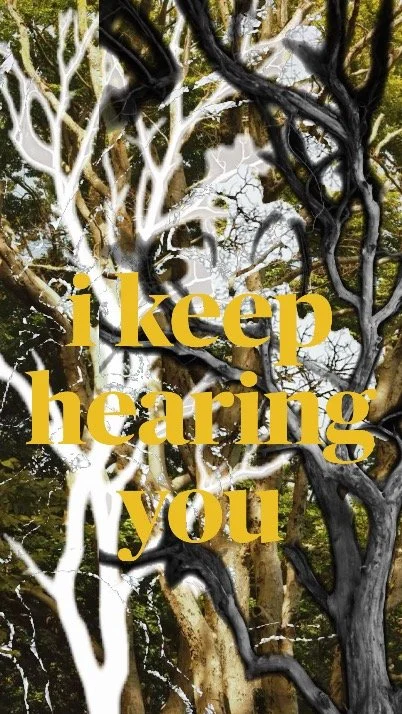
i keep hearing you

Article and Art by Bella Houck

swamp cooler stickiness;

loud thunderstorms in july;

the song of cicadas in spring;


can i ask you a question?


humming to myself in my room; 

swelled doors, forcing them shut; 

the pattering silence of snowfall; 


how many years until the sickly sap from our family tree trickles down my throat?


wind rustling through barren branches; 

hands rubbing together after being washed; 

swallowing a sob; 


i think i want to know how you felt right before you did it.

was it relief? 

fear? 

guilt? 

regret? 

nothing? 

what did you think of right before? 

what was the last thing you ate? 

why did you put on those pants? 

that shirt. 

your watch. 

i peel back the wallpaper to find my bones holding up the house.


my mother singing gently, not very often; 

garbage disposal growl; 

an old landline ringing,

the incessant dial tone; 


did god deal me the same hand as you? 

can i peek? 


bus coming to a stop, a long exhale; 

listening to conversations from the staircase;

the slow steady pulse of water pulling through the pipes as someone showers;


i’m trying to find the balance of good and bad in the world. 

of happiness and despair in mine.

when did you realize one outweighed the other? 

that there was nothing keeping you here. 

that family parties and grandchildren growing up and picking lemons and taking photos and hugging your son and kissing your wife weren’t enough. 


i taste the syrup–

i dry heave. 


ear on the kitchen table, fingers drumming against the hollow wood; 

whirring mechanical pencil sharpener;

buckles and zippers hitting metal chair legs; 


i remember peering into the bedroom and seeing dad lie in bed, his back facing me.

the light was still on. 

mom gently ushered me out.


silent sobs in the closet, don’t wake anyone up; 

christmas morning quiet; 

putting dishes away in the dishwasher, clinking porcelain; 


i care so much. i care so much that i often think i don’t care at all. 

that really terrifies me.


talking to adults, trying to feel older than I was; 

forks on plates after spaghetti dinner; 

the crinkle of sparkling water in a glass; 


i think you’d be proud of me. 

i don’t know. 

you always felt mystic to me. 

rough and calloused hands. 

square glasses and those hats my dad wears now. 

i look in the mirror, wondering how much of your face is in mine. 

our “houck” eyes squint as I look into the sun. 

our hair against my ears. 

our sleepiness after eating carbs. 

our laugh. 

our dimples.


clicking heels on hardwood;

swoosh of fabric against your leg; 

carpet static;


i don’t want to say it out loud because it evokes a certain kind of response from people. 

i’ve been so detached for so long that their pity and sadness don’t really belong to me. 

i guess they belong to you, but you’re not here anymore.

you haven’t been here for a long time. 


the silence after a final note, right before the applause begins; 

crushing a can once you’ve emptied it; 

green grass shuffling through your fingers;

an airplane taking off for the first time. 

The Thing that Catches Flies

Article by Dana Trummert Art by Riley Diehl

Sitting in the sticky trap, sinking snap, sickening sap. With bugs and ghosts, I live here. Things that laugh and things that cry. Rocks that are shaped perfectly for hitting someone. Sticks born with points and handles. Neglected natures cursed into the shape of weapons. The sticks and rocks cry because they cannot reform into kinder shapes. I cannot comfort them, myself an unkind shape, and liable to be sliced and bruised by their own unintended edges. Instead I play with the pine needles, press them into my skin, use them as pens, raise red lines over my expanse of flesh, drawing a picture in the irritation of the epidermal layer. I mostly draw long lines, which wind and wrap around my joints. It is good to be reminded that it all connects, that it is all one thing. Sometimes, pine-needle lines are all that bind me to myself. The sticky trap I live in has a way of pulling at the edges, negotiating between myself and the negation of my home. But I don’t think I will ever leave, not totally. It has a way of, you know, sticking. 


They say a good sailor doesn’t get wet above the waist when they capsize. The boat tips over and the good sailor scrambles around it like a hamster on a wheel. They find the light. They find the bottom of the boat, and the daggerboard sticking out from it, and they don’t even get wet. Then the boat starts to tip, and tip some more, and then they have to scramble back on top of it, and keep going, because the wind doesn’t just stop because the boat tipped over. I fell down a well once and my whole body got wet. Thankfully, the well was dry enough that I could stand in the water, but still. The water was nasty, worms and maggots and all kinds of things that crawl on you, disappearing when you turn on your flashlight. Bugs of the dark. That’s where I found the sticky trap. And instead of scrambling towards the light like a good sailor, I moved laterally through a tunnel at the bottom of the well, and that's where the sticky trap got me. It was too dark to see, so I ran into it head first. They say I spent about six months with my face stuck to the sticky side, but after much wiggling, I twisted around so it was sticking to my back instead. I used to struggle against it. I thought I could catch it by surprise. That if I just acted like I wasn’t ensnared, I could walk right out. The bugs laughed at me. They drank vodka and told me I couldn’t do it. I resented them, and blamed their suffering on their pessimism. But now I understand. And I don’t mind it so much, being down here in the sticky trap. 


Sometimes I think that my dreams are prophetic, which would make me a little bit psychic, but most of the time I think that's dumb. Instead, I say that overactive imagination and pervasive anxiety have converged to create acute pattern recognition, which, when combined with frequent and vivid dreams, results in a statistically improbable concurrence of dream happenings occurring in real life, down to the minute details of conversation and even weather. Once I got stuck in the sticky trap, it only got worse. Because there is a membrane between the world and the sticky trap, all things both are and are not, meaning that my dreams may have prophetic significance both in their occurrence in real life and in their failure to occur. Everything that happens also happens in the inverse, because truth in the sticky trap is subjective, and ultimately illusory. Don’t worry if it doesn’t make sense, just understand that it makes sleeping — well, more accurately, waking up — a frightful occurrence, as I must relate from subconscious to conscious the events of the night, judge the likelihood of their occurrence while waking, and approximate correct countermeasures. 


So, I wake up sweaty. Coughing surrounds me. Someone, not me, is hacking a nasty open-mouth cough. Not quite developing to a retch, but not far. The thin bottom sheet disobeyed its contract, and it is crumpled near the foot of the bed. This is not unusual, as I writhe in my sleep, trying in vain to remove phantom sticky traps that attach themselves to my limbs and numb them. I lay on the bare mattress, feeling my sweat absorb into the navy blue plastic fabric of it. It is not mine, it has known bodies before me, and imprints those bodies onto mine. I am nothing but a speck in the cosmic mattress. A mattress that carries the shape of their bodies and leaves mine aching in the lower back. I push on the exposed blue plastic of it and sebaceous filaments ooze out, oil deposits from within rendered up with a ‘pop’. Someone who slept on their stomach, whose pillow often fell off the bed. Someone who always woke up with their pillow over their head, instead of under. Someone who never bothered getting a pillow. Their dried pools of drool crust up the top half of the mattress, clusters of crystalline tetrahedrons that crunch under my weight. The oil liquifies the crystalized saliva, turning the hazy sweat an aubergine purple, with swirling misamia of the lightest yellow. I taste it, then let the bloodhound get a taste (smell first, then tentative lick). She tells me they all dreamed of acorns when it rained. They don’t even know what wells are. I give her a piece of raw bacon, and she goes back to her studio to put it in the air fryer. I am barely awake and already the air is the texture of a cat tongue, digging its barbed hooks into my skin and rasping away my freckles.


My day thus and forever in perpetuity started, I leave the house that never felt like one, striking out for idle (idyll) water. I meet a grizzled fisherman, or postman, or any woman really. It smokes a pipe and is grizzly. Haggard. World weary. The kind of person-thing that tells you the bad news with no side of marmalade toast. So leave it to Beaver that my fate is clear. I stand still, warring briefly between taking flight and buying booze. The person-thing offers me a drag. “No thanks, I don’t smoke,” I say. It’s true. Addictive personality. Some things can’t be left to chance. “Oh- wow. Yeah, honestly you shouldn’t start. This stuff will kill you.” The proffered pipe is withdrawn, it seems to wilt after rejection, slumping over like a month-old carrot finally giving up the ghost. So we sit there, It with its mournful pipe and me with my mouth still oily from the past. 


I think it’s funny how It offered me something, then told me how it would kill me. But I don’t say anything, because you aren’t supposed to say “I think it’s funny how you tried to kill me just then” in polite social culture. Not that It is concerned with social culture, but I am. Even there, in presence of the all knowing all being Divine Grizzle, I must maintain the forms. Short forms. Short form pleasantries. Vertical format. Beautiful Day. Yes, really. Gosh, and after the week we’ve had… 


The sun sets as the day begins, and I watch the light brighten and warm the grizzled person-thing’s face. It steams a little as the sunlight evaporates a layer of dampness from Its skin. It doesn’t speak, and I am so intent on being good as to forgo the concept of language entirely. Also, the steam rising from Its beard is curling and twisting in on itself in a hypnotic fashion. It nods at me, first in acknowledgement, head down, brows furrowed, then in affirmation, head up-down eyebrows flicking up. This spoken, It leaves. My eyes are glazed with rapture and I stumble forward, utterly oblivious to my surroundings. Purpose and knowledge are united in one, and I must process.


The burning bush, the laughing phantoms, and that whistling inside my ear all come into total clarity. 


I come to at a crosswalk. The same one I always cross. Everyday, the cars get a little closer. The road is expanding. Did you know that crosswalks were once totally white, not striped like they are now? The only reason they appear striped is that the roads expand, and the paint can’t expand with them, so fissures open up, like stretchmarks in the road. That is why everyday, standing next to the same crack in the cement that I stand next to everyday, the car that speeds by is a little closer than the day before. Each day the step I could take becomes more possible, approaching with certainty the day in which the choice is so infinitesimal that a careless driver could turn the wheel a millimeter as they scroll their Tiktok and eliminate my necessary burden of choice. Until then, the roads expand and my steps shrink and shrink. 


The creature didn’t tell me about the crosswalk stuff, I figured it out all on my own. It sort of just came to me one day. But don’t worry, I did the research and confirmed it. There is no misinformation in the sticky trap. Consequently, there is also no information. You might think that means there is nothing in the sticky trap, but as I said earlier, there are lots of things. Sticks, rocks, bugs, trash from storm drains, all the stomach bile from all the creatures of the world, detritus of no determinable origin, and me. You should see us get down on a Friday. 


Everything within the sticky trap gets filtered through this sort of membrane, meaning that light, sound, and sensation are all distorted from their original timbre. This means that the visible spectrum of light is different in the sticky trap. I see colors I cannot describe to anyone, and I hear sound on inaudible wavelengths. Regrettably, however, these advances to human science can never be communicated, nor verified by any means. All that is ‘true’ in the sticky trap must itself be understood as originating in its opposite form in reality. However, because the membrane outside the sticky trap is very fickle, sometimes outside senses slip in, unnoticed. So rather than knowing for certain that your experience is the opposite of what's actually happening, you have to find some way to rationalize your experience as it is sensed, and in the inverse of how you sense it. 


And worse, the sticky trap has a voice, but no mouth. So when it needs to tell you something, it excretes slime into the place where it grabbed you. And then that slime absorbs into your skin, and you just know what it wants you to do. Impulse-compulsions as unquestionable as Lego instructions, urgent and socially unrestricted. I disobey as often as I can, but it has a way of speaking to a part of your body beyond reason. In a puddle of this carnivore sticky trap crying and wiping the snot on my shirt. Bathing in mucus like a mudbath, absolving my own disobedience to the flesh which I own and which owns me. Compulsion convulsion, collusion collision, contamination contagion, and a greenly sick body resisting what its very skin demands. I do not always sleep well in the sticky trap, but when I do, I sleep deep.