Lettitor

Dear Reader,

We know midnights at home by the hum of the fridge. It’s one of the most important appliances in the house, after all. The fridge has a complicated problem to solve: everything expires, and we know that, but we’d like to be able to eat before that happens. The fridge has to figure out how to slow down time, to give us the space to live our lives before that which is organic decays into rot. And with its day-to-day importance, efficiency, and clever execution, one aspect of the fridge sticks out: the light. We all know how it feels to stare into that green bean glow. To some, a tool, to others, the epitome of melancholy. 

To the fridge, the light is entirely unnecessary. The fridge can do everything it needs to on its own; the light is for us. When the door is closed, our yogurt and beer stays in the dark. We are the ones that need to see. And as we look inside — a space we construct, yet have so little control over — the relationship is mutual. The fridge light watches us. It watches us dancing around the kitchen, our red-eyed hunger munching cold leftovers, us rationing the last of our birthday cake, before closing the door, still hungry. Even when we’d rather stay in the dark, the fridge light turns on us. Our hunger never goes unseen. Maybe that’s what makes a freezer kinder — its lightlessness grants us permission to keep forgetting our stores, only to find they’re freezer burnt when finally retrieved. 

Nothing happens in the fridge, that’s the whole point. Because of that, the fridge has to be a mirror to the stuff around it. So yes, this is an issue about the little light inside your refrigerator. It’s also, quite clearly, not.

Go ahead. Open it. This time, you might find something new. 

Catch it: it’s running,

Cipher

Dreams of January

Art and Article by William Compton

An essay in poems, fragments and dreams

In others articulating what I can’t manage to say

Writing down dreams is a frustrating practice, bagging something in ripping seams

But dreams tell truths that can’t exist in the day

And so I’ll write them

Teal pen and a burning coffee sip

Hoping: maybe I’ll find something hiding from pen and lip


A dream is a wish your heart makes

When you’re fast asleep

In dreams, you will lose your heartache

Whatever you wish for, you keep


Have faith in your dreams, and someday

Your rainbow will come smiling through

No matter how your heart is grieving

If you keep on believing

The dream that you wish will come true


  • “A Dream is a Wish Your Heart Makes,” Mack David, Al Hoffman, Jerry Livingston, Cinderella

January 16th: I found an ancient tome filled with a forgotten language. As I tried to decipher it, I was damaging it, as fragile as it was. I found it up in the mountains. I’m starting to realize that there’s an over and underworld to my dreams. I remember finding the entrance to the underworld, the gate in the lake beside the ski town. The underworld has forces and they try to keep me from the magic hiding in the overworld (the lake, the book in this dream, etc.) I only had moments with the tome before they were after me. I ended up hiding at my aunt’s house before having to run again. I kept having to skydive, mission-impossible style. I never deciphered the tome. The dream ended with me in a plane above Florence. I had to jump to escape, but I was too scared and felt too close to the buildings for my parachute. I don’t think I even had the tome anymore. And I never jumped.


What are the consequences of silence? If I wanted to give a real answer, I’d mark nothing on the page: answer unknown, no personal touch, not writing to read. To be silent is to leave yourself inside, claiming mundanity. The silent presence is unprepared for their exception, unwilling to assume room in the cosmos, more room than their skin and what’s between. In choosing silence, you begin fading. And you may stay there, forever faded.

Just come out already.

Just come out with it, baby.


We had good childhoods, but we hated being children.

January 10th: I remembered my dream over dinner. I dreamed that I was a little kid. It was first person, but I wasn’t myself. Unusual. I had an unexplainable, perfect recollection of my past life. The memories accessible as if they had been my own. Which made sense: the memories were my own, from my current life. From William Compton’s life. My future self remembering my present self and I wondered if it was real. Will I be that little kid? And will I remember myself?

In my next life, I look like myself, and my childhood home looks like itself.

Lifetimes away, will our country look like itself still?


Nothin’ really ends

For things to stay the same, they have to change again

Hello, my old friend

You change your name, but not the ways you play pretend

American Requiem

  • “American Requiem,” Beyoncé


I was hanging out with the river, becoming amazed by the many miles she’ll carry the leaves that fell into her. And with a plop, a leaf lands in front of me. And it gets caught in a looping eddy. And I watch it circle in place for twenty minutes.

January 20: It was the night we were performing Stars. Unlike an average performance dream, nothing seemed to be going horribly wrong. Behind the performance, we were hiding animals, trying to keep them safe from the forces of the underworld. There was a giraffe I had a special connection to. After the performance, we smuggled the animals back to our house, where we continued to hide them. Me and Kennedy worked together to keep them safe. Mostly, we cuddled with them on the couch.


Otters don’t know they’re hydrodynamic, they feel the push of their kicks, the pull of their paws. The otter still swims in enclosure. They learn how to use the slide. They chase the fish in the glass-walled pool. Gramma makes sure we see the otters. And we frown when they’re inside.


January 6th: I was back in the fluorescently lit facility, once again rehearsing for a play. In this dream, the play didn’t really exist. There was way more I can’t seem to remember. An important mission. Before I fell asleep, I wondered if I was going back to the facility. I don’t like it there, but I want to go back and remember my mission. 

It’s not a dream without a dull, aching fear

Goblins, monsters hiding behind unlocked doors.

It’s not a dream without magic.

The goblins want the magic back.

When I learn the secrets of the lake, it disappears again.


January 8th: I was on a huge lawn at something like a BBQ. A lot of friends and kids. I would sneak off to smoke. The event seemed to go on for days. But lurking somewhere not too far was a fortress of villains, like videogame goblins. I think I was back at the dream world’s version of Colorado College. I wonder if it’s connected to the facility somehow. Maybe the looming threat of goblin attack came from there.

When I started writing my dreams, I didn’t know that the nightly danger I faced was one threat, an underworld of monsters. I didn’t know that the magic I found—the meaning of water, the books of spells—was one unexplainable blessing, the only threat to the underworld.


January 27: I was staring into a glass of water, and it was at once all the water in the world. I realized something in that moment that might not exist outside of dreams. 


If I lose my heartache in dreams, I find it in the morning.

The goblins unmask, ICE agents and our evil president.

And the magic to best them, the meaning of water, and the language of creation turn into swirling colors.


January 26: I was at Gramma and Grampa’s house, and everyone was together and Gramma was alive. She was smoking on the patio. And I could fly, which wasn’t strange at all in the dream. I remember the feeling of weightlessness and gliding in the wind. People would ask me how I did it and I would tell them it was faith, surrendering to the wind. The one time I tried to teach someone, I fell flat on my face.


I wonder if the dream magic exists in our modern day

I wonder if I’ll find it

I wonder if I’ll fall asleep and siege the evil underworld

I wonder if I’ll wake up and remember how to fly


If you surrender to the air, you can ride it.


  • Song of Solomon, Toni Morrison

Love is the Scent of Her Freezer

Article by Sophia Murphy Art by Joy Chen

I'm taking the mac and cheese out of the colander and fixing it into my bowl as I get my drink and silverware ready. I am laughing and excited in anticipation of the movie we’re ready to watch. He walks over and sits down before me. I go into the freezer to grab something and the blast of cool air paralyzes me for a moment. A feeling comes back to me — one I’d known years before. Waiting for me is a bowl of junk food and her, ready to relax and immerse in whatever the television chooses to play. It’s around 8 or 9 pm and our pajamas are on, as we know this activity leads right into brushing teeth and then bedtime. The house is a little cold, but that is how they like it. My Nana is sitting on the couch in front of me with the television remote, waiting for me to come over. I’m no longer in Denver, I’m back on Holyoke Street, in a living room neither of us have been in since three years ago. 


She had auburn hair, almost ginger, but she’d yell at you if you called it that, it was her stylist's fault. 


Maureen Murphy grew up in the Boston area and was the youngest of three sisters. She met my Papa at the department store where they both worked, and married him at 19 years old and then had my father at 20. She always told me someone called her the street angel and a house devil, and whenever she'd tell me that, I could never disagree. She was stubborn, mean at times, angry, and forced me to eat mashed potatoes once — I’ve never tried them again. 


One of my favorite nights in front of that television, sitting on that couch, was when we watched The Hangover. It was my 10-year-old cousin, my uncle, my Nana, and some other scattered family members on a random Saturday night. Indulging in the comedy of prostitutes, missing teeth, and endless swearing was one of the most unexpected moments of family bonding. But the best part was looking over at her dying laughing to the most crude scenes you never thought you’d witness with your grandma. 


She raised three incredible children: my dad, my uncle, and my aunt. They all, of course, take on her most favorable and maybe least favorable qualities: stubbornness, anger, and standards set so high that you wouldn’t want to fail. But also humility and love that could prevail in the hardest moments. I always wanted to make her proud. 


She had two iPads and played “4 Pics 1 Word” at the same time on both. She paid for the premium Candy Crush on those iPads too. 


One night when I was fourteen years old, I snuck out of her window when I was sleeping over. I, of course, got caught from the left-open window and have never felt more guilty in my life. I thought that things would never be the same again, that she would never be able to forgive me. Being fourteen, you are being tested and prepped for the many life challenges that you will face ahead. The first time I had to take real accountability was with her the next day. I was bawling and bawling on the phone, just saying how sorry I was. 


I knew she was not perfect. She would never fail to remind me, either with her callous comments or unnecessary judgment. But it was always mostly just funny to me. We were probably far apart enough in age that we both sought entertainment from the other. She probably thought I was ignorant and sensitive, and she was, of course, hard-headed and thought she knew everything, qualities I find myself starting to develop, hesitantly but definitely, with a little bit of pride because of where I know they come from. I was so unsure about all of my relationships in high school, so unsure of who I was and how I should act. Looking back, I never questioned our relationship, or myself, around her. We’d bicker often about politics, how to bake, haircuts, and any other pointless topics we decided to give the time of day.


When I was younger, she would take me and my cousins to the mall every summer for our birthdays; we’d come home after and have fashion shows. For her entire life, I knew she didn’t have much for herself, her children, or her grandchildren, but it was never obvious to me.


The thing I miss most about her is the excitement on her face when I would take the train to see her for the weekend and surprise her. She always greeted me with a radiant smile, and a “What are you doing here?!” I had a carton of eggs and a calm demeanor because I knew whatever high school drama, classwork stress, or boredom that was going on back home, I got to spend two nights with my wacky Nana and take things slow. It was the way life should be, hanging out with the person you love, doing sudokus, and getting to see my cousins or other relatives filing in and out to see her. To so many people in her life, it felt like she was the sun on Holyoke Street they all chose to orbit around.


I miss her love for my cousin's dog, Sadie, whom one time she accidentally fed Coco Puffs, thinking it was kibble. 


My freshman year of college she got sick, so the distance I was already feeling from home became overwhelming from the anxiety I got from every text that she took a little too long to respond to, every question I had getting slightly unanswered on how she was doing; I started to feel horrible that I had left for college, mad at myself that I had gone so far from home, that I hadn’t called more in my first months there, that I didn’t visit her enough over the summer before I had left, I wanted to get on a plane every weekend that fall and go home and make everything okay but in some ways I was probably also trying to avoid it and save myself that if I went home it would not be the Nana I knew, if I went home it wouldn’t fix everything, so then I felt bad that I was too scared to see her like this and it would probably just be best to get over it and go because I’d regret it if I didn't, but I never went home before it was too late, and I’m still trying to not feel sad about that. Grief always tries its hardest to make room for guilt.


It was Thanksgiving Day, so I was finally home and I was back in Quincy with our family. She was too sick to come upstairs to eat with us, so it was time for me to go downstairs to her. The coward I was, I couldn't go alone, so I went with my brothers with unacknowledged intent, saying goodbye. She was talking to me and my brothers, and told us that she was dying soon. How could I not cry at that moment? I went off to the bathroom to collect myself and she called me a pussy to my brothers. This wasn’t time for our usual bickering, I just took it. We couldn’t butt heads anymore about stupid things, and this personality of hers was no longer entertaining to me because I couldn’t laugh and get her back by lecturing her on why that was offensive. I wanted to do nothing to make it harder for her, I just wanted her to be better. She passed away a week later.


Her contact is still pinned on my phone. It’s not practical, but it feels like I’m letting her go if I remove her from that space.


I frequently dream of her, and it’s always so normal to see her there. We’re sitting at the dinner table, she’s visiting me at college in a place she’s never actually been, she’s just there for casual moments, some more realistic than others, but it’s never shocking, it just feels right. Waking up is never sad, it's just disappointing and confusing. You think grief is supposed to feel insurmountable, but to me it just feels numbing and disassociating at times, having to act like I didn’t reunite with her merely in my own imagination and I wake up and there’s no real way to hug her, see her, feel her presence besides a fuzzy image you try to cling to from the night before. I hope she doesn’t think one day I don’t need her anymore and she’ll stop showing up. 


I’d take the feeling of emptiness the next morning any day over never seeing her again at all. 


Tears well up in my eyes as I close the freezer, and my body walks, but my mind stays frozen. I’ll never be back in front of her freezer lined with Drumsticks, frozen haddock, and the Eggo pancakes she bought for me because she knew I loved them. I’m back in Denver but my mind cannot help but crave that moment of hope when I first opened the freezer seconds ago, when the cold air transported me back, the blip of hope that I will turn around and see her sitting on that couch in her pink robe, sipping her second Amstel Light of the night, just like things were not too long ago.

Departure

Article by Kole Peterson Art by Bella Houck

I open the door to see

new groceries from them,

but only gaze upon

my last rations.


I knew my role,

my time,

in this place

was temporary,

but it feels uncanny

for it to be ending.


Freshly made pesto pasta

on his shelf,

tonight’s salad

on hers,

days-old chicken tortellini

on mine.


We shared this house,

this room,

this vessel,

for months.


I was the second to arrive,

the second to 

store a meal,

the second longest

to use this appliance.


I have watched 

many more enter,

become familiar,

become one.

But soon, 

I will become

the biggest stranger

to all of it.


They will make their hamburgers,

their yogurt bowls,

their pesto pastas and salads,

for the next nine months.


Meanwhile, I will 

depart this lifestyle

and back on-campus,

back to a lack of reality.


Here, I learned

what being an adult

truly felt like,

what living away from home

truly was.


Here, I learned

lasting skills,

like how to fix

an overflowing washer

and how to make

chicken tortellini.


Now, I will

get re-used

to complacency,

to meals being made

without my love and care

and washers being repaired

without my knowing.


My light

will no longer come

from a kitchen,
from its products,

from its vessel.


At least

until I move into one,

until I buy one

that can be

entirely my own.


It has,

they have,

been amazing company.


Fumbling around that room

making separate foods

felt awkward,

but sitting in the other room

watching the same movie

felt blissful.


I wish,

I hope they wish,

I could remain company.


I don’t want 

to go back

to what was

before this light.


I don’t want

to look ahead

at what will be

which is presently darkness.


I just want

to keep making chicken tortellini,

while he chows down

his fresh pesto pasta,

and she decides, for once,

she wants cookies instead of salad.

The Entropy of Human Connection

Article by DJ Nguyen Art by Riley Diehl

Every time I try to make a snowman, it looks like total shit. As in, the individual spheres that make up the body are all out of proportion, I can’t find sticks that are the right length or shape, someone ate the carrot, and so on. It’s not my fault, really — I grew up in Texas, a famously snowman-less place. And the act of building the snowman is arguably the important bit, the bit that actually matters in the end — a technically meaningless yet social and creative challenge that demands nothing more than your attention and your time (and a carrot). Still, I can’t help but confess to disappointment every time I take a step back and look at it. I’m not a sculptor; I never was.


I’m on the way to somewhere warmer, so I leave behind most of my warm clothes and stuff my backpack with clothes fit for a Texas winter — basically, not very different from any other time of year. Maybe the consistency is why I like going home. When I get to the airport, waiting in the TSA line, I zone out until I get to the plane. It’s hard to focus these days. There are too many things to avoid.


It’s simple, in this moment, to make an attempt at regarding the human complexities around me — to imagine the adventure that family over there is about to embark on, to wonder whether the TSA agent beckoning me through the scanner is happy with his life so far (he’s quite old, so I hope he is), to glance at the dozens of water bottles in the trash and wonder, if you could draw a line through each of their paths to get here, how far and complex a web they would sprawl — it’s easy to do, because the ponderings will stop there. Questions are exceedingly easy to ask, that’s why we have so few answers. And besides, human life is already so impenetrable and strange, so why am I expecting to understand it by a single surface-level glance? Another answerless question. My bad.


The gap between the bridge and the plane forces a current of cool, dry air into the entrance, a cold which stings my hands as I use an alcohol wipe to sanitize my handrests and settle into the middle seat. It’s a full plane, but everyone has the space they need. I’m trying to use my phone less, but I can never resist the immediate pull of a buzz in my pocket. Usually I check it with excitement. Today, I hesitate.  Maybe, somewhere inside, I know what it says. I turn it over and read the notification. It’s a text message from the most important person in the universe. They say, with empathy and grace, that they don’t want to date anymore.


The concept of “cold” holds a special, somewhat counterintuitive role in physics. We like to imagine it as the similar opposite of heat, a form of energy which can nudge matter into different states of being depending on intensity. In actuality, the cold isn’t a form of energy at all; on a molecular level, cold is absence. That is to say: the less that’s happening, the less movement there is in a system, the colder a thing is. 


This is easy to forget in a world where it feels like we’ve harnessed temperature. You supply your fridge with energy, it creates the cold — just as a microwave creates heat. But it’s exactly that comparison which highlights the difference. A microwave’s process is relatively straightforward: an electrical current brings charged electrons to the appliance. Imagine a bunch of tension wound up in a really small stream — that’s electricity, and it’s the microwave’s job to release this tension. It produces electromagnetic waves which vibrate the particles inside, transferring the concentrated buzz of electricity into a much wider spread of heat. Microwaves, and all devices which create warmth, simply spread out the energy. 


So, a device suited to create cold would have to do the opposite: gather up the energy in a wide space and concentrate it back into electricity. The problem is that this is impossible. Energy by its very nature spreads across space, which means one would have to use more energy to recondense it. So, refrigerators use “heat pumps” — rather than removing the heat, which is impossible, electricity is used to push it away. This creates the illusion that the fridge is making things cold — in reality, the warmth is simply moved out of sight. Heat cannot be destroyed; it has to go somewhere. 


It is this principle which leads us to the end of all things.


Because it’s not just a shortcoming of technology which makes the cold so difficult to control — it is a natural law in everything. The Big Bang created the stars, centralized bearers of energy all across the universe which light all worlds. As they distribute themselves out in the form of heat and color, they run out of fuel and die; some quietly collapsing in on themselves, others screaming color onto the nothingness via supernova. After all these celestial matters are done, and the universe is finally empty, there will be nowhere else for the lowly heat to go. The particles, still vibrating with memories of their conception, will be too far out from one another to create anything new. 


It is in this void that the binary separating heat and cold suddenly dissolves. Heat is tangible and measurable, the paint which brushes along the canvas of the universe. Cold is the universe, the complete artwork once the paint has dried. Because, although things may be moving now, they will soon be cold. And once they are, once they’ve run out of spark, cold is all they ever will be.


Interestingly, this exact mechanical process applies with almost perfect congruency to the concept of love. 


Like all else, you are finite. Only so many atoms make up your form, only so many years make up your lifespan, and, most pertinently to this topic, only so many traits make up your identity. You have taken great care to ensure that these are good traits, traits that form a you capable of holding and beckoning love. Love is, after all, the only positive thing that separates neural activity from every other chemical reaction; you have made a good choice in valuing it.


But you made a miscalculation somewhere along the line. You got it in your head that love was somehow exempt from the rules of reality. That it was a mystical substance, a fourth dimension, a cheat code which escapes all the boring trappings of being a thing in the universe. That you could have as much of it as needed without having to justify its presence. When laid out like that, your error is obvious, isn’t it? Nothing is able to capture infinity, such a thing does not exist. Just as there cannot be endless energy, or heat, or life, there cannot be endless love.


This is of supreme practical importance to you. The human brain cannot conjure adoration out of nothingness. Love has to come from somewhere — luckily, like everyone else, you have made it your life’s mission to harness this force. You formed connections this way and that, changed your being so that the world would be kinder, carefully measured the ingredients that make up you and switched up the recipe when customers got bored. This system of love will decay into stillness if it isn’t constantly flooded with new energy. You will die without it. You were doing a good job.


And then, you found someone that seemed to contain infinite love for you. No longer would you have to scramble around trying to fix yourself into someone lovable, you made the mistake of believing that you, just as you are, might be able to attract all the compassion in the universe. It felt so ethereally freeing, to just be loved, loved without performance or fear of the end. You got complacent. And when this love naturally ran out, you didn’t understand why. The human brain desensitizes to repeated stimuli — for each thing that is good about you, however genuine, the love grows tired over time. Eventually, all that is you becomes stillness. And in a world where the laws of equivalent exchange govern all, stillness is unacceptable. You forgot that. You won’t forget again.


For that stretch of time in which you didn’t question yourself, you were so content that you didn’t want to be anyone else. You were just you. And you are matter in a universe where all things settle into quiet. You see it now, don’t you? You’re cold. Cold is all you will ever be. 


Energy is exceedingly easy to spread out into heat, that’s why the world is so frigid.


Uh… Or at least, that’s what I think sometimes, I guess. I don’t want to be misleading — yes, this is a story about a breakup, and a lot of people have those. But mine went really well. We parted on good terms, at the right time, and as far as I can tell neither of us did anything particularly wrong. They’re a good person, and to this day I still count them as a friend. The love just ran out. As all things do. 


Though obviously preferable, clean breakups carry all sorts of their own baggage. There’s no one to blame, no crazy stories or acts of justice. It just ran its course, and at the end of it all the only thing I had to deal with was me. I hated that. I wanted the game to be more complicated, to have more variables and enemies, anything to avoid having to look at me. I know now that I was wrong, but I found myself envious of those with the ability to end their relationships with hate or sorrow — because at least then you get to fight for something. 


Though my immediate grief ran its course pretty quick, just a few days, the fallout has stuck around. When I look in the eyes of those I love, be they friends, family, or romantic interests, I see fire — the classic poetic passionate kind, sure, but also the kind that requires fuel to continue burning. And I don’t think I have enough. Sometimes I worry that I’ve led people to think there’s more me than there actually is. I can’t keep all this up. I can’t hold your love for as long as I need it.


On the night that I received that text message, I retired to my room the first chance I got. The air conditioning is broken, it runs too cold at night and too hot during the day. I fell into bed, and for the first time in a long while, I cried. I messaged an old friend about it, just to be able to talk to someone. And among the many extremely kind things they said to me as I poured glass shards of my heart into their phone, one sentence stood out.


I love you.”


It had been a long time since I had heard that and believed it.


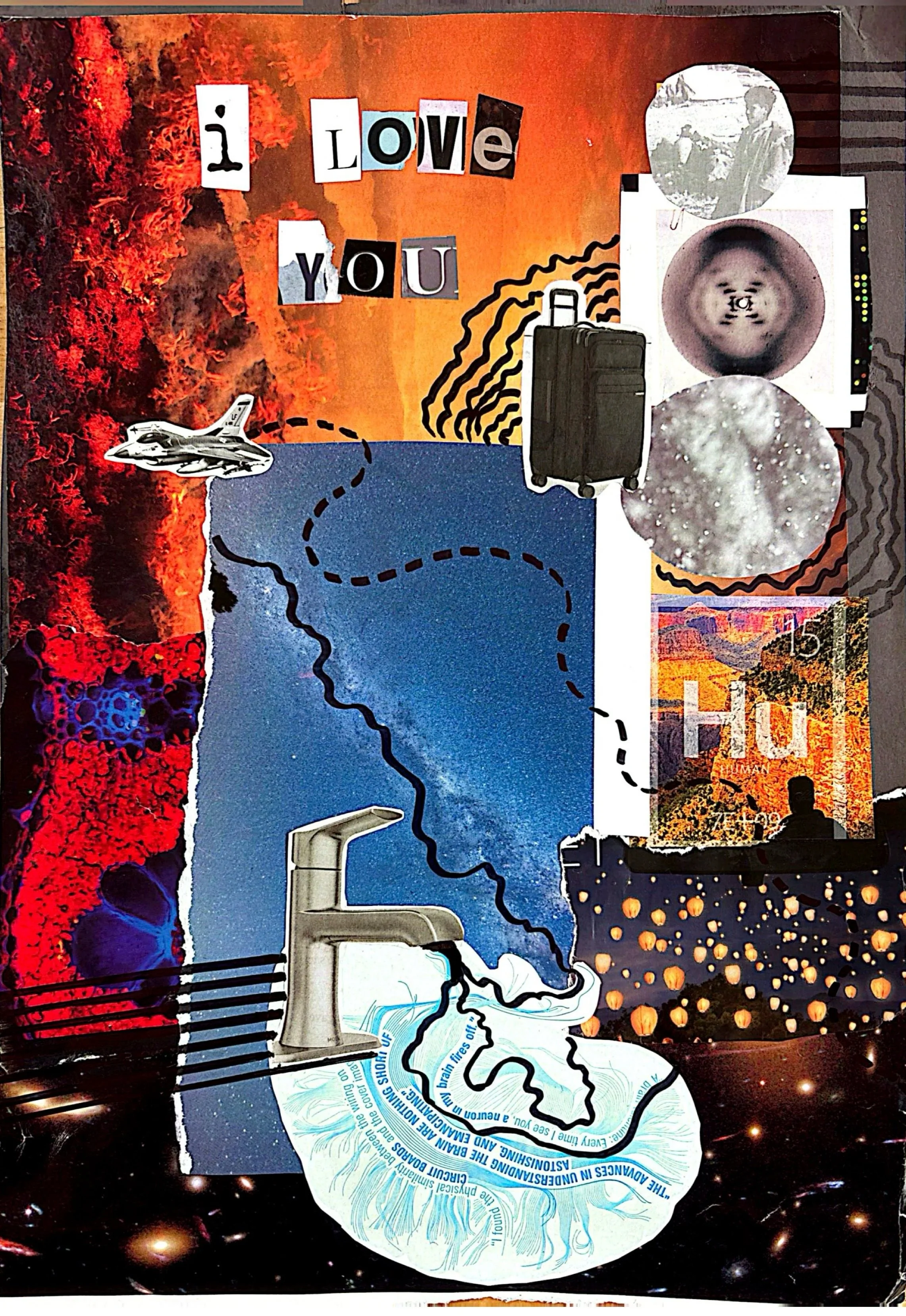
As the hours crawled into tomorrow, I had one of those not-quite-asleep-not-quite-awake dreams. I was in a house, one with everything I needed. Of its amenities, a faucet — this is where I got my drinking water. Day in and day out, I would get my sustenance from there, that crystal clear ambrosia which smoothed over all the roughness inside me, kept me alive. 


At some point, I noticed that the water had been getting colder. It sent a sharp sting down my sensitive gums, and I felt its chill travelling all throughout my body as my digestive system dispersed it into my tissue — but it was still water. Still the thing I needed to survive. At another point after that, I turned the handle and nothing came out. As I felt the mouth of the faucet, I realized that the water within had frozen over. But at least it’s still there, I thought. I placed my hands around it, exchanging the warmth of my body to melt a few drips to sustain myself with. But as days passed it got colder and colder, less and less usable. I found myself shivering and dehydrated, spending every hour attempting to coax just one more drop to stay alive.


One day I woke up, and the faucet was gone, as though it had been ripped from the wall while I was asleep. In a trance, all dry and light-headed from the struggle of trying to reverse the inevitable, I did something that I hadn’t done in awhile. I turned the handle on the front door and stepped outside. And I realized, dumbly, that it was raining.


I think I might be ready for love again. I don’t know that my scabs are quite dry yet, but… I think if I had to wait until it was all better, I would be too late. I think maybe broken is just who I am — ugly snowmen, dead stars, questions without answers. You’re saying you love that about me. I don’t understand that. But against all odds, I believe you, and it’s not often that I can fully believe someone. I’m really scared, to be honest, but I’d like to go with you. It sounds very nice to be somewhere other than here. My stuff is already packed, we can leave whenever.


Wait… I think I left the stove on. Let me check that it’s off one more time before we go. 
Dance Carefully

Article by Liza McDougall Art by Liz White

I was nervous to go alone. I was at a point in my life where I was always confident when dancing with friends, but something about entering a dance hall an hour away from my house in a small island town completely alone was petrifying to me, even though it was my favorite local band. I awkwardly sat in the car for a few minutes longer, checking my phone (nothing there), looking out the window, (yup, definitely in the parking lot) and twiddling my thumbs. Finally, I grabbed my stuff and headed up the hill. Slowly. What was wrong with me?


A few years earlier, I wouldn’t have even considered dancing to be something that I could do. I had a brief stint in jazz lessons as a kid and absolutely hated it. When I started high school, I still felt like a stranger in my own body: not comfortable in who I was. When my new classmate suggested that we join a band after school — not just any band, but a steel drum band — I thought she was crazy. I told her straight up that I had no clue what a steel drum was. She looked at me funny. Apparently everyone in high school plays the steel drums. Like a sheep, I thought I would follow the herd and try it. Playing the steel drums changed my relationship with music forever.


I walked into the dance hall, feeling a sneaking sense of imposter syndrome. I went up to the ticket window and tried to barter my way into a cheaper ticket, but you had to still be in high school to get the student discount and I had just graduated. Bummer. I nervously skimmed the room, but there was no one in the crowd that I outright recognized. However, everyone looked quite familiar, as it tends to go in a small town. I could hear the band tuning their instruments, so I avoided going into the hall quite yet and instead stood in the corner looking out the big windows to the bay.  


I thought back to when I first started playing the steel drums. I was terrible. My bandmates frequently made cheeky remarks on my inherent lack of rhythm. I couldn’t even find a beat, much less move my feet to it. While I quickly learned what the steel drums were — and I could hit a note just fine — something in me had absolutely no sense of rhythm. It was like relearning how to walk. When everyone else was on break from playing the drums, I would practice just tapping along to a metronome, eventually working up to moving my feet while playing, and finally playing notes and moving my feet at the same time. It felt unnatural, but eventually I settled into my body and learned how to play different rhythms on the steelpans while moving my feet to a beat. 


I looked out the window for as long as I could without being suspicious. After I had gone pee twice just to kill time, I knew that I had to go in and dance. I could hear the band playing, and they were playing one of my favorite songs! I had already seen this band twice that summer, but I had never gone alone. I worked up my courage and went into the room. Even though the band was bumping up on the stage, the dance floor was mostly clear. There were a few people milling around in the back, a few older folk sitting down, and basically no one dancing. It was my worst nightmare. I really wanted to dance, but I didn’t feel as though I could get in front of everyone and be the one to start.


When I learned how to play the steel drums, I learned how to dance. During our band gigs, I became the one leading the rest of the band, unashamed to move my feet, my arms, my whole body to the beat. Being in the comfort of the rest of the band made me feel unstoppable. We would all move as one, dancing and playing as a collective unit. The audience loved it, and would dance along. By the time summer rolled around, I was ready for my first real dance. Another steel drum band played, and all of the locals came out to the park to dance, dance, dance. I was proud to be one of them.


In the hall, I sat down and took off my shoes. I knew that if I did, I would be able to move so much more. I stashed my sandals under a chair, shrugged off my jacket, and tried to hype myself up to dance. A few people had started to move, more people milled in, but still the crowd wasn’t there. All of a sudden, a little girl ran up to the front, right by the stage. With curly hair in two pigtails, a bright pink top, and three layered skirts, she was an image to behold. She started jumping up and down, and, almost, dancing. I knew that I couldn’t be showed up. Even though I was there by myself, I had to start. I needed to dance.


Typically, I danced every chance that I got. Once I learned how, it was hard to stop. My friends and I frequented the floor. I learned to spin and twirl, to move my feet and to swing my arms. I learned organized moves in contra dancing or line dancing, but I also learned how to let go, lean my head back, be free, and dance, dance, dance. With my friends, I was never worried or self-conscious. When I danced, I felt at home in my body. 

Out on the dance floor– with my only partner an eight-year-old girl– I remembered once again that I love to dance. I was quick to forget, but as soon as I started moving, I remembered the beauty of it, and what I learned from my time playing the steeldrums. I remembered that I don’t need to be hidden beside others, I could dance, and I could dance on my own. I started moving and spinning and twirling. I started moving and didn’t stop. When I looked up a bit later, there were many others on the floor. It was a whole crowd. I didn’t know the names of anyone around me, but I didn’t need to know them. In the end, all I needed was to dance. 

Fragments on a Shelf

Article and Art by Riley Webb

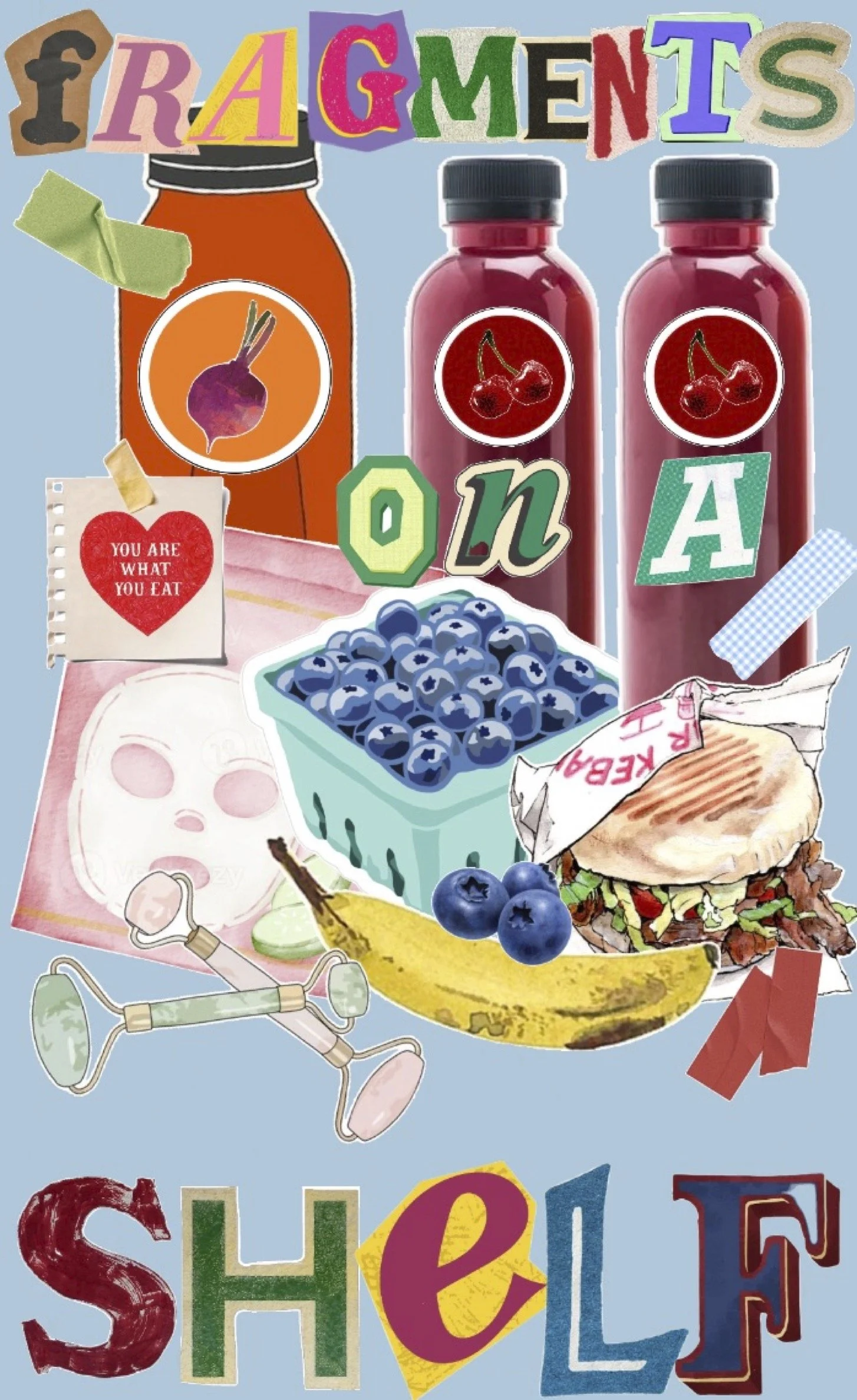
My fridge in college represents who I was a month ago, who I want to be, and all that I currently am. People say “you are what you eat,” but maybe the saying should be more like “you’re a construct of the contents in your fridge."  

Blueberries are the produce I always keep stocked. I usually put them in my quick-cook oatmeal in the mornings; having some sort of fresh fruit seems beneficial considering the dining hall is always depleted. Back at home, blueberries were always infused into my breakfast in some way. I would stumble into the kitchen at 5am before an early morning lift and have a cup of blueberry yogurt simply for the fast protein and convenience. During the weekends, I would toast two blueberry bagels, one for me and one for my brother. I would put butter on his, and honey on mine. He would sit and eat with me in the chair to my right, the same way we had sat since we moved into our house 10 years ago. During the summer, my dad would sprinkle blueberries into my smoothies. He would bring me a mason jar filled to the brim with the blended fruit, making summer mornings always taste sweet and citric. 


I have blueberries in my fridge. I am so homesick. 


I then have two types of juices, cherry and beet. Cherry for nighttime, because it contains melatonin. I heat it up and drink it slowly. It’s tart and metallic. I also think the warmth of the cup simply makes me tired, helps quell the day. Some days are so rushed and noisy, bustling from class, to the library, to the gym. When I heat up the currant colored juice, when everything slows and gives rise to swaying somnolence– like the steam that swirls from my cup. I’ve realized how much more “Colorado” and crunchy it is to drink my natural melatonin before bed; High school me would have laughed. 


I have cherry juice in my fridge. I am the healthiest I’ve ever been. 


I drink beet juice during the day, before I run. I was told that it boosts endurance and helps with strength training, something about maximizing muscle performance and recovery. In college, “maximizing” or anything along the lines of a “shortcut” has become my first choice. I’ve found that there is not enough time in the day nor days in the week for me to check everything off of my list. Most often, my backpack contains everything I need from 9am class to 7pm practice– computer, notebook, snacks, hairbrush, change of socks and underwear, deodorant, phone charger, and pajamas. When I do have time to swing by the dorm, my shot of beet juice before I head out the door is just another circumventing step in my routine. 


I have beet juice in my fridge. I am a rushed, strung-out student athlete. 


In the side compartments of my fridge, I keep face masks. Honey, eucalyptus, lavender. Soothing, rejuvenating, plumping– who really knows if they truly make a difference for your skin. Their validity is trivial to me, as it is the principle of slowing down, pampering myself, and allowing time for self-care that feels important. Beyond that, I usually only use a face mask with my girl friends. It is more fun to all look silly together and commit to the pjs, warm tea, and late chatter. Getting to know such amazing women who will indulge in both the loud and the quiet moments of college has made this experience so enjoyable. It is these moments of communal downtime that fill the gaps in the day, passing the hours from evening into night, which I now greatly cherish. 

I have face masks in my fridge. I have made lots of new friendships that I love so deeply. 


I often have some sort of take-out or leftovers in my fridge. Sometimes it is the second half of dinner from a late-night track practice, or sweet treats from a last-minute outing with friends. Other times it is a mediocre pasta dish boxed up from a date, or a failed baking experiment covered in cling-wrap. Like most college students, I keep leftovers for cost efficiency and convenience. Each styrofoam or tin-foil container equals another meal that I don’t have to waste dining dollars on. But also, each outing equates to more than the leftovers. I have noticed myself saying “yes” to more. More fun excursions with friends. More awkward first dates with guys. More new experiences and connections.


I have take-out in my fridge. I have grown so much since I started college.  


When I open my fridge, I don’t simply see food. I see pieces of home, idiosyncrasies of my schedule, and the fluidity of myself. I see fragments of my time layered upon one another, a conglomeration of constant change. Each item is evidence of adaptation and rearrangement, all nourishing an aspect of myself in some way. I am a collection of routines, choices, and memories– a construct of my fridge. 

The Peripheral Preservation of Personality

If Fridges Could Speak…

Article by Katie Patterson Art by Riley Diehl

Fridges lie on the periphery of your experience. Squeezed into corners, doors opening awkwardly, always emitting a gentle buzz (a buzz so soft you forget it’s there). They’re on the periphery, that is, until you reach into their depths, pulling out a half-eaten curry or the yogurt you forgot, chomping down on the nutrients that sustain life. “You Are What You Eat—” the Building Three Coffee shop attendee’s shirt said, “—So Eat Deliciously.” If we are what we eat, do fridges eat who we are? Or, at the very least, is it a fridge’s periphery status that makes it the perfect place to preserve someone’s identity?


Sometimes, after a run in Atlanta’s hot and humid summer mornings, I’d rush back into Mog and Grandad’s to be greeted by the instant refreshment of their air-conditioned house. It always had dimmed lights, wooden floorboards cooled by the dark blue humming AC, and elegant pottery pieces sitting around patiently, picking up dust. Sweating, the thick and stuffy outside air still stuck to my skin and prickling down my throat, I’d have the urge (and often urge-induced action) to open their fridge door, letting that icy coldness flow over and into me, calming my brain. 


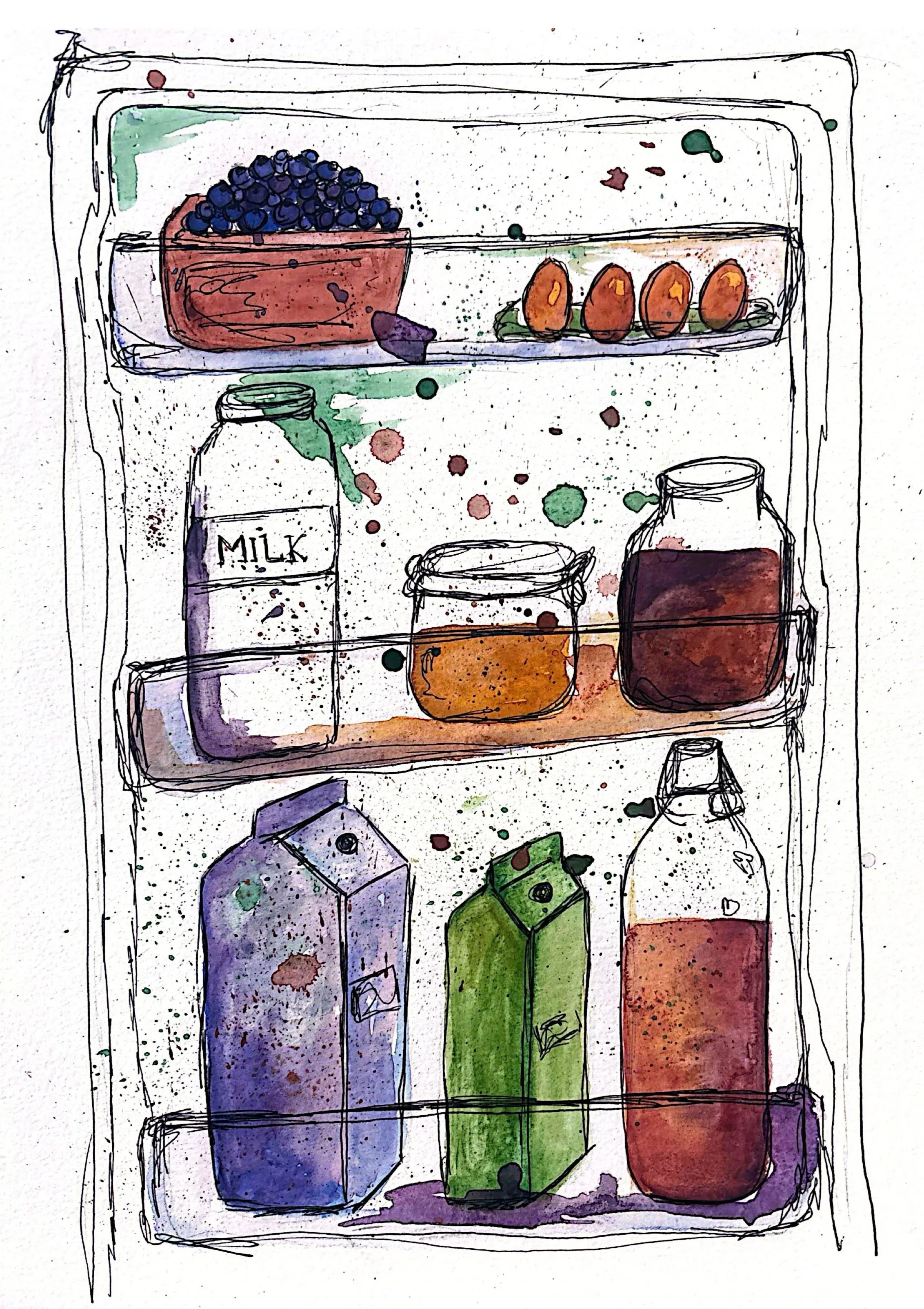
Grandad passed away in 2017. I know Mog’s fridge better than I know or remember the Mog-Grandad fridge. Mog’s fridge is always stocked with milk — half-and-half or whole milk — her favorites. As I’ve grown up, she’s often drunk milk with dinner (which used to seem foreign and charming to me). The last time I looked into her fridge, it seemed practically empty — a few condiments, the staple milk-gallons, some homemade sweet iced tea, one or two restaurant leftovers, and a half-eaten banana (that’s another thing: one of her go-to meals is a mug of milk, half a banana, and some almonds). 


Mog recently gave me her old car, and it still smells like her. Baby powder, lily flowers, cool lake, tinge of sourness, smoky cardamom. Indescribable, as many scents are. Kyle and I had a routine of waking Mog up in the mornings when we’d visit; waiting till the microwave clock turned eight, we’d tiptoe to her door, open it slowly and quietly, crouch down on the carpet, before pouncing up on either side of her bed, and enveloping her in a giant joint wake-up hug! One morning, we sprayed a small glass jar around the room — a gentle mist of lavender landed on everything. The delicate fall of lavender particles holds the same weight as the group doze which inevitably followed our wake-up scheme… the same weight as Mog’s kisses landing on my cheek. 


Grandad had this twinkle in his eye, and this habit of bouncing his front teeth together under his lips — a habit Mama picked up. When we visited, Grandad always made us grapenuts heaped with hand-cut strawberries, blueberries, and bananas. He would hand it to us in the morning, a quiet offering, along with the newspaper cut-outs he’d leave for my parents. These memories are woven into me, into the quilt of my being. Moments retrieved from the back of the fridge. 


I presume that, at the very least, the Mog-Grandad fridge contained berries. Some sort of grilled or barbecued meat, too. Corn on the cob! I know that Grandad watched a lot of cooking shows, and food was something he loved. At Christmas each year, my parents would gift him the newest edition of “America’s Test Kitchen.” He’d keep these books in his “den,” or office: a dark room, with a leather couch, blue light from the news always glowing, neatly-stacked newspaper clips, hundreds of books, a collection of records. It made me nervous, but I’d always be the one to hold my breath, walk down the hall to his den, and tell him dinner was ready.


I was scared of going in there, in the same way I was scared of talking to him for extended periods of time. There were a few times we did speak. Like in the Magritte museum lobby, waiting for Mama to park the car, he told me of Mama’s strength — how she ran at the head of the marathon despite arriving late to the race. Or, the time we sat around the garden table, his feet up on the edge, telling me family stories and legacies. While I always floated away from those talks filled with warmth, there was something about those still, deeper, long-winded conversations that my nine-year-old self skirted away from.


Maybe, like many, my grandfather is someone I wish I’d sat with longer, asked more questions to. Regardless, his kindness still lies in Mama’s eyes, in Mog’s stories, in the way even I sometimes bounce my front teeth. 


My immediate family’s fridge is quite a different species from Mog’s, or even Mog-Grandad’s. Full to the brim with half-eaten, once-delicious, forgotten items. We (meaning one of my parents (meaning, probably Mama)) clean it out once every… three to four months? But in the meantime, leftovers are packed in there on a near-daily basis. During the tri-yearly fridge-cleaning endeavor, it is not unusual to find the moldy tops of forgotten chilli, half-used bouillon, or apple cranberry jam. My family has had many fridges. We’ve moved around a lot. For a while, our fridge contained my dad’s collection of kombucha bottles (bits of scoby and raspberries floating around in sunset-colored liquid). Now, it is always stocked with two separate egg cartons — one with raw eggs, the other with boiled (Kyle and Mama are currently into consuming as much protein as possible). My current favorite, though, is looking into the fridge and finding the repercussions of Papa’s new key-lime pie recipe staring back at me. So tart! 


The sustenance of berries… the smell of sour kombucha mixing with the earthiness of eggs… the people I love. These ingredients stirred meticulously into large bowls, full to the brim with hundreds of smells, tastes, memories, people. 

Squinting Beyond Belief

Article by Stella Epstein Art by Talia Cardin

The fridge light is dim

It makes me squint into the darkness

I know what there used to be


It is never this dark in the dorm

Someone has a light on

Or my alarm clock illuminates the floor


At home, the darkness is lit only by memory

I remember the floorboards 

Where they squeak and how


But I am now afraid my memory is flawed

From being gone


Home has changed

Brother has glasses now

And Dad has started yoga 


Mom calls me

So I know the changes happen

But I do not remember them


My life back home

Is beyond the light of the fridge


That life is out there somewhere

I cannot always see


If I use my phone to see that life

I will disrupt the sanctity of the night

So I keep the darkness 


And I may fall 

Over new people back home

Changes I did not know


But in the light, 

I see my life here


The intimacy of seeing her get ready for the night

Seeing her undo the day

I know her


First her hair, 

Then her clothes

Finally, the jewelry


Then she is someone only I know

Because this is the inside version

Where she laughs loudly and lets herself be silly


This scares me

Because she knows me

Would be akin to her loving me


So my knowing her

Must become the same


The intimacy of letting me see her

When she lets me read her tarot (Three of Cups, The Lovers, The Wheel of Fortune) 

And I work to let her see me


In those moments, 

I discover parts of myself I didn't know


Her sight highlights new nooks 

That I couldn't see by the fridge


I want to have both

Life at home

Where everything is familiar

And life here

Where I find something different every day


This is a balancing act 

Which I always perform


The dishes I stack to bring to the kitchen

Finding something new in the familiar

And something familiar in the new


I carry out the old snack plates

Then find new ones

That I’ll eat in the fridge light

Things to keep cold, so as to prevent spoiling

a running list

Article by Riley Burr Art by Jennifer Martinez

1. Ice cream

2. Leftovers

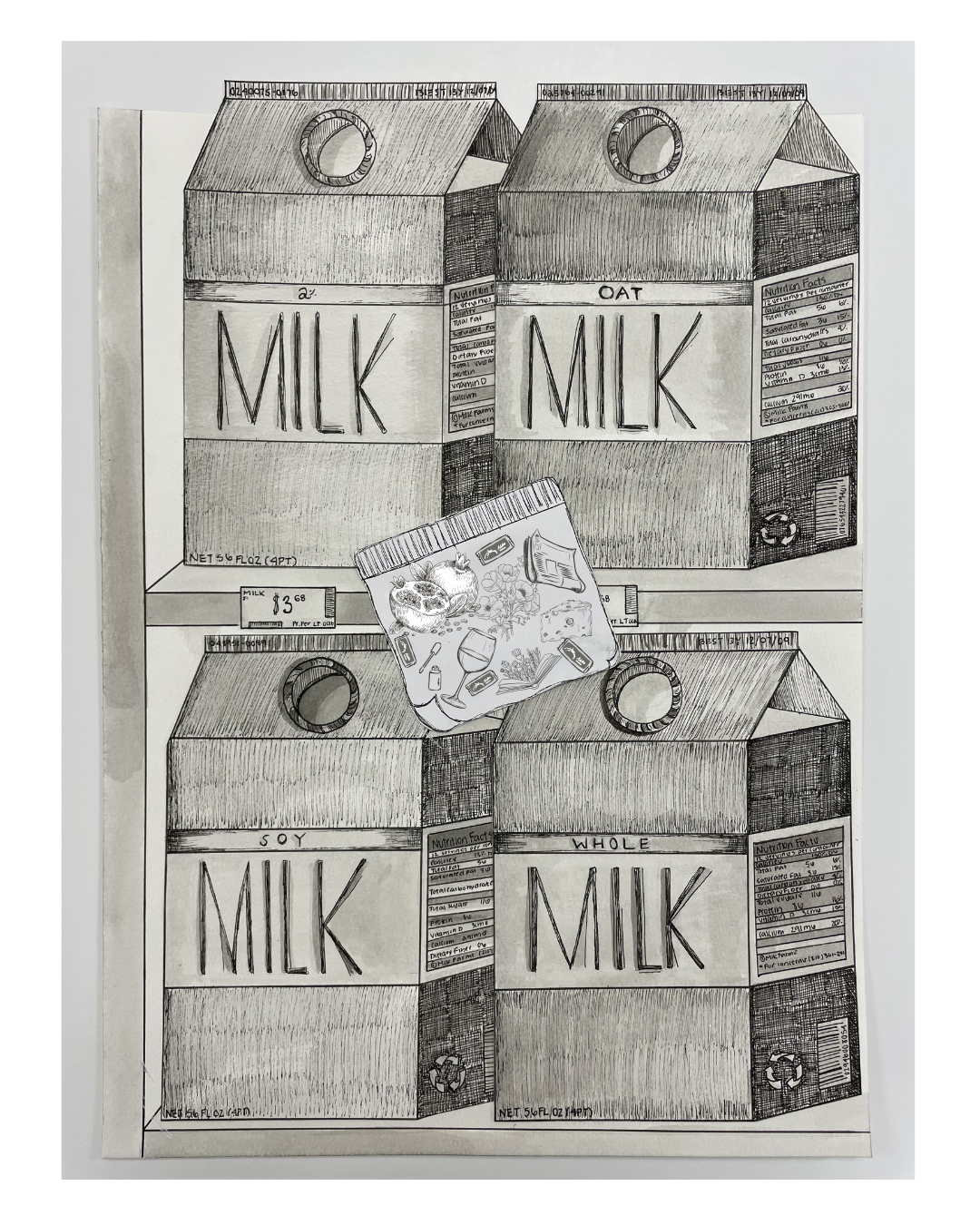
3. Oatmilk, but only after it’s been opened

4. Corsages

5. Cheese

6. The pomegranate you split with your best friend last winter

  • It strikes me, each time I open a pomegranate, how much the cutting board looks like a murder scene. What’s that one TikTok quote? “For you, I would,” or something along those lines. Meaning that when you love someone, it’s worth the mess. Mom used to joke about it, showing her red-stained fingers, crying Blood! Blood!

7. Those little sauce packets that come with takeout orders that you never eat and just sit in the fridge until someone throws them away

  • Next time you order takeout, they’ll reappear in the fridge.

  • Next time they reappear, someone will throw them out.

  • There’s a metaphor in here somewhere. If I wanted to be obnoxious I’d write it down. I just wonder if there’s certain things in life that I’ll never be able to get rid of.

8. The view of the sunset from The Preserve

  • How many body-balancing deep breaths did you take sitting on that hill? How many times did you leave crumbs on the grass for the mouse just there in the bushes? Do you miss your friends in other cities? This country is vast; the people you love are scattered throughout it.

  • This country is vast.

  • The people you love are scattered throughout it.

9. Books about plants

  • But not the plants themselves, they’ll freeze if you leave them in front of the open window overnight. Learned that lesson the hard way last winter.

10. The clogs you thrifted over the summer

  • Ely calls it shoe rot; the thrift gods giveth and the thrift gods taketh away. I still keep them in my closet, though, and I will until the day they completely disintegrate beneath my feet. I do this to every pair of shoes I own. I think part of me believes that someday I can fix them. This part of me holds onto broken and breaking things with two clenched fists.

11. Red

  • Booths in the second floor of the library

  • Sunburn on your legs the night he first kissed you

  • Wine we never finished (we liked the idea more than the taste)

  • Nail polish

  • Campfire embers

12. Local print journalism

  • Denver lost 440 reporters in ten years after the rise of the internet forced local newspapers to cut costs. “Think,” says my professor, “about how much information we’ve lost.”

  • Washington Post fires half its staff; Bezos’s income remains the same.

  • I send Dad my Catalyst articles. Here is what we have in common: a deep and stubborn love for dysfunctional and/or declining things. This includes local print journalism and each other.

13. Flowers

  • Or: every bouquet of flowers he’s ever given you.

  • Or: the idea of life, rebirth, unity, the cyclical nature of the universe, etc.

  • Or: the flowers Ophelia hands out right before she dies. Rosemary, pansies, fennel, columbines, rue, a daisy, and no violets. “Do you think she does it on purpose?” My director asks. “Do you think she knew what she was doing?”

14. The American Dream

  • Love for an ugly country

  • Love (which is straining) for an ugly country (which is growing uglier)

  • I don’t think optimism is naive.

  • There has to be a way out. There has to be a way to make this better.

15. Green

  • Matcha

  • Plants in the windowsill; frozen. Kept there well past any chance of saving.

  • Sweater

  • Stoplight

  • You give up on houseplants a week after they all die. In the process of dumping their frozen carcasses into the trash, you find a singular stubborn shoot still clinging to its singular stubborn life. In a few weeks it will grow a leaf, then maybe two.

16. Perfectly healed ear piercings

  • Soaking q-tips in saline solution every morning really makes you think about commitment. You still can’t help but sleep on your side.

  • It’s not too bad. They’ve still got a chance, don’t you think?

17. The last fragment of hope you’ve so desperately clung to for years and years

  • It’s changed colors and has a funny smell but you still might be able to use it. Deep in the back of the fridge, you still might be able to use it.  

You Were Supposed to be the One

Article by Anonymous Art by Perry Davis

December 5th, 2025: 

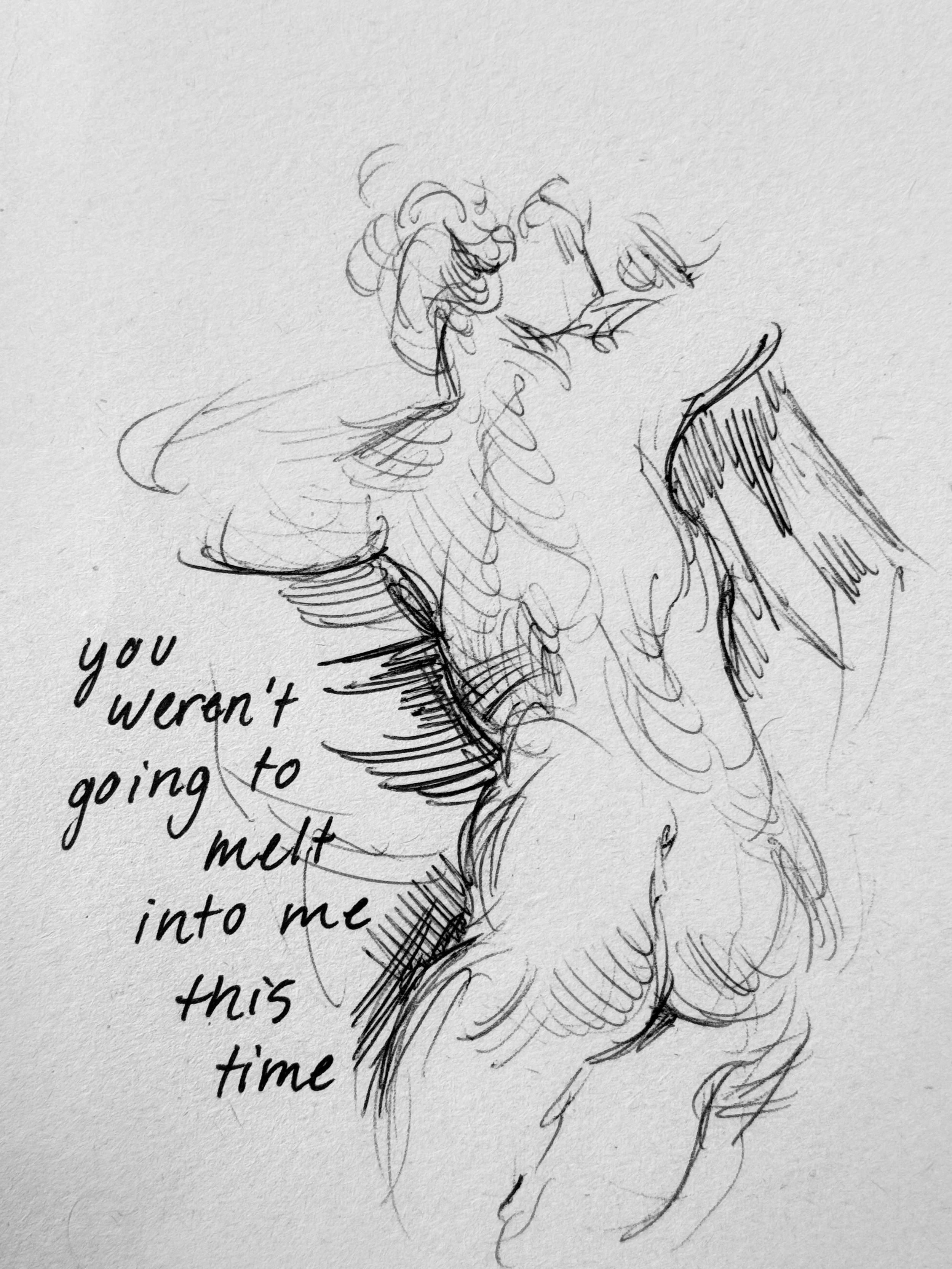
I remember the day I had to leave: the closed door I wanted to reopen, the kinetic energy that escaped with you, and the stillness of the air in the wake of your decision. The softness that seemed so embedded within you was replaced with a stoicism I didn’t recognize. You weren’t going to melt into me this time. I wasn’t going to apologize for bringing it up or ask you three more times that evening, “we’re good, right?” 

No, this time you turned your body away from me when I reached towards you. This time, the gentleness that cushioned these talks in the past was all steel. This time, I knew I wasn’t going to sit next to you on the couch while you smoothed my hair.

Once home, I threw off my heavy bag designated for that weekend. A long train of clothes thrown off hangers and out of dresser drawers leftover from my previous determination to impress you with my outfit escorted me to my unmade bed, ready for my dwelling. In my dreams, your hand sheltered mine, and your cigarette breath whispered sweet melodies into my ear. 

At 2:00 am, I woke up to deep hunger pains. In the kitchen, I opened the fridge to its nagging, fluorescent light. 

October 29th, 2025

I increasingly have nighttime panic attacks. The feeling seems more permanent, like life-ending existential dread. In one waking dream, I am traveling in the belly of a ship, one body stowed among hundreds; in another, I am certain that I am a brick in a wall, forever mortared in place. I wake from these dreams folded into myself, every muscle of my body clenched. You sigh and turn your back to me as I thrash and pummel my head into the pillow. I just want to be held in a vice grip by human arms, squeezed until I remember how to sob. 

April 2nd, 2023

I spent four years fixating on every curve of my body and the calories of my toothpaste. Four years of blocking out every voice of every loved one. On April 2nd, I let go of four years of conditioning and discipline. In front of the fridge light, tiptoeing so my mom doesn’t wake up to find me in my darkest moment, I eat a microwave pizza, the entirety of my brother’s graduation cake meant for the next day, a family-size bag of Cheetos, and three ice cream sandwiches.

October 7th, 2025

We take long naps after smoking weed. The thick air fogs our brains as we become quiet, dreamy creatures. We moan, vulnerably, about what we hate most about ourselves. I rant about my existentialist fears that appeared “inconspicuously” after I first read Sartre. You tell me you hate the color yellow and your ex-girlfriend. I run off on a tangent about the death of artistic influences due to the progression of AI and technocapitalism. 

Well, I don’t know. Instagram elicits trust by revealing intangible rules and helping users achieve algorithmic appeal. But, like, its strategic, business-oriented foray into algorithmic transparency, hinged on the temptation of algorithmic appeal, does little to actually like meaningfully, um alleviate the disciplining effects of its, of its, well, algorithmic power.

Yeah, and, like, fuck, I don’t know, I’m pretty high, you say. 

June 10th, 2019

I’m addicted to baking banana bread. I find new recipes on TikTok every week, and eagerly wait for the night to finally get the kitchen all to myself. I put my headphones in, turn on Alex G, and dance on the hardwood floor while mixing the batter. My mom comes upstairs as I am watching Seinfeld and stuffing my face with the sweet, warm bread. She stands at my door and stares. 

You should eat like a woman, she says, and then walks off without another word. 

August 4th, 2025: 

You and I develop a routine. 

Do you love me? I ask as I shut off the bedside lamp. 

Of course, you say. I love you. 

I don’t believe you, I say. 


April 2nd, 2018: 

While making dinner, my mother screams at my father for not helping, my father screams at my mother for being needy. Her tears fall into the chicken masala as her hand trembles while stirring the sauce. My father sits and watches, then walks to the fridge for a can of beer. I don’t want to see their vulnerability up close. I avoid the kitchen after that.

May 16th, 2025: 

While the sun is falling and the moon shine outlines each curve of your nose, I tell you my mother’s words, almost to reassure myself I can still remember them. I stare at your foggy eyes as they begin to drift off and whisper evanescent memories. You nod at the end of each story and make a cute, slight frown just so I know you are listening. Thank you. 

June 10th, 2016

I watch my mother weigh her food. She waits for the scale to reach 0 pounds, and then meticulously cuts her banana, puts a glob of almond butter on the side, and places it on top. She glances at my disoriented eyes. 

You will understand once you’re older, she says with a smirk. 

March 3rd, 2025

You send me a good-morning text once you wake up every day. We FaceTime after my class. I strip in front of the camera, not thinking twice. I visit you every weekend and we entwine our fingers on the street, displaying our love while my heart skips. It all feels too intimate. I am not used to being this closely tied to a person, but you desensitize me. Is this what love feels like? I feel like I’ve been adopted into a secret subculture. 

February 14, 2013:

I have never seen my parents hug, kiss, or hold hands. 

Daddy is my best friend, my mother would tell me and my older brother. 

Suuure, we’d say. Once, during dinner, my brother and I ask my father if this is true. 

Say it, say it, we chant.

Mommy is my best friend, he says, laughing with relief and embarrassment when he reaches the end of the sentence. I love her. 

What is love? I ask.

I provide the money for her to cook our dinners, do our laundry, pay the bills, and drive you two around. 

Then my father turns and pats her on the shoulder. My mother sits, unaltered. 

January 29th, 2025

The bus is filled with smells of unflushed pee, an old man’s tired, snoring breath, smoke from a grape-flavored vape, and Marlboro Reds. Some on a commute from work, others from school, some for the ride, and me, to meet you. I fear the smells have besieged me. With no other choice, I rub deodorant harshly between my boobs and under my armpits — afraid a perfume will leave the impression I’m trying too hard. I pull out my phone’s camera and stare at every red mark on my face; the trapped oxygen of the bus brings all my pores to the surface, as if they want to escape with me. 

Your nervous, adolescent chattiness is refreshing. When I first make you laugh, I glimpse the twelve-year-old inside of you, and my shoulders untighten. Altogether, I forget about my smell. 

For our first date, we go to a taco restaurant. I order three tacos and you order two. I overthink my decision the whole time, attempting to eat slowly, like a woman. 

September 21st, 2010: 

I fall into a routine with my mother. 

Do you love me? I ask while climbing into bed. 

Would I cook all your food if I didn’t? she replies, pulling the blanket over me. 

I’m not sure. 

Or do your laundry and take you to the doctor? she says, walking toward my bedroom door. 

I guess not, I said before she turned off the light.

December 5th, 2025: 

The hunger pains harassed me. I decided not to eat and closed the fridge.