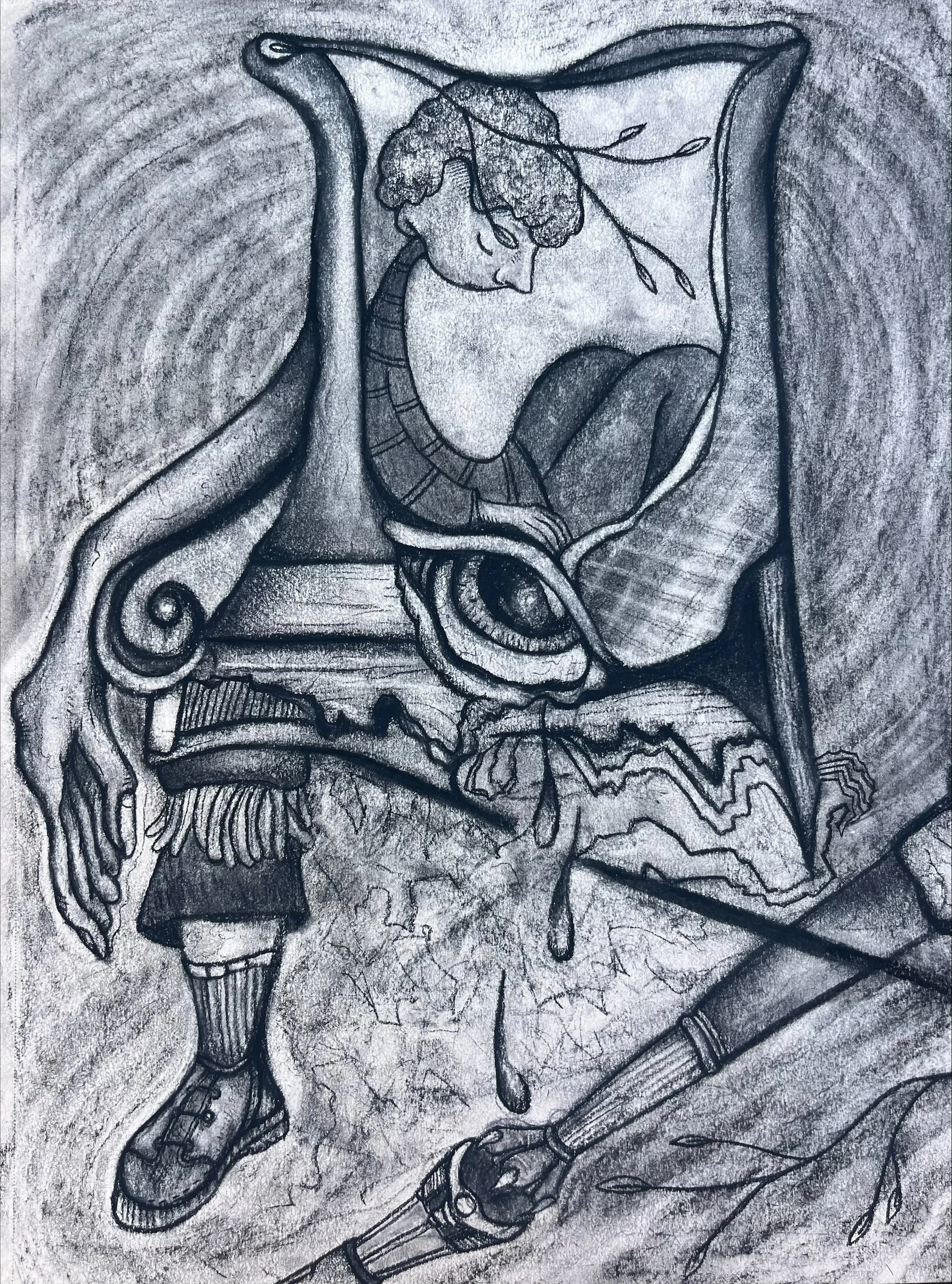
The Screaming Color and the Fade to Black

Article and Art by William Compton

Gramma died for the fag in her hand, in an all-consuming sense

Went out in screaming color

Black lungs and the teal ones, please

No new lease at the first scary cough: a last trip to the Gulf for a better porch to smoke on

That’s screaming color

It feels like Grampa’s been dying my whole life

And fighting to live the way he did back then, fighting an inevitable conclusion

He fights to be at home. Well, he’s not anymore.

There’s one way to win the fight against aging

Either way, let decaying be a smoothing muller

You can fade to black or go out in screaming color


There’s who I am, and there’s who I want to be. Gramma never called me Will, but you have. I’m William to my mom and my sister and my dad. Writing my own name as Will, or saying it, is starting to grind. A process of hiding, or, more namely, dividing into who I am and who I am to you. It occurs to me that I left William back in Wichita. And it might not be true to you, my being Will(iam). And if Will is a third person, and William the first person view, the screaming color and the fade to black can coexist: who I think I am, versus who I must be to you.


Recently, I’ve been a loser, doing all the same things I’ve done the past two years when I didn’t think I was a loser at all. You can’t hate small talk when you hate Big Talk, too. But I do. Big Talk at my lips is an incessant shake in my spine: it is to William Compton as oil to wine. Will getting slippery, coating his mouth without tasting. Big Talk wilts William down with acidity.

Right now, Momma needs Big Talk about the fact that her dad is dying. 

She says that my nose is a perfect replica of her dad’s. I say that my pride is just like his, too.

Pride grips life and grips continence and rips cloth, wringing out more.


I’ve never forthright lost someone, or gained someone either

Don’t let them in, don’t make them leave

Spools weave between each other seamlessly

Weft by weft, fading tapestry to black.

How do you put your finger on the trigger?

Then pull it


I was sad Gramma won’t be at my wedding. She appeared in my dream the next night. You think I won’t be at your wedding. I’m just a sleep away. Gramma’s having fun as a ghost, making the whole family believe in them. She tickled Grampa awake one night. 

Swapping ghost stories is somehow as cheery as she makes it. She’s working hard, too. Curing things. I was knocking down death’s door before she bumped me in line. If I never made it to college, it wasn’t going to be because of my grades. I haven’t smacked my head on the wall since she left. Apparently, that’s the power you get when you become screaming colors.

If — in a metaphysical way — we die for our descendants, if we die to drag their falsehoods with us, I wonder what Grampa has planned for me. What’s the final word on fading to black?


The real fear here is that there isn’t one. That can’t be true, can it?

My nose is like his, and my pride too.

Is Grampa fading to black because that’s all he’s ever known? The process of fading. He was born in the 1930s, a boy who greatly loved to sing. Who would he be if he had been born as me? The son of his own daughter, the end of what he started. What if he could complete what he began for me? What maddening colors could he be, and how do I become them?


I know it's fucked up to use these deaths for my extended metaphor. But I really need this. Recently, the present has been entirely preventing me from living in the past. And I certainly can’t see what’s next.


I pray for clarity: hear back I can have it for the price of sincerity.

I’m a pussy with the men I like and the friends who hurt my feelings.

Hardly inspired enough. Look around at dystopian dealings.

What am I here for?

To be fun? Appealing?

Or to be heard, whether whispering or screaming.


They’ll taste weed and coffee, and they’ll get good head, but I won’t let them give it back. They’ll get support, but not someone who sides with them unconditionally. And they’ll get loving eyes. But my eyes are meant to look sad, not loving. They can have my body, but it’ll always look like an artist’s will. I’ll love our home, but I’ll always love Wichita more. I’ll love them, but never more than my oldest friends. I’ll draw them and enshrine them in my writing. But they’ll always know that I love my pen when it gets bloody. And they’ll wonder.

My love life is scratches on a page, scrawl on the wall.

Perpetual reflection. A protagonist’s action.

The first rule of pyrotechnics is to have the fire extinguisher handy.

Still a wimp when I can always just have a bowl?


Why do we lose to the things that we lose to?

My Grampa’s in a facility

Fuck it. My poor Grampa’s lost his damn mind.

Rambling, obsessed with catching the train to Hutchinson

Where his mother’s buried

With once again being his mother’s son

Legacies crash down around me. Dig in mulch, but neglect the tree. Tulip bulbs are sights of memory, not Gramma’s full face staring at me. Gramma is my aunt at the wedding ceremony.


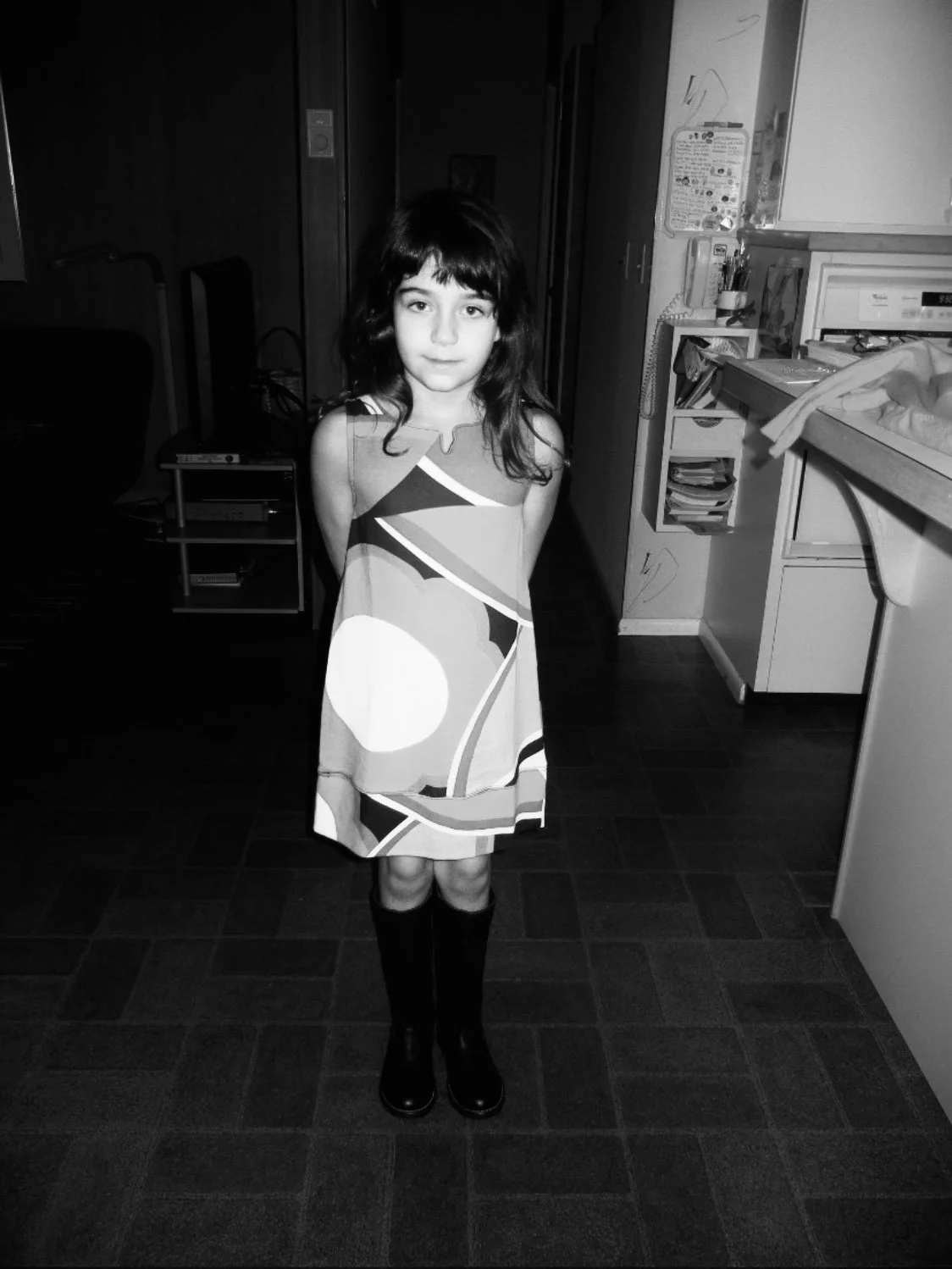
Oh, to be a '60s girl in a nice dress

Oh, to be twirling

To be in love with a good man. 

What have you been working on? Hopefully, a very sensible degree to tide me over to fame. Sensible. Makes me shudder with anticipation. Sensible. Do sensible men like curly hair and tardiness? How sorry will I be to him? As sorry as a '60s girl in a nice dress? Will he like my books?

Screaming color William C allows a charcoal suit strapper to stand next to me. Should I really try harder to get the hooks out? Let's flip the coin, spin the tires, burnout.

God, Gramma Terrisa was a betty in the seventies. And she barked when she was mad. Her too-old husband under her thumb the whole time I knew them. She died in her sixties, which is starting to seem quite young. Left grandbabies unknown, and her babies hurting with the suddenness. But she lived in screaming fucking color. And so what if she died that way, too?


The screaming color or the fade to black.

Black slacks, smacked ass, a singing gig, bury Gramma next

And be perplexed by the position she puts me in by dying for my sins

To un-bin the screaming colors of my soul

Unfading. I turned to black too young

To screaming color I go.

My Mom has Died Four Times

Article by Seniada Vigil Art by Sana Bhakoo

As far as I am concerned, my mom has nearly died four times. The number is higher than this, and the events don't line up. But the truth is not within a distance that my concern is inclined to stretch. There has been no death, nor miraculous return, but I have mourned the imaginary over and over again. Laying flowers on sanguine memories has yet to help me, but grief is hardly rational, even when it’s real, so I might as well hold another service.

The first time I thought my mom was dead was somewhere around the third grade. I had gotten the usual spiel: she’d be out till 10 pm with a friend, don’t forget to eat, I’d keep her phone so I could call someone in an emergency, she loved me, bye bye. I was used to being left home alone, my mom had a life to live, and I had shows to watch, but I was still scared of the dark. It got darker when she left, but that's okay, it was only 10 pm. I have always liked to tell myself things will be okay. No one gets back perfectly on time. I was sure she’d be back soon. Then it was 10:30. That was okay too; maybe she got caught up. Then it was 11 pm. I called my mom to ask when she’d be back, and her phone rang. I didn’t know who to call. The ringing phone in my hand was no help; no one in there could help me. I got cold at 11:30; Virginia doesn’t really get very cold, even at night, especially in the spring. But how cold it really is doesn’t matter when you’re shaking. There was a knock, or there might’ve been, but every noise that could’ve been my mom coming to warm me up and turn on the lights came from downstairs. It was darker downstairs, where the neighbors were asleep, notably unable to make the distinctive noises of a familiar return. From 11:35, each minute got heavier, slower, meaner. I checked the clock after five minutes, and it had only turned 11:36. I have always been one to whip myself into a frenzy, but 10 is not 11 is not midnight, and I couldn’t bring myself to shut the blinds that were letting the dark in. Tension rose within me until my thoughts wrapped around my throat. Shaking turned to tears turned to a phone number. I could’ve sworn that every heaving breath dimmed the lights. I called my aunt and tried not to cry with all the might an 8-year-old who knows just enough to feel guilty, but not enough to look into the dark, can muster. I begged my aunt to find my mom, to tell me where she was, and to turn on the lights.

Stop.

Remember what has not happened.

See the reds in vivid detail.

Delay until tomorrow.


Something shifted after that. The windows were looser, the deadbolts less certain, the vents more navigable. I was so sure that someone would get in the house, that someone was already in the house. I think, in a way, my mom had already died in my head. I just needed a way to fill in how. The air was pumped with poison, the streets were more abrasive and hungry, and strangers stood closer. It didn't matter how many days rolled past one, stupid, dark night. It didn't matter how many meals she fed me. None of it mattered. Some part of me knew she was dead. So every night I read myself a bedtime story written in her blood. It was more than shaking, more than a weight; it was a signed death warrant. The details filled themselves in sloppily. Shot, stabbed, torn to shreds. She was gone, and the doors were still locked. The murderous mirages followed me everywhere. They were always behind my back, or the shower curtain. I tried to press my back against a wall, but grasping hands melted through and dug into me. My mom was long dead, and there was no one left to protect me.

Stop.

Remember what has happened.

Watch the reds chase you.

Delay what is behind you.


Few things are more jarring than your weeping mother telling you she is suicidal. Because of you, or rather because of the lack of you. The knowledge of your dead mother shifts and becomes something altogether different. The responsibility for your mother’s death. You already knew she was dead, of course, she is dead already, but now the blood pools in your nails and fingerprints instead of at your feet. Of course, she is dead already, but now you can’t help but wonder what missed call did her in. OF COURSE, she is dead already, but you are afraid, and silent, and expressionless in that car when she tells you that your rotten silence has seeped too far in. She had told you that you were drifting  a  p   a    r     t. She told you how much it hurt her. But tucked away in the mountains, it all felt so far away. Now, here, in the passenger seat, it feels like you need to do anything in your power to push it all away again. This is a bad moment. You do not want to be here. All you can think to do is pray that you will not be held accountable for the body in the driver's seat. All you can muster is stone stillness. The tears might implicate you in the crime. “I’m sorry,” is all you can manage to say


Stop.

Remember what you’ve done.

Wipe the red off your hands.

Delay.


There’s a special sort of exhaustion that comes with thinking your mom is dead for most of your life. It’s an old, bone-deep tiredness that creeps in and makes my fingertips and eyelids heavy. Sometimes in the moments before sleep, exhaustion can look like apathy, and I can convince myself that all the pre-traumatic stress of mourning a living woman has prepared me. Sometimes I convince myself that I won’t cry when I finally get the call I’ve been waiting for. And then there’s a crash, and my mom is in the hospital. It proves me right, I’m fine, I don’t tell the same friends I normally tell. It’s easy to be okay, it’s easy to feel prepared. My mom has been dead for years. I’m ready for this. I tell the person next to me that I’m ready for this. I know the next steps, and all I have to do is keep it together. But, as it always does eventually, the weight catches up to me. Tears burn my cheeks, my throat burns as it acquiesces to my mind's demand for silence. I won’t let my roommate hear me cry. I’m supposed to be okay with this. I won’t let myself hear sobs. A sharp breath is the only hint at my saline-soaked cheeks. I’m breathing too fast, too slow, and then suddenly not at all. As I hold my hands over my mouth and nose, I beg myself for silence; it doesn’t matter how I get it. I wish that I could say that I have never been so afraid. But I am always afraid. It is never the height of the fear that surprises me, but its insistence to remain undeterred by time. There is no healing. How can you blame a child for being afraid without their mama there to hold their hand?


Stop,

Take a deep breath,

Your mom is alive.

What is ‘Nothing?’

Two Overlapping Conversations that Both Mean Nothing (and Together Mean Something)

Article and Art by Rusty Rhea

What is Nothing


Of course, there’s an easy answer. It’s the absence of a ‘something.’ There was something there, someone maybe, but regardless of what it was, it’s gone now. You turn around, you reach out, and you feel nothing. You feel for something that used to be there. You feel emotions turn to ash in your stomach as the day crawls to a finish, and then there’s  


A sound I can never really get used to. The sound of a wasteland of thought, all that I have left. The last of anything I have. There is a world out there, full of somebodies, full of something. I am one of the few who was given nothing. There is only emptiness. I can sit and watch the world as it turns, and I may even turn with it, but I lack the things to feel. I only feel that there can be a constant 


‘Nothing.’ It’s a fine explanation, really. One cannot deny the simplicity of nothing. This is the solace we are afforded. There is a room full of everything we know, and we can be sure this is something; this is the only thing we can be sure of. We can put something to fill the empty spots, to clear out the nothing. We can spend our days working, spending every minute eradicating nothing, to know there is something. Don’t we deserve a simple explanation? Of something being able to triumph over nothing?  


So, we’re done here, right? Fine, we have nothing. Get a few somethings. Pick yourself up by your bootstraps. Back in my day, I bought a something for just eight dollars, and I dug my nails into my something so hard it bled. I kept the nothings away for the entire winter. That made it worth it, didn’t it? I had to bury it in the coming spring, but flowers bloomed, and that's a something too.  


Alright. You don’t like that answer.  


Okay, so we scrap the solace part. It’s just fucked up. We’re fucked. We have nothing, and there is no choice in this. Happy now? We can chase a something, but that doesn’t really change the ending. No matter how hard our feet hit the ground, how hard our breath escapes us, the sound of the thumping of pavement — there is no outrunning the darkness of the setting sun. No matter the scramble towards the crumbling edge. At the end of the day, when we shut our eyes tight and truly see nothing, its embrace will be waiting. We can stop trying to find something out there, because there isn’t a point. There is nothingness surrounding us, suffocating us, clouding our vision to everyone but ourselves. We lose everything, and then nothing remains. 

Well, we should consider the upsides, too: if all we have is nothing, then nothing is all that matters, right? We have to find a solution, a Band-Aid to slap on, a way to smile at the end of the day. What’s the point if we can’t find a way to make it better? Why do we get up every day and continue on? There must be an upside, there simply must be one, because then all there is 


An everyday onslaught of emotions that rush towards me, even as I sit on this crumbling wall, even as I look toward the skies. It is a relief and a tragedy to know that this onslaught is temporary, that I will migrate home as the day starts to cool. That I will open the door to a dark room and know that it is a fate most fitting.  


There is a crack in the jar of everything I hold dear, and the trickle is slow but constant. Leaving behind a drip, drip, drip as I shuffle from some dark room to another. It is easy to know I am broken, to feel emotions rush out of me, no matter how hard I staunch the wound and bite my lip. The plumber can see a leaky faucet, but no matter how hard the pipe turns, the leak can never really stop.  


There is someone who passes by, someone that I might even recognize. A laugh emanates from a clumsy smile, and a head clutches a phone to their neck. There is no life outside of this moment, shared between the two. The moment, of course, moves on, and life stills for me once again. For a second, there was something melodious about the blend between the bubbling laugh and the losing of something that will always return to 


A vile nothing.  


If we’re being honest, ‘Nothing really matters!’ doesn’t really help, does it? You can tell yourself it does; we can all pretend. It still leaves a bad taste in our mouths. We can push our boulders up our hills every day and rejoice at how we will always have to find our way to the bottom. We can shake our fist at whatever higher power we want, to the universe itself even. We can cover our nothing with whatever we get our hands on first. We can constantly fill our cups to the point where it runneth over, but 


Drip, drip, drip.  


It’ll be empty eventually, right? The boulder rolls back down the hill, and we have to follow it. The cup will never stay full. Whatever we hold the tightest onto, it will crack and fade beneath our grip 


Slipping like ash between my fingers. I sometimes wish that I had never learned that there were people out there who could feel more than nothing, who did not live on an hourglass that would always return to empty. I spend so many hours sitting and watching lives I can never lead. There were times afterwards where I would spend days with those somebodies, my absence of anything was able to perfectly reflect the image of those emotions I caught scattered among faces. It never worked the way I wanted it to. 


So, square one. We’re fucked again. Sorry. 


Not sorry, actually. It’s clear this whole “nothing as the absence of something” could never work. So we’re actually a step behind square one. We’re off the plate. Our feet are in the grass, and day approaches. How can we call nothing ‘nothing’? After all, 


I spend every day in a room, on a wall, on the edge of something insignificant. I watch something that I thought was mine drip, drip, drip away. I want to be something. I want to choke down everything flowing out, to stop staring into the abyss.  


Isn’t that something? 


It’s my nothing.


You can think it’s a cop-out all you want, but if we think that 


I must have nothing; I must bleed out every emotion that enters to be able to return to the husk that I know best. What else can I do with


This feeling of being suffocated by nothingness, of the darkness that blots out the light... If we think that those are all-powerful, then that has gotta mean that nothing is something. We have nothing, sure, but that doesn’t mean the absence of anything. Nothing remains, so we have something that continues with us. We are suffocated by nothing, so something must be filling our lungs. We can see nothing in the dark but we can still be sure that I'll know what's really there if I just reach out. If there’s truly nothing, as in an absence, then how can we explain  


That drip?


I don’t think I’ll ever be able to understand it. The drip follows me wherever I go, even when I smile. Even when I still laugh, even when I still wake up, even with a world surrounded by darkness, there is 


The existence of something that gives us strength once again? 


Something that flows out of me. But 


Something that flows back into us, allowing us to rise again. It never meant that we were empty to begin with, or that we were destined to stay empty. If there’s something flowing out of us that will one day flow back in, we don’t lose anything. Maybe all that ‘something’ is just hidden away. We just aren’t able to see it. We reach out, and there’s something that reaches back. It may just be air, but just because we don’t see it, doesn’t mean it’s not there. Just because it isn’t here this second doesn’t mean that there will never be something.


Time always flows, and the chiming of the clock will always pass. I will wake up, and it will be a new day, with the same sun. 


What else could there be? 


Sitting, watching the lives of others drowning in a sea of nothing, asking myself, “How could I ever be happy?” but 


Those fleeting moments of crying at the movies, calling our friends, rambling excitedly about a story that made us laugh are all we have. That is happiness. All we have is a lifetime of these moments sewn together. Everything we feel stays with us. Not gone or drained out of us. Hiding in the fabric of our lives. Somewhere we can’t quite find yet. Reaching out into the dark. Even if 


There’s nothing to be done. 


We spend every day working towards this unobtainable idea of having ‘something,’ of being ‘something,’ and those joys we find in the process; it means we’re living.  


Maybe I am nothing, and I live a life of nothing. 


So that makes us something. Well, at least we are definitely not an absence of something.


And that is everything. 

What was the question again? 

America’s Favorite Carcinogen

Article and Art by Nalani Wood

Some of us had our first sip of alcohol after a successful heist of our parents' not-so-secret stash of aperitifs, those decadent beverages that we were never allowed to try. Maybe it was a bottle of coconut rum sipped straight from the white Malibu bottle. Maybe we got our hands on some wine and strutted around in too-big heels sipping sour grape juice from a wine glass. Maybe it was a sip of whisky at the dinner table, a supervised indulgence meant to prove it didn’t taste good enough to want again. We come into contact with alcohol in the holiest of places, sipping Christ’s blood with your grandma and grandpa in your finest Easter attire. Perhaps you shared a beer with dad, a bonding beverage at the stadium, cheering for your favorite team. Whatever it may be, alcohol often enters our lives innocently. Casual attitudes towards occasional consumption instill a sense of acceptance and trust in a compound that chemically transforms into poison when our bodies digest it. 

Everyone has a different relationship with alcohol, a different origin story, a different pattern of indulgence. We partake in plenty of things that aren’t great for us; that doesn’t necessarily make them evil. What’s fucked up is how casually, almost proudly,  so many of us drink to get fucked up. We joke about getting wasted, smashed, properly pickled, sauced, hammered, plastered, shitfaced. We tell stories of blacking out like it’s a silly adventure or a badge of honor, rather than a period of amnesia induced by excessive alcohol consumption. Our emotional and physical integrity can easily slip out of our grasp because of a few too many drinks.  The “tactical vomit” technique is employed by some to override the nausea our bodies send to us when we have ingested too much poison. While a few fingers shoved down your throat might relieve the nausea, the overproduction of stomach acid caused by irritated stomach lining and subsequent production of toxic byproducts has still occurred. 

For many, a few drinks pair well with almost any occasion. Built into so many rituals of life, birthday parties, promotions, heartbreaks, drinking wiggles its way into celebration, grieving, or just a casual Tuesday evening. Crafting a creative cocktail and adding a tasteful shot of some spirit or another isn’t a problem until it is. The issue with drinking, especially for young people, is that it can be such a slippery slope. Getting tipsy often leads to getting drunk, especially in college. People think they need to be drunk to go out, whether for social lubrication or to fend off the cold with a heavy buzz replacing their jacket. 

Beyond the broad societal acceptance of overindulgent drinking, alcohol is woven into the fabric of college life in an unfortunate way. It’s how we celebrate, how we flirt, how we decompress and cope. Saying no to a drink is isolating. If you don’t drink, some people will want to know why or convince you to partake, thinking they’re doing you a favor by pulling you into the fun. Social pressure to drink is built into the expectations and realities of most college campuses. College makes drinking feel like a shared ritual of becoming. Choosing to step away from that rhythm is to step outside a strong pulse of campus life. Staying sober isn’t just abstaining; it’s a choice to opt out of the shorthand that so much of college socializing depends on. 

Some are drawn to drinking in order to protect their minds from the incessant condition we all share — consciousness. Prehistoric human societies started the substance-induced reality-bending trend, employing psychedelics from ungulate feces in religious rituals. Today, mind-altering substances are not all treated equally within societal circles. For example, MDMA is lauded by some scientists and Molly lovers as a miracle, but is condemned by the FDA as a Schedule 1 substance along with heroin and marijuana. The classification of substances by the FDA, regarding both addiction and health risks, is guided more by prejudice and fear than by scientific evidence. Alcohol is inarguably a kind of mind-altering substance, but is not classified as a controlled substance under FDA regulations. As liberal arts students, we have all discussed how institutional paradigms are influenced by and influence societal paradigms, including the way we approach drinking. When we don’t form relationships with alcohol intentionally, drinking can easily become a shared language of escape and coping, innocently disguised as social bonding. 

Drinking is so normalized that people willfully ignore what alcohol is. Classified by the International Agency for Research on Cancer as a group one carcinogen, alcohol is up there with tobacco, asbestos, and radiation. Causes of cancer are numerous and can be difficult to track, given how many other carcinogenic substances are floating around on shelves, in water, and in the air. While cancer research is incomplete, data undoubtedly shows that drinking increases your risk of developing cancer in your mouth, throat, along your digestive tract, and in your esophagus and colon. For those of us blessed with boobs, drinking also increases our risk of breast cancer. Of course, how frequently we drink has an impact on the degree of these risks, and there is inadequate scientific clarity on exact quantities that would be deadly, nor on the contributions of gender and genetics. Some uncertainty surrounding alcohol shouldn’t sway us to minimize the fact that any amount of drinking incrementally increases the risk of deadly health problems. Beyond the cancer risks, alcohol indirectly increases the occurrence of traffic accidents as well. 

I grew up on Maui, (pop. 168,307), and knew a lot of people who would combat their angsty teen island syndrome boredom by sneaking out of the house, tapping shoulder in a dark parking lot to acquire some cheap, shitty alcohol to drink in a park. This classic nighttime activity often led to drunk driving. On the North Shore, a few roads are notoriously used as race tracks by drivers making decisions with an undeveloped prefrontal cortex. Smeared on the narrow country roads are mementos of tight turns and drunk drifting. A friend of mine once flipped a car by accidentally driving it up a steep and slippery grass berm. She was going slow enough that the worst of the damage was only to the side of the car that scraped the neighbors rock wall and no one got hurt. The incident also propelled her into delinquent fame. In the small community of high school students on Maui, being the girl who flipped a car will get you some invitations to parties at cliffside pool houses. Not too shabby a consequence for risking your life and the lives of others. She never drove drunk again of course, flipping a car would scare the shit out of anyone, but I remember my younger sister’s squad of giggling sixteen-year-old friends once recounting the story years later with giddy awe and smug teenage respect. 

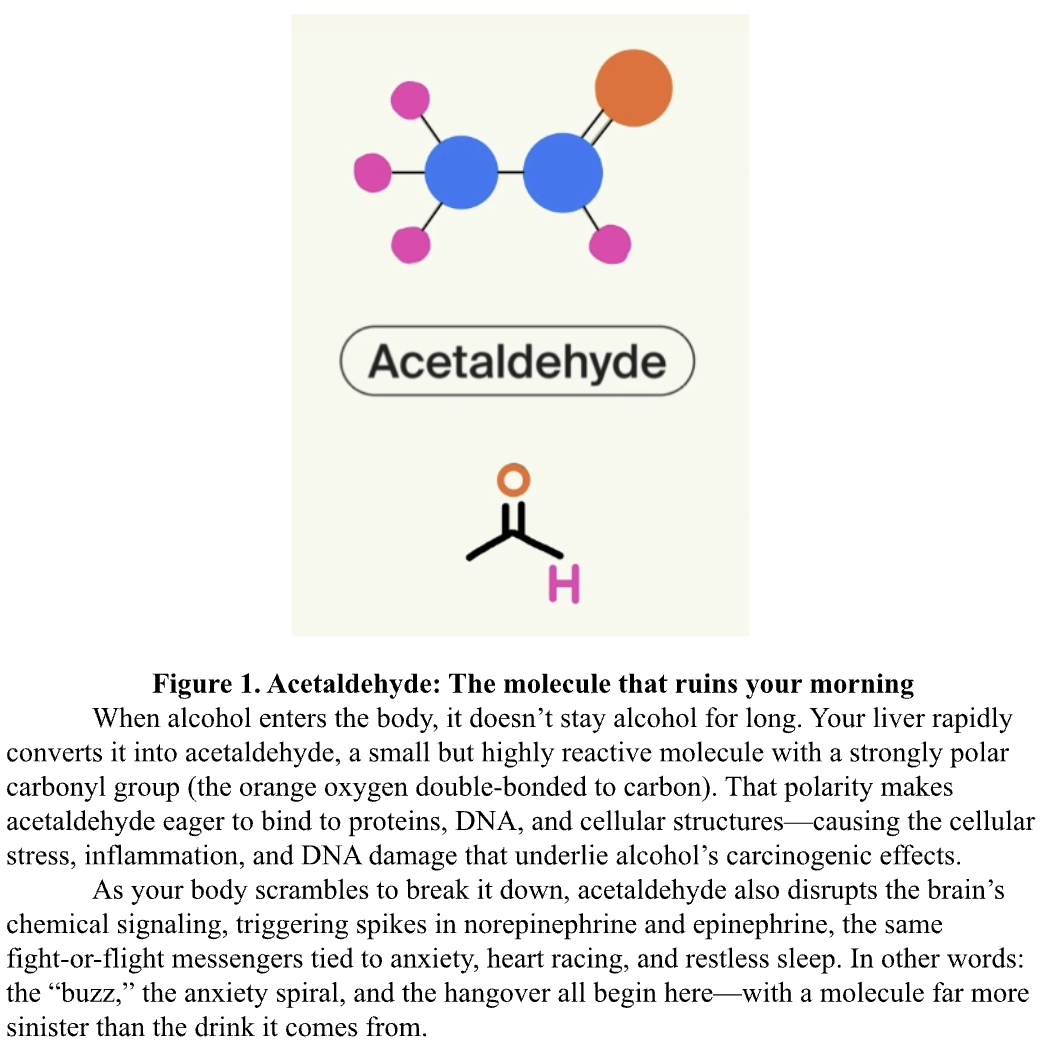
When you’re young, forbidden fruits are alluring simply because of the natural draw to have what one cannot have. Once the clock strikes your legal drinking age however, society’s misguided perception of drinking takes hold and perpetuates our collective drinking problem. Cigarettes had their moment of reckoning. Visceral depictions of discolored lungs and mandatory warnings on any purchase of tobacco don’t make it harder to find a pack of cigarettes, but succeed sometimes in dissuading the choice to keep buying that pack. Societal rebranding has not hampered smokers who smoke despite the cognitive dissonance between addiction and cancer. Arguably, the nicotine conversation shouldn’t be over, considering all the yummy vape flavors that target the young before their brains develop enough to understand the risks. Alcohol is still somehow at large, like a certain elected official whose undisputed criminal record logically should impact his political station, but it just doesn't seem to matter. An undercover poison. A wolf adorned in sheep's wool. A ticking bomb with a fancy label and an expensive-looking gold muselet. An unassuming liquid until it metabolizes into acetaldehyde (see Fig. 1), wreaking havoc on DNA and building up in the body. Different alcohol metabolism, diverse gut microphones, and the efficiency of the enzyme aldehyde dehydrogenase (ADL2) impact how effectively the body can break down acetaldehyde. I personally can’t tell how well my body breaks down the metabolic byproducts of alcohol, but I can tell when I have a hangover. A hangover is an indication that your body was not able to break down acetaldehyde quickly enough after its introduction into your system. Any hangovers we have woken up with in our lives are evidence that our bodies were overwhelmed by poison. It’s not like a long run that leaves you sore for a bit but ultimately results in better lung capacity and endurance. Drinking isn’t a sport. It will never make you stronger because it is poison. It will steal your gains after a workout, will dehydrate your body, and make you sleep poorly. We don’t talk enough about how bad alcohol is for us. 

We talk about the liver. We talk about how strong and heroic our liver is after a Feisty Floko Friday. We might even talk about a headache and drink electrolytes to counteract our body’s desperate screams for help. But what about the complex signaling of our brains, working hard to regulate our moods, build our memories, and chemically orchestrate our decision making, derailed by even moderate alcohol consumption? I’m not arguing that we should consign ourselves to a life without ever having a drink again. I just feel that we should choose how much we want to drink taking into consideration the full scope of what we are doing to our bodies and our minds.

Science Geek. Ice Cream Freak.

Article and Art by Maya Rosen

The sun is white hot. I stand there, inches away from the shade of the big tent. It’s meant for the guests in their knees-out, only-for-Friday kind of business casual. The people in the all black, full-length aprons don’t deserve shade, of course. Come back when you're making six figures. 

The company has spared no expense. Each guest gets four drinks, free food, and unlimited axe-throwing (they all signed waivers). It’s a hot Wednesday afternoon, but I can hardly tell what day it is. As they order, they add a scoop of rainbow sprinkles. It’s to celebrate, they are finally “over the hump!” and then they laugh and laugh. Their hump is over, but not for my kind of job; my weekends only mean more work, longer hours. I laugh with them. 

Sweat pools on my uniform, outlining the embarrassing slogan embossed across the back. If I were to turn around, it would read: “Science Geek. Ice Cream Freak.” I don’t turn around much. That’s the sort of advertising my boss decided to go for when she left her job marketing pills to people who don’t need them to open a liquid nitrogen ice cream franchise. Now she’s 100k in debt, standing embarrassed outside the tent, waving to people who don’t remember her. And so, eyes squinting for five hours, I watch the loafers mill around the asphalt.

When they walk over, I offer them a free scoop, free in the sense that it’s paid for by the company that pays for their salary, and health insurance, and eye insurance, and phone. It's another thing paid for, but they don’t want it. They’re all on diets. But they’ll take just a little bit. I scoop them a sliver, and they say, “Oh! That’s too much!” But they come back every hour for more. 

Still, these slivers I’m handing away don’t make a dent in the vat of ice cream we brought. The rest forms a puddle. I try my best to keep it off the tablecloth. I re-freeze it bare-handed in the Liquid nitrogen at -321 degrees (I’m supposed to know that fact). I normally don’t like that step, but it’s sort of nice today. The fog cools me down, keeps me smiling. They watch me do it and say, “Gosh, isn’t that dangerous?” I shake my head. It’s perfectly safe, as long as you don’t get it on your skin. But, they don’t give us gloves, of course (I signed a waiver).

This kind of ice cream is riddled with options, nauseatingly so. As my boss always says, there were over 1 billion options (whether this is actually true, or just marketing, I’m not sure). It's all 99% corn syrup flavors that we add 2 pumps to 8 oz of unflavored cream. We have 50 of these syrups, and you can add as many different flavors to one ice cream as you want. Then you can mix in whatever you want. So you can make Strawberry, Banana, cookie-dough ice cream, for example. Half of the $8 ice creams I shell out are plain vanilla. 

One rule we always have to follow, though, is we can’t interfere. If they order something that sounds like it will taste like a poop-vomit sandwich, I have to make it, and serve it. Sometimes it feels like I’m shooting a nature documentary, watching my star penguin get mauled to death by a sea lion. I just have to let it happen. So I hand them their diarrhea colored peanut butter, pumpkin, orange, blueberry, mint with gummy bears, and watch them take a bite. Then they'll hand it back to me and ask me to remake it. It doesn’t taste right. When the line is long, sometimes I really think I’ll lose it. I want to scream: “YOU MADE THIS!" Instead, I just remake it, and push the tip jar real close when I hand it over. 

A man stands at the table. No order, just speaks to me about his new baby, and with the tip jar empty, I care. 

“We’ve got another on the way. Can you believe it?” 

I don’t respond. 

“A boy!” he says, grinning. 

“Oh, how far along?” I say, looking past him at the growing line. 

“We’re only trying, I mean,” he says. 

Ew. I don’t say that aloud.

“So you're hoping for a boy then?” I say this aloud.

“Oh, more than hoping. IVF! We can do those things now. We can pick,”

A silence. 

“So we’re having all boys! Thank God!”

The irony of thanking God doesn’t quite hit him. 

He explains the exact IVF process for the next 10 minutes. He isn’t wrong in assuming that I wouldn’t know anything about in-vitro-fertilization, but he is wrong in his assumption that I care for his special male-baby recipe. He gives it to me anyways. 

I’m not sure why I thought this parking lot full of pharmaceutical execs would have any sort of moral integrity, but I’m still surprised at his mention of casual eugenics. I guess in this job, though, all I deal with is choice. I give them one billion options, and then I judge when they pick vanilla, or peanut butter (it’s for dogs), or something too creative. Still, it feels a bit different to me to be ordering your unconceived fetus's XY chromosomes off a menu. But what do I know? I’m just a Mad Scientist (this is my official job title), and I’m standing here serving people something that probably shouldn’t be FDA-approved. 

I hand him a sliver of vanilla ice cream. 

“Actually, I wanted chocolate,” he says. 

I tell him we’re out, as a full vat sits on the table. He doesn’t question it. I feel a sort of superior moral calling to teach this man a lesson: sometimes, we don’t always get what we want. 

Then I spit in his ice cream and tell him he’s a eugenististic-misogynistic-pig, and he should never procreate. 

Except I don’t actually do any of that; what actually happens is I smile, I laugh, and I let him explain to me about the incredible feats of modern medicine that prevent him from ever having to experience the horrors of having a daughter. I let him tell me about how he couldn’t handle the “drama” of it all, and now he’ll never have to. I laugh at this, then I congratulate him on all the sex he’s about to have with his wife (not quite in those words), and then I give him a big fat scoop of chocolate. Worst of all, I give him more sprinkles than I’m supposed to give out. He calls them “Jimmies,” though, and I’m really not surprised. 

I give him an extra scoop to bring home to his not-pregnant wife, and I wonder if she’s real.

Another man comes up to me after the first one leaves, he just stood at the table watching me. He liked my smile, he said. I smile more for him. He says he likes the necklace that sits atop the vague outline of my bra. My necklace is a broken, once-gold chain. I’m fairly certain that that’s not quite what he was looking at. I offer him a bright thank you. 

And then, what happens is the sun gets hotter, and unshaded from the tent, I melt into the logo-embossed tablecloth and hot pavement. I am a puddle of chocolate syrup, and sweat is stuck like glue to that spot. All that’s left of me is a wide smile floating at the center. It’s okay, though, I don’t need my arms — no one is really ordering ice cream anyway. 

I make $100 in tips that day. More than I ever make. All for scooping just five collective icecreams or so. 

“Corporate money isn’t real,” my boss tells me, as she plops the check down in my pile of goo. “You’ll learn that one day.”

Then, she scoops me off the asphalt into a to-go cup and blasts me with a shot of liquid nitrogen, so I stay in one piece. She stacks me on top of 5 boxes of family-sized Chipotle leftovers that they let her take home to her kids. We walk out past the empty bounce house, and the smiling faces return to their cars, spirits almost as high as their BAC. 

I’m loaded into the front seat of the catering truck. It’s hot in there still, she rolls the windows down. I am whole again. At -321 degrees, I am refrozen. She buckles me in, and I’m repacked tight with a lid so I don’t spill onto the car seats. She has to be careful. It’s a lease. 

As the car jostles in the hour-long ride back to the store, the check floats to my surface. It’s covered in my chocolate goo, but I think it should still clear. By the time we get back, I must unmelt enough to lift the tanks of nitrogen and load them back into the store, and pack our unused bags of milk away. They can’t be good anymore, sitting out in the hot sun like that; it makes things expire fast. My boss has me put them in the freezer again; she can’t afford to believe in “expiration dates” right now. 

I add my $100 together with my six hours of wages. It’s a good job as far as things go. I scoop ice cream, and I eat ice cream, and I sit on my phone in the backroom. It’s a good job. Even though that parking lot turned me into a freezing heap of dairy-slop, I know I'll be back again tomorrow. 

Critical Inquiries into Female Mammalian Norms and Practices

Content warning: quoted use of the R-word

Article by Charlotte Maley Art by Liz White

I live with girls because I’m an anthropologist. Sometimes, I feel like a voyeur. A peeping Tom. I’m looking into an exclusive garden for holy beings with secrets I’m not worthy of knowing. I notice delicate earlobes and thin, shiny lips. I see a group of ethereal objects, obscured by cloudy halos, huddled together at a desk in class, confirming with each other that none of them did the reading because why would these daughters of divinity need theory? Maybe philosophy was invented to understand these creatures who float through this dimension, devoid of tangible substance, and just because heaven could only have been discovered by watching them.

Most of the time, however, I think they’re just mentally handicapped.

I live in their territory because I’m a good anthropologist. I keep my distance and don’t intervene when they eat their own kind. In the opaque and damp forest of female culture, who am I to tell right from wrong? I’m the Jane Goodall of girls — I respect their primitive customs because I’m aware enough to be scared. Take it from me, the expert who dwells on the periphery of their sacred lake, that these are the most potent things of this world, and they’re here to destroy us. Wolves dressed as little girls. We’re right to be terrified of the little games because, if we were expected to play, we’d fail.

I learn their language because I’m a dedicated anthropologist. The girls dance around the bonfire of their intentions, luring the listener away from the burning bodies atop their roasting sticks. I hear about a house on a street by campus where three nymphs have waged war on their roommate for ‘not locking the doors at night,’ but the proper translation of such an expression is this: “We are annoyed by our roommate’s main character syndrome, and there is absolutely nothing she could do to win back our favor. We desire the annihilation of her whole person, which we will simulate through never-ending gossip and petty accusations, as well as a gradual exclusion.” 

Another nymphet, once separate from the situation, throws herself into the dancing circle to play peacemaker. The main sacrifice is not enough — she needs a side project — and starts doing her own mesmerizing leaps and turns. I just want everyone to get along, she claims, but I’ve paid special attention to this girl, and my field notes suggest that she needs this dramatic performance more than any of them. No one ever makes her the ring leader of this ceremony due to her slightness, so she introduces a solo act called ‘mediator.’ No one, not even the poor victim, wants this role filled, but they permit it for a little while because her half-time show extends the crescendo and prolongs the finale. There’s so much pent-up anger and aggression waiting to explode.

It’s a terribly gorgeous tradition, this dancing circle, and I watch many curious explorers mistake angelicism for innocence. There was a documentary that came out a few years ago, called Grizzly Man, about a guy who tried to live with the brown bears in Alaska. He thought these predators were his friends. He was, of course, mauled to death because of his ignorance, and I see the same thing happen to many men who mistake poison ivy and stinging nettles for simple leaves; they’ve become so civilised that they’ve forgotten that wild animals are dangerous — they see nature as beautiful before it is cruel — leading them to trust Venus flytraps. For example, I’m at a restaurant and overhear a woman to my left say to her partner that she was diagnosed with a learning disability called ‘slow processing disorder.’ The man across from her nods, raises his eyebrows, and says, “Slow? You mean you actually got diagnosed as retarded?” It was like watching a man walk up to a bear and ask for a handshake — I had to look away.

I try to understand the girls because the rules of their society are never formal. In the world of men, everything is explicit… There are constitutions and due process. There’s a paper trail and logical formula to follow. In the forest, on the contrary, not only are there no documents, but putting something into clear language is one of the central taboos, punishable by social exclusion. There is a common misconception that, because the girls don’t value the hard dollar, they don’t have a system of exchange or tendency to exploit, but this couldn’t be farther from the truth. 

Girls, like humans, have a gift-giving culture, but it’s not traceable because it’s not material, at least not to our poorly adjusted outsider eyes. Instead, it takes form in ‘emotional energy,’ and indebtedness cannot be calculated through net-loss functions by numerical equations. However, debt can only be assessed intuitively. The charge of ‘emotional vampirism’ is pressed because someone ‘felt’ it, and penalization is carried out with social isolation as vengeance. A central feature of these girl groups is that you can’t dip too deep into the pot of emotional attention. That’s what therapists are for. Therapists are prostitutes for women.

I’ve noticed that a girl can get more than her fair share from the cauldron of emotional energy if worse things have happened to her. To be a victim in the dancing circle is a prized position, and the central sport, the most important competition to win, revolves around this achievement. If that’s impossible for a girl, due to favorable life circumstances, she can take the role of most attuned and sensitive, but no girl ever gives up reaching for victimhood completely. One day in the forest, I heard this conversation between three nymphs:

“We need to throw Sarah a birthday party. She’s never had one.”

“That’s really, really awful.”

“Well, I mean, I had them when I was little,” said Sarah.

“Yeah, my parents weren’t really birthday party people either,” said the first.

“Me neither,” offered the second. “They threw me, like, one, but they said it was too much work, so that was the last time.”

“No, after that — for me — they would like, invite my friends over for cupcakes or something, but that was it.”

“God.”

“It’s so fucked up.”

Recently, I’ve noticed another thing, which is that there can never be any acknowledgement of who’s on top of the social hierarchy. There’s always a girl in command, but if the conductor ever called attention to herself as such, she’d be banished from the forest forever. Such behavior is not merely not permitted, but entirely unthinkable to the female kind. Likewise, no girl can be the subject of praise if she is actually worthy of it, for everyone has to remain under the banner of equality, the same way that no one can get more from the pot of emotional reserve than they ‘deserve’. I’m thinking of this one phenomenon in particular, which happens often, and it totally fascinates me; a girl who’s self-deprecating will be met by the other girl appreciating her. However, if the girl is self-appreciating, the other girl will call a council behind the first one’s back, and they’ll denigrate her image ad nauseam. It’s as if, for every compliment a girl gets, a derogatory remark must be made to even it all out. Again, I find this custom so interesting. Is it the preservation of democratic values? Is this a primitive form of communism? I’m wary of applying my anthropomorphic language to this curiosity. Perhaps it stems from some sort of spiritual attunement that the human race can’t access at this time because, despite popular understanding, the girls might be more evolved than us? 

I’m aware that my ability to completely understand the girls is limited because I’m a humble anthropologist. The anthropologist, being on the outside, might get a picture of the culture in a way that alludes to some sort of aesthetic totality, but what makes us capable of objectivity is that we are observing and not participating; the full portrait is available to the filmmaker. People who become experts in a topic are usually those who are so foreign to the concept that its mundane inner workings become an object of incredible interest. In other words, they lack an intuitive understanding. The psychologist, for example, is usually the most mentally ill or socially incapable person. Completely impotent to understand human relationships, they look to extract constants from variables in order to come up with a formula to control the situation that they would otherwise be totally unable to respond to. The expert is always an anthropologist. This is why people shouldn’t trust ‘experts.’

I tell you all of this because I’m an anthropologist who, first and foremost, loves the girls. They are the only thing that gives this life any excitement at all, and only because their world is another realm that might as well be magic. Talking about feelings, it seems, is a primary activity of the girls because it’s an art form. Cloaking the actual meaning of the intention, which always stems from an animalistic impulse, is a delicate craft with a high mortality rate, like tightroping, but they brave it nonetheless, and only because they don’t accept the given of this earth, but transcend it instead. They are endlessly creative and refuse to fix anything. They honor the silent barbarity of nature and try to emulate it themselves. They are little goddesses, and like Gods, they instill fear and respect in anyone who dares to see what they’re actually up to.

The Fucked Up Issue(s)

Culminating streams and the yellow-orange continuum

Article and Art by Anonymous

A stream of consciousness, late at night:

I held a lot of shame when I first started masturbating as a ten-year-old. I imagined Gran and Oma looking down at me from the afterlife with revulsion and disappointment. For a while, I believed I was the only person my age who did it; I am too young to have sexual desire, I thought. I used to think I was “fucked up.” It wasn’t until the later teenage years that my friends started talking about masturbation, and the fact that some of them, too, had been doing it since they were little. Parts of me still feel shame when I masturbate. 

A memory of stepping on ants: I stood over a crack in our driveway, filled with ants, quickly hopping, then smudging them with my shoes. Guilt. I killed them, thought I shouldn’t do this, then promptly stepped on them some more. This happened several times. Eventually, I told myself not to do it again.

A memory of creating houses: jungle gyms and tree houses for ants out of small sticks and leaves. 

I have compulsions and superstitions sometimes. I will be overeating, for instance, and tonight it was a pint of ice cream. I told myself I should stop, but didn’t, letting my mouth quickly lick the sweet (yet not fully satisfying) Dutch chocolate cream until one bite-sized portion remained. Stop. If you eat this, something bad will happen to Opa. Why did I think that eating the last bite, after having eaten like 50 bites, held enough power to harm someone 800 miles away? I hesitated. I finished the pint. Because: A) my therapist told me my superstitions hold no power. B) I had already eaten so much — what more would 1 bite do? C) I really wanted that fucking ice cream.

I do not use the word ‘fuck’ or ‘fucked’ or ‘fucking’ (or any further renditions of the word) much in my vocabulary. If I do, it doesn’t feel natural coming out of my mouth. If I do, it’s because those around me seem to be using it, and I feel the need to conform. If I do, it’s to empathize with someone who’s gone through something really fucked up.

A wise person once told my friend Ella: “Feeling guilty about overeating will only set you up to think you have a problem, which will only further the guilt and the problem.” You ate it. It’s no big deal. It’s uncorrelated to other overeating times.

The thing is, though, that it is correlated. Sometimes I overeat because I’m bored, but most of the time it’s a reaction to stress and fear, and my way of easing that pain. It always, however, results in shame.

— — — 

Cipher Editor Meeting Notes:

DJ: Think about the theme/ what you’re trying to convey.

DJ: In what direction does your story head toward? Hope? 

Me: No happy ending. I want the idea to end in the present.

— — — 

A later night, a later stream of consciousness:

🎵What’s it gonna take? What’s it gonna take? What’s it gonna take to free a celestial body?🎵


Music sometimes: The lines and the chords and the waves and the build, a heart-aching, move-sending intensity! 


There’s a certain warmth that spreads in my chest when I notice my own beauty. Like the crinkles next to my eyes or the way I smile. Sometimes I just grin and laugh at myself in the mirror. 


It’s beautiful when things are touched by a golden orange warm light — like how my bedroom is illuminated right now by the most gentle of creams, dimly lit, so soft and grounded. 


As I’ve let what I want to write marinate, I’ve noticed my material shifting depending on my current mood and outlook on life. Right now, I’m in a mood of seeing things as highly adorable.


I was just looking back at all the photos on my computer — photos since 2017, almost ten years ago — watching old videos and photos of myself, noticing how young I looked. Recognizing the trace of a different body and lived experience. 


🎵When I took another look, the past was not a history book, there was just some linear perception 🎵


I looked back at videos of sitting on Sunset Rock, experiencing the sunset; something I’ve done at least a hundred times. I love my grown ability to sit spaciously, admiring beauty around me. These videos remind me that even six years ago, I would sit through it all, acutely attentive to the shift in shapes, the wisps and shades of cloud; enlivened by the brisk wind, in love with the different bird calls. 


🎵Everyone knows to dance, even with just one finger 🎵


When looking at these photos, I also noticed how much thinner my thighs were. How hot I used to be. How unhot I feel now in comparison. Yet today, I rejoice in the goofiness of my chin, or in how music can rock my mortal soul in a way that makes me feel incredibly alive. 


I want to paint myself in a way that makes you, audience, see me as right. And if not as right, at least well-intentioned. I don’t want to highlight the parts of myself that feel disgusting, inhumane, monstrous, “fucked up.”


It was Halloween recently. And I wrote in my journal: “monsters, zombies, witches… the things we are afraid of. Why do they scare us? I suppose monsters eat us, zombies try to kill us, witches cast spells on us. But do we ever question their character? Who are the monsters in our day-to-day lives? Who do we have strong resistance against and fear towards?”


It’s such a good sensation. The buzzing. The high. The tension, and desire to scream, followed by a relief, a contrast in tightness with a soft ease. What a delight! And there is no way we are to talk freely about that sensation! 


[You can clearly tell that I am in the middle of understanding. In the middle of processing. In the process of becoming.] 


And I am becoming during every second. And that realization makes me smirk, closing my eyes, in deep gratitude (can you tell I’ve read a lot of Ross Gay?).


🎵Kiss the ones you are right now, kiss your body up and down other than your elbows! 🎵


Realizing I’m self-centered, art-encapsulated, short-attentioned. I wish to be more attentive to the communities and work that is built on coalition. That is built on love. That is built within life. The life of vulnerability, of bravery. I love you. In the bravery and vulnerability of “I love you.” 


A memory of confiding in Ella: I told them I’m sometimes ashamed to feel love, admiration, aesthetic satisfaction when looking at myself. They grumbled eloquently about how negative connotations of words like “self-absorption” and "vanity" cause people to shift their self-love to the periphery. They reminded me that if we can see the beauty in ourselves, we can see the beauty in others. And vice versa (“You are a part of me I do not yet know” ~ Valarie Kaur). And that’s when I remembered we are all made of the same clay; we’ve all been water, we’ve all been sunbeams. Acknowledging our own beauty is acknowledging the beauty of a golden sunbeam tickling a leaf. It’s rejoicing at the way swallows fly in packs, in freeing swooping dives. Icy lakes. The guffaw of a friend, their head tilted back in an uncontrollable release; cathartic (the feeling of infinite goodness). 


It also means that these cages I find myself in — hyperfixating on my thighs, a revulsion toward the self, a revulsion toward others — a squashing of ants — they are a product of everyone and everything, too. I’ve gathered these pieces from around me. These pieces tell us who and what to be afraid of; they tell us that our world is filled with monsters, and that the scariest ones can be found within ourselves.


🎵Cuz as for your elbows, they’re on their own, wandering like a rolling stone, rubbing up against the edges of experience! 🎵~ “Spud Infinity” by Big Thief


I don’t mean to be grim. Or pessimistic. Or, optimistic, really. I acknowledge the intense beauty of it all. And the “what the fuck is happening, why is life so hard and complicated?” nature of it all, too. Often, I just feel like screaming. AHHHHHHHHHHHHHHHHHHHHHHHHHHHHH!


Insert: all the love I have, ever.      

Finding Myself and (Almost) Losing My Job

Rock weed and other slimy things that leave a bad taste in your mouth

Article by Dana Trummert Art by Riley Diehl

The summer began very early in the morning, only five or so hours after the school year ended. But buzzing with the electricity of the unknown, I popped up with ease. My mom shaved my head, and we got on the road. 

If you are looking to piss off a loving family, try going to college 2,000 miles away from home, don’t come back for Thanksgiving or Spring Break, and then plan a summer job on an inaccessible island. All love can be tested. 

We parked the truck at the ferry landing and unloaded our bikes and trailer. We were the last to board, and as the ferry pushed its way through the explodingly green islands, an unsuppressable smile bloomed on my face. The Salish Sea is the northern side of Puget Sound, both of which are inlets of the Pacific Ocean. If you look at a map sideways, the Salish Sea and Puget Sound form two branches of a tree, whose trunk is the Strait of Juan de Fuca, and whose roots are the Pacific. The branches split north and south, one end flowing up into Canada, the other down to Washington State. Living in the Puget Sound, the Salish felt familiar, but wilder, ruled by different forces than the Sound. I couldn’t wait to meet this water, and come to know and love it. This would be my home, my place, for the next three months. With a freshly shaved head and a mediocre knowledge of flora and fauna, I would be a sea kayak guide in the San Juan Islands. 

With all the idealism of something much thought about and little understood, I imagined how awed the guests would be at the natural landscape, how much fun the tours would be, and how naturally I would adopt the skills of a kayaker. Mostly, I imagined how much fun I would have drinking with the other guides, and the funny stories we would tell around the campfire. In truth, I became a tourist sheep-herder, getting them from ferry landing to beach, out in circles on the water, and back to their hotels in one piece. They almost never dressed appropriately, seemed allergic to instruction, and tipped poorly. It was a great time, idealism notwithstanding. 

Living in a tent, learning to fly fish, playing disc golf, drinking Rainier beers, chatting around a dying fire. Finding a circle of people huddled in the outdoor kitchen, leaning in to hear the gossip. Eyes always alert, head always swiveling. Raccoons circling the peripheries of light, ready to pick up the remains. 

Can of worms, can of pink salmon (brown with bones) (expired). RV smelling like shit and death. Sweet elder Subaru, the abused pet in a toxic work environment, making revolution with a volume knob that only goes up. 

I thought it would be nice to live in the same place I worked. I didn’t consider that my boss could (would) bother me while I cooked breakfast, that I could never take a phone call (talk shit) in my own home (tent), and that I was only one bad day away from not having a place to sleep. 

The island was a microcosm of tourism and white privilege. Of appropriated culture and veneers of bohemianism. I always had this feeling when I hung out with the locals that something ominous waited at the end of every sentence, sitting in the periphery, just out of my line of sight. And it was never that they were unkind, but there was something about them that I would never, or could never, understand. I chalk it up to money, but it could be something more. 

I met a girl who grows psilocybin mushrooms in her closet and works her office job from home. That whole group reeked of money, mid-thirties, and trying to be young again. I didn't know how to say that I was still young and wanted it to be over. Instead, I said “I don’t really know, but you guys feel like my big sisters”.

The training for the job began; I said no goodbyes to the local crowd as I backpedaled into what I hoped would be more familiar territory. 

The boss's name was Jake. He was 25, mustached, and very annoying. His laugh was fake, he used corporate lingo in odd moments, and he gave me the ick — big time. Not just in a ‘ew’ way, but in a ‘don’t be alone in a room with him’ way.

I bonded with my coworkers immediately. It was hard not to when training was a three-day camping trip together. There were five of us initially. They were granola-stoner-college grads travelling the country, picking up work where they could and living cheaply. I was star-struck and inspired. 

The day we got back from the training trip, my boss fired Al, my favorite coworker. She was the oldest and reminded me of my mom’s best friend. She was also the most outspoken of the group, and "took no shit." She packed her car and was gone in the morning. I learned that speaking up was not a safe decision with this job. She was only on the island for a week. 

Then there were four. Two had previous experience guiding and started working immediately. Me and the other girl, Emma, sat around and waited. The season was slow, or so Jake said. 

My boss used the L2 American Canoe Assessment to determine our readiness to guide. This included re-entry skills, self-rescues, and assisted rescues. He didn’t teach us the skills so much as demonstrate them and then ask us to repeat. I don’t know what training is supposed to look like for sea kayaking, but my experience was a lot of waterboarding myself in a scummy lake, and pretending that the water coming out of my eyes was fresh and not salty. 

So I spent the first month spraying pesticides and swinging a machete at Himalayan blackberries. I learned about all the invasive species on the island, and slowly exterminated them from the property. When the others weren't guiding, they would cut the grass with a weedwacker. It felt like a purgatorial torture ritual. My birthday happened that month. I had tickets for a concert back on the mainland, but I wasn’t given permission to leave the island, because we had lake training. So instead I spent my birthday re-salinating the lake and flopping around in the water. The other guides gave me peanut M&M’s and drug-store birthday cards. It was a small and unspeakable kindness.

Thankfully, the season started to get busy in June, and Jake's employees got tired of being treated like dogs. Trust is the result of stress and time, much like a diamond. For Jake, trust was more about convenience than material reality. His stress, plus my time pulling weeds, somehow equaled trust. When there wasn't enough work to go around, he didn’t trust me, but as soon as it got busy, I became worthy. Then, and only then, did he trust me to guide. This is a cynical view, and I could say I worked hard to ‘earn’ that trust, but let's be real, who really trusts a 19-year-old? But trust, as I would learn, equaled work. Lots of work. 

In the span of two weeks, I ran twelve bioluminescence tours. We picked up guests at 11 pm and dropped them off at 2 am. Some idiots would bring their kids. I wouldn’t get to sleep until 3 am, and wake up around 8 am, 9 at the latest. The sun would rise early and superheat my tent until I ripped the door open, stripping off layers I had put on only five hours before. I don’t remember much from those two weeks except the subtle degradation of putting still-wet wool socks over raisin-skinned feet. 

Then the J-1s arrived and made my life look like a walk in the park. One arrived around 10 pm and was gone before the morning. We never heard what happened to him, but I imagine he set his sights on higher things than a two-man tent and a single bathroom shared ten ways. The others stayed, shivering. Details trickled out as we all got to know each other. Having no previous knowledge of J-1 visas, I learned the system and its failings simultaneously: 


J-1 students must be housed.

Jake did not house the J-1 students. He lied to the agency, claiming they were staying in a hostel and gave them two-person tents to live in. They were informed of this fact before they arrived, but had no experience camping in variable climates. 

J-1 students must be given the number of work hours agreed upon in the hiring process. 

Jake could barely keep the five existing guides gainfully employed. When six new employees arrived, he didn’t have a shot. 

J-1 students must not be required to perform dangerous or physically strenuous activities.

All outdoor guide work carries inherent risk. Your body is the very least on the line; its abuse a prerequisite to success. The J-1 students were told they would be doing office work, maintenance, and gear packing. Two of them didn’t know how to swim. 

After concocting a web of lies to get these international students on US soil, Jake quickly decided they would not be useful to him, so he got rid of them. Some of this happened naturally; most saw the writing on the wall and sought other under-the-table employment. My boss's name was written on their visa, so any outside employment had to be under-the-table; otherwise, their visa would be withdrawn. Soon, all of the international students were working twelve-hour days in town, making the daily commute from camp to work. I would sometimes return from bioluminescence tours around the same time the students returned from their jobs. We chatted in the kitchen, sharing leftover sushi and cigarettes. 

The whole situation made me sick. The reputation of the company was terrible, as was guide retention. It was clear that Jake had signed up to receive J-1 students because he needed the labor power and was unable to meet demand with local workers. Yet his mismanagement fucked them over, royally. Many of them came to the island to make money while they could, and instead of the stable job they were promised, they walked into a jobless minefield. 

Us guides were unified on this point, and simultaneously consumed with our own struggles. We went from underworked to overworked in the blink of an eye, some guides running morning, mid-day, evening tours back to back to back. Returning from these long days, all you could do was drink, or smoke, and stare into the fire with dead eyes, hoping to rekindle the warmth of your soul with the company of friends. People who actually knew your name. But god, did we gossip. Exhaustion, anger, and indignation fueled the litany of complaints against Jake, a list that only expanded with the passing of days. 

Our kitchen gossip organized into demands, and we formed a loose workers' union. I sat in the library typing up a Google Doc, researching other guide unions, heart beating fast for no reason at all. We all knew we weren't making Google Docs for fun, but the precise moment to hard-launch our unofficial labor union was unclear. 

Until Jake demanded the J-1 students pay $500 a month "for rent." He would later claim that it was all his mother’s idea. This was untenable to everyone and made it clear that action was necessary. I can’t remember exactly what happened, but I saw a screenshot of an email one of the J-1 students, Bozidar, received. Jake had emailed the agency, informing them that Bozidar had been "non-compliant" and was no longer an employee of the company. This was grounds for Bozidar’s visa to be canceled. When employees don’t go along with your schemes, Jake decided, just deport them!

I walked to Jake's office. I knocked on the shit-smelling RV. I didn’t step back. He answered. I asked to talk with him. He said, “Let's talk tomorrow." I said, “No, I need to talk to you now." 

I told him I heard about the email and that I was unhappy with how he had treated the J-1 students. It was his responsibility to give them work and a place to live. He made that agreement when he signed up to host J-1 students. They were working people with lives, not numbers in his spreadsheet. The rent was the final straw. To charge his employees rent after denying them work and leaving them potentially jobless in a semi-remote area of a foreign country was cruel. And on top of it all, to cancel Bozidar’s visa because his employees are dissatisfied, fucked up. 

I told Jake I wouldn’t run my tour that night unless he rescinded the email to the agency about Bozidar and reduced the rent according to the J-1 student’s terms. I told him I was not interested in working for a company that treated workers the way he was treating us. 

I walked away feeling like I was going to vomit up my heart, along with my god damn kidney. I sent a stupid text with jittery fingers, something to the effect of “Let's do this shit,” or “it's on.” 

He asked each of the other guides if they would take my shift, they all said no. He called a meeting in the kitchen, co-opting our sacred gossip zone. He was a fucking disaster. He accused us of "emotional violence." We all held our tongues, for the most part. We had our Google Doc. He had no choice; he agreed to our demands, wheedling small pieces away here and there. The email was rescinded, and the rent was renegotiated according to the J-1's terms. 

After that, I ran another bioluminescence tour. The work was still pretty shit. But there’s something nobody can tell you about it: No matter how tired you are, how pissed or apathetic you have become to the job, something happens when you pop out of the van and greet your guests. You black out a little bit. A piece of you returns to shadow, and the script takes precedent. The same joke is funny every night. The same drive, the same commentary, the same small talk. Timed out minute by minute. Hour by hour. And you think it will never end while it's happening. It feels impossible and undetermined, like you are alone on the water, talking to ghosts in kayaks. And then your digital clock ticks past 12:35 am, and you raise your voice and turn on your headlamp to shuffle the sheep back to shore. And you smile and fake laugh and tell everyone how much fun you had, manifesting that your false joy will generate false thank yous, tens and twenties, I have Venmo or Zelle, too. They never tip on the night tours. Something about 2 am and wet feet doesn’t inspire generosity in even the kindest of people. Driving home screaming. Driving home in silence. Driving home with the dead eyes of a fake smile finally dying and returning to hell. Driving home with nothing in my hand. Driving home with a clutch of bills. Making myself wait until I got back to camp to count it. Consumed. Half-asleep and buzzed. And you go home just to sleep, just to wake up, just to do it all again, to smoke weed and get too high and curl up in your tent and fear the rustling grass and the shivering trees. You sleep and wake up on fire. You close your eyes and wake up on the water. You forget what your voice sounds like, forget what it sounds like without its cherry cola bubbles. It awakens with a croak, or a groan, or a scream. Just to do it all again in the morning. And the worst part of the vicious cycle? 

You fucking love it. 
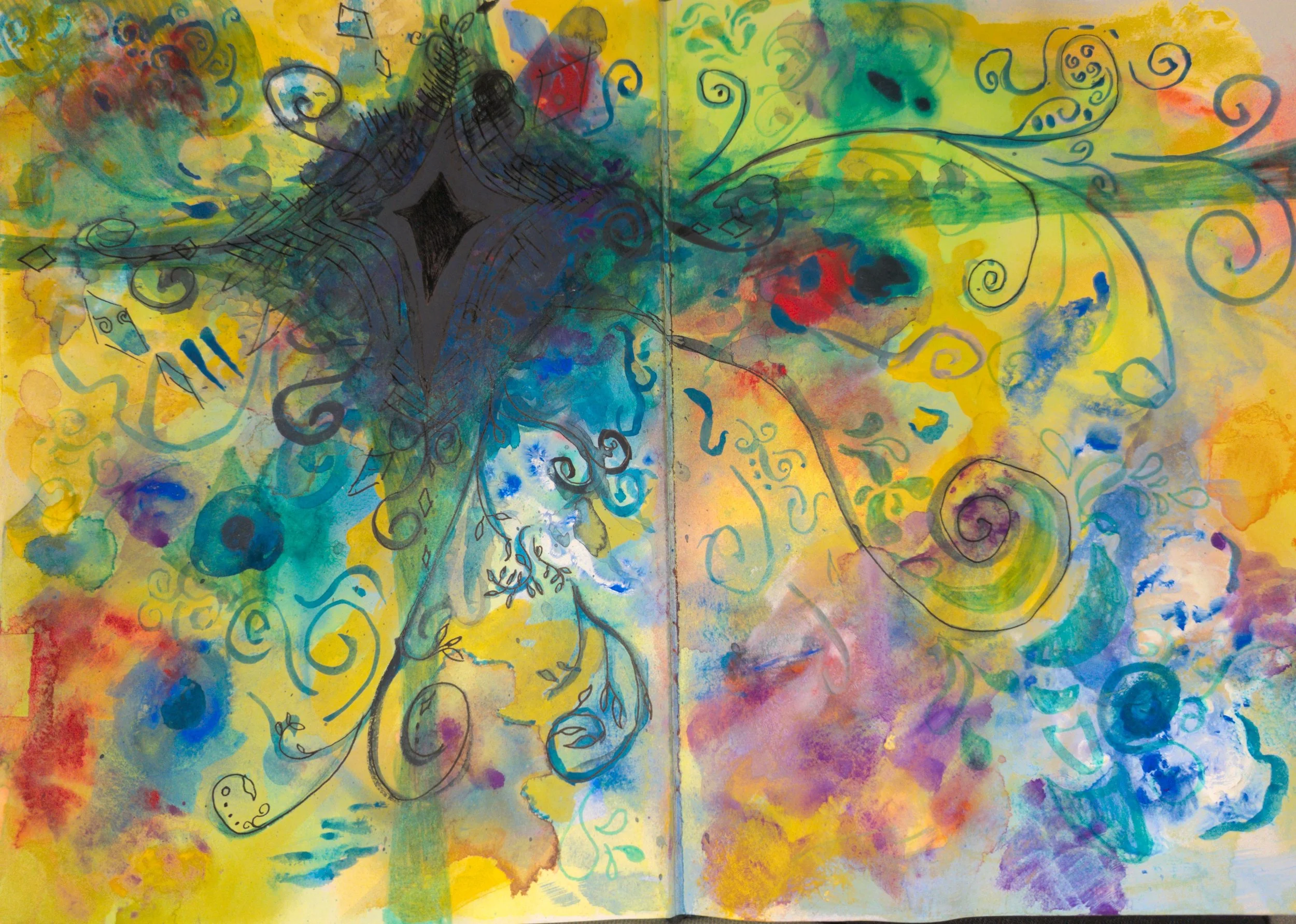
Thinker Toys

Article and Art by Linnea Anderson

i never played, i tinkered. and now, i dream about toy stores. as a girl, i went to thinker toys and drooled over gears and switches and mazes packed up in cardboard boxes. at the counter, they’d ask you if it was a gift and they’d wrap it for you in bright, crisp paper. several varieties of hideous and obnoxious bright crisp paper tethered to the wall on large metal spools. you'd pick your favorite paper and they’d rip it down ceremoniously. you’d flinch at the sound of it. you’d see the cardboard box one last time before you bring it to the party. and then scotch tape. and then you pray on it. 

oh, i hope they’ll like it. 

and you leave thinker toys with a big bow and a receipt. 

you loath your friend for being born on this day. because you’d wish it was your day and this box yours and you picked it out for yourself. you'd wish you could have every little thing from that store on the shelves in your bedroom. and you wish your mother would never tell you. it was enough. 

that box with the obnoxious, bright, crisp paper would sit somewhere in your house. all wrapped up and obscured. and you’d think about how you could just wait until dark and maybe carefully peel the wrapping off and maybe tinker with it and maybe pretend someone broke in and robbed your house. \

but they only stole the gift from thinker toys. 

you invented this scheme to tell your parents because thinker toys were all anyone ever wanted. every kid would have thinker toy wrapping paper on their gifts at the party and you’d think this is all i ever need. you’d leave the party with a goodie bag and think, thank god they had cake and goodie bags. 

and still, you’d dream about the next time you’d get to shop for new clothes or the donut you’d get on friday and the candy at the grocery store on sunday and how halloween is coming up and you need a new costume and anna has a horse and a trampoline and i am just right here.

with the things i already have.

the tinkering made you act this way. the odd ways you tried to play. you were tactical. you had endless things to fiddle with and somehow you always used them all up. you did it on purpose. passively abiding by some rules you set for yourself. you made it already. played with it already. solved it already. you tinkered and then you were done. you never understood the rules. you never understood it was about play. 

you never played the game. 

still, you had all those tinker games from thinker toys lined up on your shelves. the ones that were never supposed to be out of plays. 

perplexus. plaster clear sphere. yellow and gray tracks. a marble. numbers to follow. a start and finish line. the ball fell off? start again. 

american girl dolls. outfits. fake food and fake animals. tremendous personalities and endless offbeat interpersonal relationships. dress them undress them. let them speak and sit them down.

couch cushions. stacked and pinched in the open door frame. bed with every single plush toy in the house. run down hall. jump crash through the cushions. find yourself in bed swallowed by all your childhood capital and your brother and your dad. 

a brother. a deck of cards. tag. climb tree. bring jump rocket launcher to park. 

a dad. up and down every water slide. day trip to anywhere we want. arcade. board game. sweet treat. story time. 

anna. big green lawn. toy john denver. park nearby. lemonade stand. mexican wedding cakes. fashion show. basketball hoop. horse.

gran and grandad. big house and hex bugs and that new thing they found and brought home just for you to tinker with when mom and dad are gone and they feed you jelly beans and salmon for dinner. but all i want is a soda. dad always gets us sodas.

friends come easily because your life did. and they fight over you and pull you on the playground. and ur shoulders start to separate because everyone wants something that is as easy as you. you were a yes-girl. thats what mom called it. it was always yes, or sure, or thats ok, or fine. you could go along with it. for long enough.

other kids find all the little things to put together that were never supposed to be that way. and they make cakes out of mud and invent new games and you just go along with it because that’s being good. teachers call it well mannered. gran calls it generous. 

brother calls it sister. friend calls it best friend. 

mom calls it laid back. dad calls it nothing at all. 

mom and dad were only down the hall and you wake up in the middle of the night and think i could just be there too. you’d walk down the little ramp in their room and you’d speak “dad” softly into the darkness. and you’d say it again because it was too soft the first time. and he was too soft too because he’d get up out of bed, leave the duvet folded over. he'd take the hall back to your bed and you’d get into his. moms alarm clock would tweet “here comes the sun” as it had for the past 20 years. and she’d say: good morning: wake up: time for school. 

you go to school for fifteen more years. you keep tinkering. and it all starts to contort and dry up and fester.

i’m sorry i’m so rotten now, ill try to wash it off. 

things start to unravel and you can’t sleep because it’s itching you and your brain doesn’t like you the same as it once did in the days you frequented thinker toys. 

now, i dream about toy stores.

i think tomorrow, ill go to thinker toys and buy something and tell them its a present. and ill rip the wrapping paper away and tear at the box and let everything little piece of my new gadget fly and scatter across the floor of my room. i'll rip apart the manual and engineer some new way to play with it. i'll build it wrong and take it apart and throw it on the ground for good measure. i’ll hate it but i’ll learn to love it.

isn’t that why we play?

Know Why You Are Fascist

Article by Anonymous Art by Katie Patterson

Because you lack the most primordial sense:

the common one.


Because you prime law and order above all;

and everything, in its place, should fall:

immigrants on the other side of the wall,

and Bukele, Museveni, and Trump

in the presidential hall.


Because you’ve always been a tiny bit dumb —

and instead of correcting it with time and effort, 

to savagery you resort. 


Because you fear getting something robbed.

Perhaps your job? No worries, Bob, 

a snob with a complex of God

could always stop it all.


Because the economy is sacred, 

we gotta let it be.


Because the economy is awful, 

we gotta intervene. 


Because you don't know what economy is 

but you trust it's gotta be fixed. 


Because you holster your gun 

every Sunday before church, 

you swear Jesus would prefer 

the Second Amendment to be preserved.


Because racism is a lie, 

those were different times. 


Because colonialism ended centuries ago, 

anyone with a history book would know.


Because you’re enthused by

your daily dose of Fox News,

and different worldviews

would most likely confuse you.


Because the patriarchy is a myth,

women should get a grip.


Because childbirth disgusts you,

but abortion is an unnecessary misfortune

for women who should learn to live with more caution. 


Because you suspect public health —

it’s an invention of the communist realm.

Why should you care,

if it has nothing to do with your own wealth?


Because you have the same attributes as Elon Musk—

But you weren’t struck by luck, 

So you simply suck. 


Because you might have a kink for tyranny

and conspiracy indistinctly.


Because you profess meritocracy

as the foundation for success —

unless affirmative action is stressed.


Because you are afraid

that society’s values will be frayed.


Because you believe ineptitude is a matter of race/gender/religion —

which is like believing in the tooth fairy 

or the invisible hand. 


Because you love to see

the world run by clowns.


Because deep down, you are:

antiblack, antilatino, antiasian, antiwhite,

antipurple, antigreen, antiblue —

but that’s too much.

So with all that combined, 

you call yourself colorblind.

Polished Riverbed

Article by Mandala Covey-Bleiberg Art by Nora Johnson

Each passing day of my life, there is something that I discover about grief. It ebbs and flows like a river, but its trickle is always present, a soft current down the riverbed. When I first felt grief, the slate rocks that lined the bottom were jagged, black and rough. Now, with each passing day, the water erodes the rocks down, turning them flat and smooth. Someday, there will be only a horizontal, polished riverbed for the waters of grief to dance down. 

Beside the highway in my hometown, there is a white ghost bike which sits upright on the side of the pavement. In the winter, the enormous amounts of snow that cover the mountain and basins seem to completely avoid the bicycle. It remains hollowed out, an always-visible homage throughout the entire year. Fake flowers sit tied onto the side of the white frame, shimmering yellow, beating against the side of metal during windy days. The plastic petals dull after each passing summer in the high UV of the Rockies. The bike was cemented down by the pavement almost three years ago, this coming Spring. I see it as I drive down the valley; I see it sometimes, in the daydreams that occur when I have a migraine — stuck between the hazy real-life world and the catacombs of memory. 

Crested Butte is infamous for its snow. Our title as the “Last Great Colorado Ski Town” holds up. Winters mean a blanket of white over the mountain valleys, mornings when the thermostat reads -30 degrees, seasonal depression and the haunting hallucination of another, warmer time. 

Thirty years ago, a woman, a man, and several of their friends were backcountry skiing when an avalanche cascaded down the snowy hillside. In its frigid, cement-like grasp, the woman was sucked down the slope as her husband watched. There was nothing he could do to stop it. 

The two had been married for years. Mike and his wife had grown together, lost together. She was a teacher. The community loved her almost as much as he did. After the avalanche, Mike was alone, shivering, as cold as his wife who suffocated underneath the avalanche's clutch.​​ 

It had been over three decades since that avalanche when Mike died on the highway. Four years ago, he’d been biking downvalley on a route that was routine for him. Crested Butte lacks paved roads for bikers, so riding along the highway to Gunnison is common. He was hit by a car driven by someone he’d known for over twenty years, a local who also knew the highway's turns and potholes. Mike’s bike still sits on the side of the highway, fake flowers sashaying in the wind. The court ruled that the entire situation was a complete accident. Mike had just gotten remarried to his new wife, a woman he was head over heels in love with after years of combating depression. He was in the prime of his life, ironic but true for a man well into his seventies. 

My uncle and Mike were best friends. My uncle and Mike were brothers in the truest sense. For all they lacked in blood relation, they made up for in memories, in moments and shared loves. They shared their phone plan for over forty years. They survived storms in the mountains on their bicycles, blizzards on skis and disastrous drivers while road-biking in European countries. If there was Mike, there was my uncle following behind. It seemed that only death could separate the two. And it did. 

I know that death is common. I know that in the end, there will be only bones and then dust and then all the darkness that we’ve ever known will hollow out. We will be hollow; there will be no more me, no more you, no more of our suffering. There is something tragic about how the world functions, and something as resolutely beautiful as a mountainside covered in flowers, breathing with the breeze. As resolutely beautiful as the flowers on the side of the Ghost bike. We all see the end of another person. If you can escape life without feeling the grasp of death upon your heart, playing with the strings in your chest, then you are lucky. 

My uncle was never the same. His eyes, cold as the cornice on a mountain, had none of their usual shimmer. There was a before, and there was an after, and there would be no going back. There was nothing he could do to stop it. Stop what happened, stop the car from slamming into Mike’s bicycle. I wonder if my uncle has memories, in the state he is in now, or if all that happened blurs away, rain washing it out of his mind. The moments of them biking together in France, the moments of him and my aunt laughing in the canyon country, the animals he saw in Botswana, the regulars at the bar he owned. 

My uncle has spiraled. He lost his closest friend, his honorary brother. He lost his mind. He lost us. He will not come back. It's easy to say: that is incredibly unfair, what the fuck is wrong with the universe? Yet, it's just as easy to respond: life is unfair. The universe owes you nothing.  

I have lost people before. I have watched my Grandmother, a woman most exceptionally strong and resolute, have her mind pull away from her, dementia clutching her emotions, feelings, and memories away. Like an awful magic trick, when the magician pulls the tablecloth out from under the fully set table, and instead of perfection, all of the cookery comes crashing down onto the floor. She withered. You do not know how a person can wither until you watch them die like a zombie. When you clasp their hand, and there is no blood in their fingertips, the fingertips that held you and carried you and fed you and watched you grow. 

I have seen my Grandfather die, too. In that squeaky clean, glossy room, his lungs filled with fluid, and he coughed and coughed and coughed. I have watched him take in that last breath, felt the last pump of their blood extend to their fingertips, from the heart to the hands. 

There were moments in my youth when I was unexplainably lonely, and unwavering was my uncle’s steady presence as my best friend. Now, it seems that he has washed down the riverbed too. 

My uncle’s temporal lobe is seventy percent gone. The memories of him and Mike melt away like snowmelt, the memories of him and my aunt, the memories of him and me, the mountains. The days swoon by, and with each moment, he dwindles. Still strong, but unequivocally gone. He is a warm body on this Earth as a man without the bones of life inside of him. Hollow. 

I just hope, in the end, that he will reunite with Mike and they will ride together. The dirt of the trail will be warm in the chilly air. The magpies will sing, accentuated by the call of the robin, the chickadee. They will make a chorus, just for my uncle and Mike, as they glide along the aspen forests, clean air in their full lungs. Tragedy is all around us, but so too is the riverbed, washing, washing, washing all of our grief downstream. 

The Chair

Article by Anonymous Art by Avy Diamond

Unfortunately, for the majority of my childhood, I had a very avoidant attitude when it came to conflict with others, and especially when it came to conflict within my family. I had learned that the best way to stay out of trouble was to avoid disagreement. And lie. Of course, that's not how life works at all; I would still get caught and get in more trouble for what I did because I had lied about it. This was a near-constant battle between my parents and me. I would lie, get caught, get in trouble for it, apologize, and say that I learned my lesson, but the cycle would only continue. I always felt bad about what I had done, but my brain would still say that this is the path of least resistance. That all changed when I didn’t own up to my actions when I should have, and it inadvertently made my mom break down sobbing into my father's arms, feeling guilty about something she didn’t do. 

My grandfather was one of the first 130 people to die in the US from COVID-19. His death turned my dad’s world upside down in ways that I am still discovering today. One of the few objects that my dad possesses to remember him by is this old leather chair that sits in his office. One day, I walked into the office to do something I can’t remember, but I do remember that part of the chair gave way when I sat down in it. Nothing shattered or tore, but something was no longer stable, though it appeared fine. So instead of telling my grieving father that I, his son, had hurt this chair that was so precious to him, I avoided it. I did more than avoid it; I lied by omission to my dad and lied to myself by saying that no one used the chair anyway, so it wasn’t a big deal. It became more than a big deal when my mother sat down in the chair weeks later, and it shattered. She didn’t know the chair was in such a fragile state, so she sat in it like anybody would, and it tore itself and broke under her. 

My father and I quickly came running at the noise, and we found my mother sitting on the floor, hysterically sobbing, thinking that she had destroyed something that she hadn’t. She wouldn’t stop apologizing. She just sat there and wept while my father held her, telling her it was ok, and that it was just a chair. 

I stood and watched all of this with a lump of lead in my stomach, knowing what my inaction had done to my mom. Within a day, I told them both everything in a fit of my own tears. I got in some trouble, but my dad and mom forgave me. I still think about that day. I think about it a lot, and remembering the pain I caused my mom still hurts me. I still lie, not as much as I used to. Only a normal human amount I think. But I’m not really sure how much that is supposed to be. 

These last few paragraphs were written several weeks before this one. I recently talked with my father on the phone and mentioned the piece that I was writing for Cipher. I talked about how I was writing about the time I broke his chair all those years back. For several moments, he just looked at me. He then said, “You never told me any of this,” as disappointment took over his face. In my memory, I could’ve sworn that I told both my parents that day the truth. That I had broken the chair. According to my dad’s memory, I never did. The way he looked at me over the FaceTime call makes me believe that his memory might be right. 

After all of my lying to my parents, I never expected my brain, my memories, to lie to me. 

But why wouldn’t they? It was the path of least resistance. 

Lettitor

Dear Reader,

Few singular words in the modern English language carry as many definitions, as much emotion, and as heavy cultural baggage as the humble “fuck.” There is no etymological consensus over the origins and early usage of the word — plenty of theories, sure, but when you dig into it, we really don’t know how it came to be. That kind of makes sense, doesn’t it? If you learned that “fuck” was simply a translation, or an acronym, or a rehashing of something else, it wouldn’t feel right. Fuck is fuck, we can’t imagine it being much else.

One explanation for the desert of etymological history surrounding “fuck” is the fact that no one wanted to write it down. People likely said it out loud relatively naturally, but it was too taboo and offensive to be immortalized in documents, certainly not in any deemed formal enough to be archived. “Fuck” was likely reserved for the uncomfortable, the unprofessional, and the lines of irrational hate and love that were drawn into the sand with the knowledge that waves would soon crash, washing the beach anew. Maybe it was a word that could only be spoken when a situation was fucked up enough to warrant it. Maybe it was only said when people were fucked up enough to not want it to be remembered. And though times have changed, they haven't changed that much.

So what happens when we ask college students to write pieces, explicitly asking them to be “fucked?” The answer is simple, and complicated, and most of all, fucked up. Some of these pieces are callouts, some are callbacks, and some feel like swallowing a large pill without water. This is your trigger warning. This is your moment to close the magazine and live without the Fucked Up issue. To ignore the etches of fucked-upness in our muscles. But those etches are already there, carved by years of side comments, minimum wage jobs, and the realization that everything means more than you’d like it to. No amount of immobility will guarantee atrophy, so you might as well flex while you’re still limber and READ THIS FUCKING ISSUE. 

Pardon our French,

Cipher